The Evolutionary Biology of Dragons: Could Dragons Actually Evolve?
 Cordelia Cross
Sep 3, 2026 01:35
0
Cordelia Cross
Sep 3, 2026 01:35
0
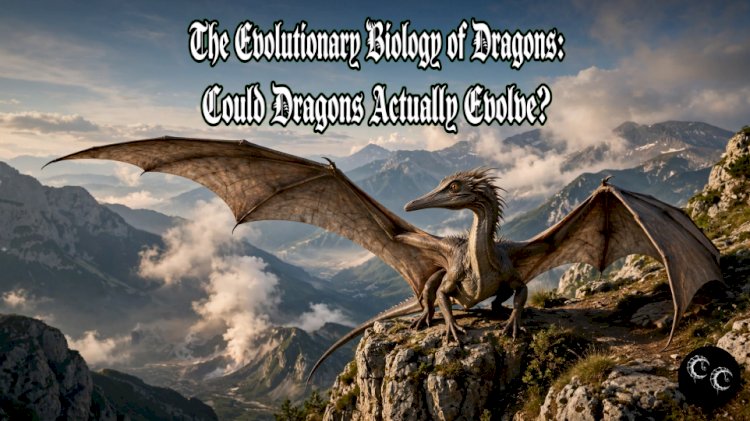
The Evolutionary Biology of Dragons: Could Dragons Actually Evolve?
Dragons are one of those creatures that seem almost perfectly designed to make biologists sigh.
They have four legs, enormous wings, long tails, armored bodies, giant claws, sharp teeth, and, depending on the story, the ability to breathe fire. Traditional Western dragons are basically walking contradictions to several of the rules that govern animal anatomy on Earth. They are too big, too heavy, and somehow expected to fly while carrying enough muscle to make a bear look underdressed.
And yet, dragons remain one of the most recognizable creatures in fantasy.
So what would happen if we stopped treating dragons as magical creatures and asked a slightly more ridiculous question?
Could something resembling a traditional dragon actually evolve under Earth's physics?
The answer is complicated. Some parts of the dragon concept are surprisingly plausible. Others run into serious biological problems. And then there is the small matter of a six-limbed vertebrate flying around while setting things on fire.
Let's break down the biology.
The Six-Limb Problem
The first major obstacle appears before the dragon even gets off the ground.
Traditional Western dragons are usually depicted with four walking legs and two wings. That makes them hexapods, meaning they have six limbs.
Earth's familiar land vertebrates do not work that way.
Tetrapods, the group that includes amphibians, reptiles, birds, and mammals, evolved from ancestors with four limbs. Their basic body plan is deeply rooted in their evolutionary history. Birds did not evolve six limbs so they could have both legs and wings. Their wings are modified forelimbs.
That is why a bird has two legs and two wings rather than four legs and two wings.
For a traditional six-limbed dragon to evolve naturally from a vertebrate lineage, something would need to happen that we have never observed in Earth's vertebrate evolutionary history: the developmental system would need to produce an additional pair of limbs.
That is not necessarily a violation of physics. Evolution can produce some remarkably strange body plans. But it would require a very different developmental pathway from the one used by modern vertebrates.
In other words, the dragon's biggest problem may not actually be flight.
It might be getting six limbs in the first place.
Could Evolution Create Six-Limbed Vertebrates?
If we allow ourselves to step outside Earth's existing evolutionary history, the idea becomes more interesting.
Evolution does not follow a master blueprint that says every animal must have four limbs. It works with inherited developmental systems and modifies structures over enormous periods of time.
Arthropods already demonstrate that animals can successfully evolve with six or more limbs. Insects have six legs, while spiders and other arachnids have eight. Centipedes have even more, because apparently nature occasionally looks at moderation and walks in the opposite direction.
The issue is that arthropods and vertebrates use fundamentally different body plans.
A hypothetical six-limbed vertebrate lineage would need developmental changes that allow additional paired appendages to form while maintaining a functional skeleton, nervous system, muscles, blood supply, and organs.
That is an enormous evolutionary challenge, but it is not the same thing as saying it is physically impossible.
If you are writing fantasy, this gives you a pretty useful explanation: your dragons may descend from an ancient vertebrate lineage that evolved a six-limbed body plan extremely early in its history.
Once that body plan existed, evolution could modify it in all sorts of strange directions.
Then Comes the Really Difficult Part: Flight
Flight is where dragons start getting into trouble.
Flying animals have to overcome gravity while generating enough lift to remain airborne. That requires wings capable of producing sufficient aerodynamic force, along with muscles powerful enough to move them.
Birds solve this problem with lightweight skeletons, powerful flight muscles, specialized feathers, efficient respiratory systems, and body shapes adapted for flight.
Bats use a different approach, with flexible membranes stretched across elongated fingers.
Pterosaurs, which are particularly interesting for dragon comparisons, evolved yet another solution. They were flying reptiles with enormous wings supported by a single elongated finger.
Dragons would need their own solution.
A giant dragon with a bulky body, thick limbs, heavy armor, and a massive head would have an enormous amount of weight to keep airborne. Simply giving it larger wings does not automatically solve the problem.
At some point, the wings become so large that the dragon has difficulty moving them efficiently.
This creates a fundamental engineering problem.
The heavier the dragon becomes, the more lift it needs.
The more lift it needs, the larger and more powerful its wings must become.
Larger wings require more muscle.
More muscle adds more weight.
Now the dragon needs even more lift.
Congratulations. You have discovered the biological version of a very expensive renovation project.
A Dragon Would Probably Need to Be Lighter Than It Looks
One possible solution is body construction.
A realistic flying dragon would probably need to be much lighter than the classic fantasy version suggests. Large hollow or air-filled bones could help reduce mass, similar to adaptations found in birds and pterosaurs.
The body might also need extensive air spaces connected to the respiratory system.
This is where birds become particularly interesting.
Birds have a highly efficient respiratory system involving air sacs that allow air to move through the lungs in a largely one-way flow. This helps provide oxygen efficiently during demanding activities such as flight.
A dragon with an extremely efficient respiratory system could potentially support a high metabolism while flying.
But even then, there are limits.
A dragon the size of a small airplane is not simply going to flap its wings and casually hover because the author said so.
At some point, physics gets a vote.
The Dragon Might Need to Be More Like a Pterosaur
If we want a large flying reptile that actually has a chance of working, pterosaurs provide one of the most useful real-world examples.
Some pterosaurs became enormous. Quetzalcoatlus, one of the largest known flying animals, had a wingspan estimated at roughly 10 meters or more depending on the reconstruction.
That is already an astonishing amount of animal.
Pterosaurs show that vertebrate flight can reach much larger scales than modern birds. Their anatomy included specialized lightweight construction, powerful flight muscles, and wing structures unlike those of either birds or bats.
A biologically plausible dragon could borrow from this general strategy.
Instead of looking like a giant lizard with wings glued onto its back, it might have a highly specialized skeleton, enormous flight muscles, lightweight tissues, and a body shaped specifically around flight.
It might also spend much more time gliding than continuously flapping.
Which brings us to another important question.
Would a dragon actually fly like a bird?
Probably not.
Gliding Could Be the Dragon's Secret Weapon
Large flying animals benefit enormously from using environmental energy rather than generating all of their lift through constant muscle-powered flapping.
Thermals, wind currents, cliffs, and other environmental features can help a large animal stay airborne.
A dragon could potentially behave more like a giant soaring predator than a giant hummingbird.
It might launch from cliffs, use rising air to gain altitude, glide for long distances, and only flap when necessary. That would dramatically reduce the energy required for sustained flight.
It could also explain why dragons in fantasy stories are often associated with mountains.
Mountain ranges are excellent places for a large soaring animal to exploit wind and thermal currents.
Suddenly the classic image of a dragon circling above a mountain peak starts looking slightly less ridiculous.
Slightly.
Now We Have to Talk About Fire
Flight was difficult.
Fire breathing is where things get wonderfully absurd.
There is no known vertebrate that naturally breathes fire, but biology does have some impressive examples of chemical weaponry.
The bombardier beetle, for example, can produce a hot chemical spray as a defensive mechanism. Other organisms produce toxins, acids, venom, irritating chemicals, or combustible compounds.
So nature clearly has some experience with animals carrying miniature chemistry laboratories inside their bodies.
A dragon would need to take this concept much further.
One possibility is that a dragon could produce two separate chemical substances that remain stable individually but react when combined. The dragon could store them in specialized glands and release them through ducts near the mouth.
Once the chemicals mixed, a reaction could produce heat, flame, or an intensely hot spray.
This would be extremely dangerous for the dragon itself.
Which means the dragon would also need specialized biological protection.
How Would a Dragon Avoid Burning Its Own Face?
This might be the biggest problem with fire breathing.
If an animal produces an extremely hot flame directly from its mouth, the tissues around the mouth and throat would need to survive the heat.
A realistic fire-breathing dragon might therefore have thick, heat-resistant tissues around its mouth and specialized structures protecting the respiratory system.
It might also produce a fuel that burns outside the mouth rather than inside the animal.
Think of it as a biological flamethrower rather than an internal furnace.
The dragon could release fuel droplets or vapor while simultaneously producing an ignition source near the mouth. The resulting flame would occur after the fuel leaves the body.
Even then, the dragon would have to manage heat, pressure, chemical storage, and accidental ignition.
Evolution would have quite a checklist.
Where Does the Fuel Come From?
This raises another problem.
Fire requires fuel.
A dragon would need to acquire the ingredients for its chemical weapon from its diet or produce them metabolically.
That means fire breathing would probably be energetically expensive.
Perhaps dragons would need specialized diets rich in particular minerals or organic compounds. Maybe their digestive systems contain microbial communities capable of producing combustible gases. Perhaps the chemicals are synthesized from compounds found in certain plants or prey.
This could even influence dragon behavior.
A dragon that has not eaten enough might not be capable of producing a full-strength flame.
Suddenly "the dragon has not eaten today" becomes a legitimate tactical consideration.
Fire Breathing Might Be More Like a Chemical Spray
If we are trying to stay close to biology, a dragon might not produce the giant roaring fireball fantasy usually gives us.
A more realistic system could involve an ignitable mist, spray, or short-range burst.
The flame might last only a few seconds.
It might have a limited range.
The dragon might need time to replenish the chemicals.
There could be a significant risk of injury if the mechanism malfunctions.
And honestly, those limitations could make the dragon more interesting.
A creature that can breathe unlimited fire whenever the plot needs it is impressive. A creature that has one or two powerful fire attacks before needing time to recover has an actual biological strategy.
Dragons Would Need an Incredible Metabolism
Flying is expensive.
Large animals already require enormous amounts of energy simply to maintain their bodies. Add flight and a chemical weapon capable of producing extreme heat, and the dragon's energy demands become ridiculous.
A realistic dragon would probably need to eat a lot.
Possibly an absurd amount.
That creates another useful evolutionary constraint. Dragons might have long periods of rest between major activities. They could spend hours soaring without flapping to conserve energy. They might eat enormous meals and then remain inactive while