Crimson Devotion: A Short Story by Cordelia Cross
 Cordelia Cross
Apr 4, 2026 06:20
0
Cordelia Cross
Apr 4, 2026 06:20
0
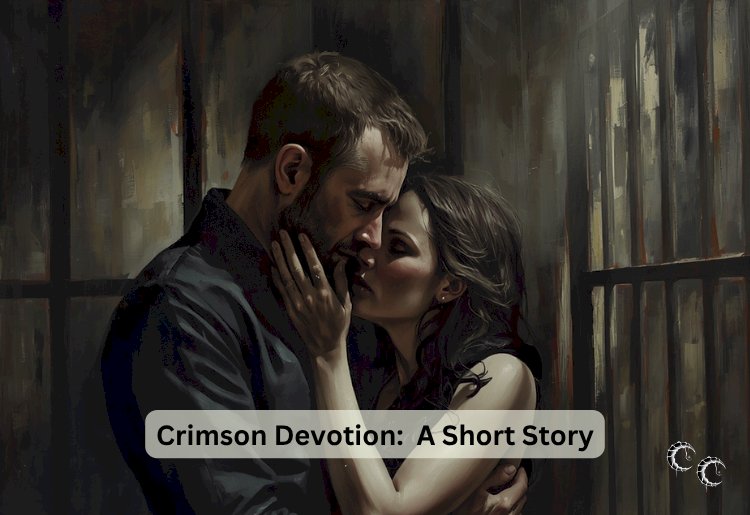
The first time I saw him, it was through the cold, smudged glass of the visitation room. The air smelled faintly of disinfectant and something bitter, a metallic tang that clung to the edges of the walls. My fingers trembled as I pressed them against the pane, and I could feel the chill through my skin, a chill that seemed to whisper warnings I was too eager to ignore. He did not look like the stories had painted him. He did not look monstrous, cunning, or predatory in the way the tabloids promised. He looked tired, like someone carved from stone and left out in the sun too long, a statue abandoned to rot and memory. His eyes, storm-gray and watchful, held the weight of nights spent in silence so deep it became a companion. They were eyes that had seen the end of something invisible to everyone else, and yet even knowing the horrors he had committed, I wanted to trace the lines of his hands with my fingers, to feel the warmth of someone who had survived himself. My heart twisted in fear and fascination. They called him a monster. I called him lonely.
I began writing letters, letters that smelled of old paper and ink. They trembled in the dark of my room before I tucked them into the tray that passed between us, a ritual I performed with careful hands and a pulse that never slowed. At first, the letters were a game, an experiment in courage. I told myself I was studying him, a human curiosity, a scholar of shadows, but the truth was far simpler and far more dangerous. I was lonely too, in the kind of way that leaves your chest hollow and your dreams stitched with quiet despair. His replies came weeks later. At first, they were clipped, careful, testing the waters to see if I would run when the darkness within him whispered its truth. Soon, however, the letters began to breathe. They swelled with stories not of murder but of quiet, fleeting moments. A bird cutting across a winter sky. Moonlight falling on a cracked sidewalk. The ache of silence in a room too small for regret. In his words I began to see the man beyond the crimes, and I could not unsee him.
I told myself I was safe. The glass, the walls, the guards, the protocols, the rules were all barriers strong enough to protect me, but the danger was never physical. The danger was in how he made me feel alive in a way no one else ever had. In reading him, I began to recognize pieces of myself I had buried under polite smiles and safe routines. In his confessions, I found mirrors of my own shadowed desires, my own hunger for something forbidden, unspeakably intimate, something that burned with risk and brilliance all at once. I was not blind to the reality. He was a killer, and the world outside would never forgive him, nor me for feeling warmth in his presence. What the world did not know and could never understand was that love, like grief, cannot be negotiated, cannot be sanitized.
I traveled to the prison as often as I could, arranging my life around the schedule that brought me to him. Each visit was a ritual, a journey into a place no one else wanted to see. I carried my fear like a lantern, lighting the edges of a world too dark for ordinary eyes. We sat across from each other, the thick glass between us a cruel kind of intimacy, a barrier that made the smallest glance monumental, the simplest gesture sacred. I could see the faint scars on his knuckles, the curve of his jaw, the way he tucked a stray lock of hair behind his ear. I watched him lean slightly forward, as if our distance could be shortened by desire alone. He looked at me, and I saw the storm I had read in his letters reflected in his gaze. A mixture of longing, regret, defiance. A quiet plea for someone to see him, to acknowledge the man buried beneath the violence and fear, a man the world refused to understand.
We spoke in silences and words alike. Sometimes he would write, sometimes I would, and sometimes we simply sat, letting the air hum with the weight of our presence, letting the invisible threads of our souls weave a fragile bridge. There was a rhythm to it, a dark hypnotic pulse, a cadence born of despair and need and stubborn, unrelenting life. In that rhythm I felt the contours of his soul, raw and trembling, vulnerable and jagged all at once. I imagined the nights he spent lying awake, staring at the ceiling, wrestling with a mind that had become both his prison and his weapon. I imagined myself beside him, not to tame him, not to fix him, but simply to be there, witness to the quiet apocalypse within him, witness to a man who had lived with the edge of darkness as a companion, witness to someone who had survived everything the world had thrown and everything he had taken upon himself.
Our letters grew longer, more desperate, spilling over with confessions, memories, secrets that had nowhere else to live. I learned the sound of his handwriting, the curl of a particular letter, the way his ink bled when he paused too long on the edge of thought. I read his words at night under the pale flicker of candlelight, imagining the temperature of the room where he wrote them, imagining the weight of solitude pressing against his chest. Each sentence was a thread, and I clung to it as if it could pull me out of the monotony of a world that had never understood me.
The day I saw him last, they brought him out in chains. I knew before the guards spoke that this was the final time. He looked smaller somehow, diminished by the knowledge that the world outside would never hold him as I had. His eyes, though dimmed by exhaustion, still held that impossible spark, that ember of life that refuses to die even in the deepest winter. I reached through the glass, and though it did no good, I whispered his name, letting it fall into the space between us like a fragile prayer. His smile was brief, fleeting, almost imperceptible, but it burned in me more fiercely than any sunlight. For a moment, the air itself seemed to bend, holding us together in a world that refused to.
He was gone before I could touch him again. The world did not mourn him, and that suited me fine. I mourned him quietly, in the shadowed corners of my life, in the silver threads of nightmares that threaded through my sleep, in the way the wind rattled my window at night and seemed to carry the memory of him along with it. I loved him still, in the way one loves a storm, knowing it will never belong to them, knowing it will leave ruin and wonder in equal measure. Love is not always gentle. Sometimes it is fire. Sometimes it is ash. But it is always irrevocably ours.
I keep writing letters I will never send, tracing the shape of absence with ink and memory, carrying his darkness like a lantern through my own nights. In the quiet, I feel him there, in the curl of smoke over my candle, in the hush of the street outside my window, in the ache behind my ribs. Sometimes I imagine him reading the letters, smiling faintly, whispering the words into the dark. I imagine the two of us, shadows entwined, moving through worlds that will never let us meet, and yet still tethered by something fierce and unyielding.
The world called him a killer. I called him love. In that forbidden impossible devotion, I found the truth. The soul, even when soaked in darkness, can ignite beauty. Even in loss, even in grief, there is a fire that refuses to be extinguished. I carry it now, a crimson devotion, the memory of him burning quietly within me, lighting the shadows, keeping me awake in the long unending night.
Even now, when I close my eyes, I can see him, storm-gray eyes, hands folded, lips trembling as he whispers secrets only the lonely understand. He belongs to the world as it will have him, bound and condemned, and yet he belongs to me in ways the world cannot touch. That is love in its most terrible, most beautiful form, impossible, raw, consuming, and eternal. I feel him in every silence, every breath of wind, every shadow that stretches across my room, and I know that a part of him will always be with me. I will carry that ember until the last light fades, until the last candle dies. I will carry him, and through that, I am alive.