The Glass That Remembers by Cordelia Cross
 Cordelia Cross
Feb 10, 2026 01:35
0
Cordelia Cross
Feb 10, 2026 01:35
0
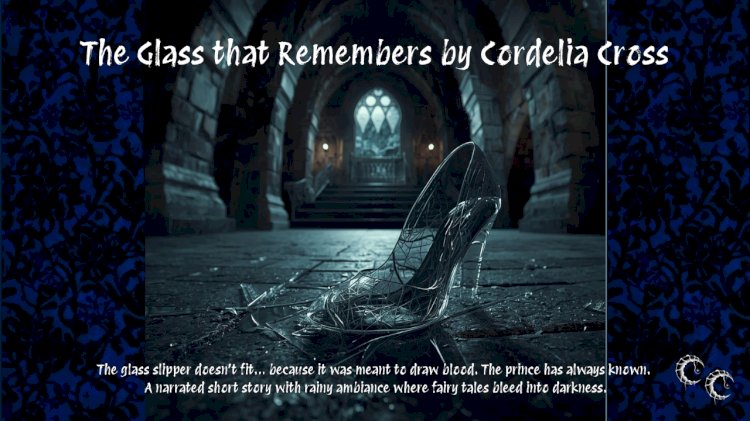
The first time Cinderella bled, it was not from the slipper.
It was from the way the prince looked at her.
She felt it before she understood it. A thin, quiet tearing somewhere behind her ribs, as if something old and careful inside her had split open and begun to leak. She stood in the great hall with her hands folded neatly, ash still clinging to the hem of her dress, and felt his gaze settle on her like a blade disguised as light.
Everyone else saw a miracle.
Everyone else saw the girl lifted from cinders, the shimmer of magic still trembling around her like a held breath. They saw glass catching candlelight, saw silk where there had once been rags, saw the promise of salvation shaped like a man with a crown waiting in her future.
But the prince did not look at her as though she had been saved.
He looked at her as though she had been chosen.
His eyes did not roam. They fixed. They lingered too long, not on her face, not on her smile, but on her feet, bare and pale against the marble floor. Cinderella felt the weight of that attention sink into her bones, and for a moment she had the strangest urge to hide her toes beneath her skirt, to curl them inward like something exposed and vulnerable.
The slipper rested in his hands, cradled with reverence. It was smaller than she remembered. Thinner. The glass was clear, too clear, without a single bubble or flaw, and it caught the light in a way that made her stomach twist. It was beautiful in the way knives were beautiful when freshly polished.
She had danced in them once. She remembered the pressure, the way the edges had kissed her skin too closely, the way she had smiled through a faint, growing ache because she had believed pain was the cost of becoming something more.
The court murmured behind her. Her stepmother stood rigid, calculating. Her stepsisters fidgeted, each of them suddenly aware of their own feet, their own blood beneath skin.
The prince knelt.
It was a gesture meant to humble him, to elevate her. But as he lowered himself, Cinderella felt no rush of triumph. Instead she felt the room tilt slightly, as though the world had leaned in to listen.
“You fled so quickly,” he said softly, his voice gentle enough to make everyone else sigh. “I was afraid I had dreamed you.”
She swallowed. “I did not mean to run.”
“I know,” he replied, and smiled in a way that did not reach his eyes. “Magic has its limits.”
His fingers brushed the inside of the slipper as he lifted it. Cinderella noticed then, with a sharp clarity that made her heart stutter, that the inner edge was not smooth. Tiny ridges caught the light, almost invisible unless you knew to look for them. Etched. Sharpened.
She inhaled sharply before she could stop herself.
The prince’s gaze flicked up to her face, quick and precise. He saw the moment recognition bloomed in her eyes. He saw fear take root. His smile deepened, just slightly.
“You see it,” he murmured, too low for the others to hear.
Her pulse roared in her ears. “See what?”
“The truth,” he said. “Glass is not meant to be kind.”
He reached for her foot.
Cinderella hesitated. It was the smallest pause, the briefest tightening of muscle, but it was enough. The court fell silent, sensing something shift without knowing why. The prince’s hand hovered, patient, expectant.
“You do not have to be afraid,” he said, though his tone suggested the opposite. “It will only hurt if you do not belong.”
The words settled over her like a curse.
She thought of the nights spent scrubbing floors until her hands cracked. Of learning to move quietly, to take up less space, to accept pain as a companion rather than an enemy. She thought of how easily the world asked women to bleed for their place in it, and how often they did so with smiles stitched into their faces.
Slowly, she lifted her foot.
The glass kissed her skin.
It burned.
Not sharply, not yet, but with a promise. A warning. The ridges pressed into her heel, her arch, her toes. She bit the inside of her cheek to keep from gasping. The prince guided the slipper with deliberate care, his fingers steady, his expression rapt.
The glass slid on.
And then it bit.
Blood bloomed beneath the transparent surface, a dark, spreading stain that drew a collective breath from the room. Cinderella cried out despite herself, the sound torn from her chest as pain flared bright and immediate. She staggered, instinctively pulling back, but the slipper held fast, clinging as though it had found what it was made for.
The prince’s hands tightened around her ankle, not restraining her, not comforting her, but claiming the moment.
“Yes,” he whispered, reverent. “There it is.”
Tears blurred her vision. The floor swayed. She tasted iron. Her heart hammered against her ribs as understanding slammed into her with brutal force.
It had never been about fit.
The slipper was not a test of size or destiny or magic.
It was a test of willingness.
The prince rose slowly, still holding her foot, and turned her toward the watching court. Her blood gleamed through the glass like a jewel, like proof.
“This,” he announced, voice ringing clear and proud, “is how we know.”
Applause erupted. Cheers. Relief. Celebration.
Cinderella stood trembling, her foot aflame, her body screaming to run, and realized with chilling clarity that the fairy tale had not saved her.
It had marked her.
And the prince had always known exactly what the glass was made to do.
They dressed the wound as if it were an honor.
Servants knelt at her feet with linen and gentle hands, murmuring reassurances that tasted like lies. The glass slipper was not removed. It could not be. When they tried, the edges drew deeper, drinking eagerly, and the prince lifted a hand to stop them, his expression serene.
“Not yet,” he said. “Let it learn her.”
Cinderella sat very still while they wrapped her ankle, the cloth soaking through almost immediately. The pain throbbed in time with her pulse, a constant reminder that the glass had teeth. Every heartbeat pressed the slipper closer, as if it were settling, rooting itself into her.
The prince offered his arm. She took it because there was nowhere else to go.
The walk through the palace felt endless. Marble floors reflected her face back at her, pale and fractured by light, a woman she barely recognized. Each step sent a fresh wave of pain up her leg. She focused on breathing, on not crying, on holding herself together in front of eyes that devoured the spectacle.
They called her brave.
They called her blessed.
They did not call her bleeding.
The chamber they brought her to was vast and white, all silk curtains and gold filigree, a room built to cradle a future queen. The door closed behind them with a sound too final for comfort. Only then did the prince release her arm.
He studied her openly now, without the performance of courtly restraint. His gaze traced the line of her body, the tension in her shoulders, the way she favored her injured foot.
“You are quieter than I expected,” he said.
“I am in pain,” she replied, surprised at the steadiness of her voice.
“Yes,” he agreed pleasantly. “That is part of it.”
She sank onto the edge of the bed, careful, controlled. The mattress was softer than anything she had ever touched, but she could not relax into it. Pain had a way of sharpening awareness, of peeling away illusion.
“What is it for,” she asked. “The glass.”
He tilted his head, considering her. “Do you truly not know?”
She met his gaze. “I think I do. But I want to hear you say it.”
The prince smiled, slow and almost fond. “Glass remembers,” he said. “It keeps what it cuts. Blood. Shape. Truth. Long after flesh heals, glass remembers what it has taken.”
A chill crept up her spine.
“My mother commissioned the slipper,” he continued. “A long time ago. She understood that love, real love, requires proof. Sacrifice. A willingness to be marked.”
Cinderella laughed, a short, sharp sound that surprised them both. “You mean obedience.”
He did not deny it. “I mean devotion.”
He crossed the room and knelt before her again, this time without ceremony. His fingers brushed the soaked bandage, and she flinched.
“Do you know how many girls tried to wear it,” he asked. “How many smiled and lied and bled anyway, hoping it would be enough.”
Her stomach turned. “You let them.”
“I watched,” he said. “They screamed. They begged. They broke.”
“And me,” she whispered. “What am I doing.”
He looked up at her then, truly looked, and something like curiosity flickered across his face. “You are still sitting here.”
The words lodged in her chest.
She had been taught to endure. To wait. To believe that suffering was a doorway to something better. She had survived her stepmother by learning when to be silent, when to bow her head, when to swallow her anger until it turned inward and quiet.
The slipper had recognized that.
That was the horror of it.
The prince rose and offered his hand again. “You will heal,” he said. “The glass will dull once it knows you are worthy. You will be queen. You will never scrub floors again.”
She stared at his hand, clean and unmarked.
“And if I say no,” she asked.
His smile did not waver. “Then the glass will not let you go.”
Her breath caught.
He left her then, as though the conversation were settled. The door closed softly behind him, sealing her into the room with silk sheets and golden light and a slipper that pulsed faintly against her skin, warm and alive.
Cinderella lay back slowly, tears slipping into her hair. The pain had become a constant hum, no longer sharp but deep, invasive. She could feel the glass adapting, tightening, learning the shape of her foot as intimately as memory.
She pressed her palm to the mirror across the room.
Her reflection stared back at her, eyes bright with unshed tears, blood staining the clear curve of glass at her ankle. For a moment she thought she saw the reflection move independently, its mouth opening as if to speak.
She leaned closer.
“If you are going to trap me,” she whispered to the glass, to the room, to the story that had chosen her, “you should know this.”
Her reflection smiled, just slightly.
“I have survived worse.”
And somewhere deep within the slipper, the glass shifted, listening.
The castle began to watch her.
At first it was subtle, the way corridors seemed to lengthen when she limped through them, the way doors opened a heartbeat too early or too late. Cinderella felt eyes on her even when she was alone, felt the weight of attention settle on her shoulders like a familiar burden.
The slipper had not loosened.
It no longer cut as sharply, but that was worse in its own way. The pain had become intimate, a deep, aching pressure that pulsed with her pulse, as if the glass were breathing with her. She could feel it remembering her, storing her blood and heat and endurance.
She was dressed in finery now, silk and velvet that brushed her skin with a softness that felt undeserved. Servants followed her, attentive and quiet, their gazes sliding away from her foot. No one asked how she felt. No one ever did.
She learned the rhythms of the palace the way she had once learned the rhythms of her old house. Where to stand to avoid notice. When to speak. When silence would be safer. Survival had always been her talent.
But the mirror in her chamber had begun to change.
It no longer reflected her exactly. Sometimes it showed her standing straighter, eyes harder, mouth set in a way she did not recognize. Other times it showed her on her knees, the glass slipper filled entirely with red, her face twisted in pain she had not yet felt.
She stopped trusting it.
One night, unable to sleep, she rose and walked barefoot across the cold floor, dragging the slipper behind her like an anchor. Moonlight spilled through the tall windows, painting the room in silver and shadow. She stood before the mirror and raised her hand.
The reflection did not mirror her.
It lifted its hand a moment later, as though deciding whether to comply.
“Who are you,” Cinderella whispered.
The reflection smiled, slow and knowing. “Who you are becoming.”
Her throat tightened. “I did not ask for this.”
“No one ever does,” the reflection replied. “They ask for rescue. They do not read the cost.”
Cinderella pressed her palm to the glass. It was warm.
“The prince thinks he has chosen me,” she said. “But the slipper chose me first.”
“Yes,” the reflection agreed. “Because you endure.”
The word felt heavy, dangerous.
“I do not want to endure anymore,” Cinderella said, surprising herself with the fierceness of it. “I want to live.”
The reflection studied her. Its eyes were older than hers, sharper. “Then you must decide what the glass is allowed to remember.”
Before she could ask what that meant, pain flared white hot. She cried out as the slipper tightened suddenly, ridges biting deep. She collapsed to the floor, clutching her ankle, breath tearing from her lungs.
The mirror rippled.
The reflection stepped forward, pressing both hands against the glass. “Listen to me,” it said urgently. “The slipper feeds on submission. It learns from silence. Every time you accept the pain without resistance, it binds itself deeper.”
Tears streamed down Cinderella’s face. “What do I do.”
“Refuse,” the reflection said. “Not with words. With will.”
The pain surged again, and something in Cinderella snapped.
She screamed.
It was not a polite sound. It was not restrained or ladylike or grateful. It was raw and feral and furious, a sound dragged from the depths of her chest where she had buried it for years. She slammed her fist against the floor, against the mirror, against the story itself.
The castle shuddered.
The slipper faltered.
For the first time since it had touched her skin, the glass loosened, just slightly. The pain wavered, uncertain.
The reflection smiled, fierce and bright. “Yes,” it breathed. “It does not know what to do with defiance.”
Cinderella gasped, clutching her ankle as the pain receded to a dull roar. She looked down at the slipper. Blood still stained it, but the glow had dimmed, the ridges less pronounced.
The glass was confused.
Footsteps echoed in the corridor outside her chamber.
The reflection’s expression sharpened. “You do not have much time. The prince will come. He will feel the change.”
The door opened.
The prince stood framed in moonlight, his gaze snapping immediately to her foot, to the slipper. His smile faded.
“What have you done,” he asked quietly.
Cinderella rose, trembling but upright. Her voice shook, but it did not break. “I stopped being quiet.”
The castle seemed to inhale.
For the first time, the prince looked uncertain. He stepped toward her, and the slipper tightened again in warning, but not as cruelly as before. Cinderella held her ground, breathing through the pain, meeting his gaze.
“You chose the wrong girl,” she said softly. “You wanted someone who would bleed beautifully. Someone who would disappear into the glass.”
She smiled, a thin, dangerous thing. “I have already learned how to survive hell. You should have asked yourself what I might do once I stopped accepting it.”
The prince said nothing.
And somewhere deep in the palace, the glass remembered that defiance, too.
The prince did not strike her.
That was the first thing she noticed.
His anger was colder than that. It moved with calculation, with restraint honed by years of power that had never been challenged. He gestured once, sharply, and the servants who had been waiting just beyond the door stepped inside, eyes lowered, hands ready.
“Take her,” he said. “She needs to rest.”
Cinderella laughed, breathless and bitter. “You mean you need me quiet again.”
His jaw tightened. “You are not well.”
The castle disagreed.
The floor beneath her feet vibrated faintly, a low hum that resonated up her bones. The walls creaked, a slow stretching sound, like something waking from a long sleep. The mirror behind her rippled violently, the reflection pounding against the glass with both fists now, mouth open in a silent shout.
The servants hesitated.
The prince noticed.
“What are you waiting for,” he snapped.
Cinderella straightened, despite the pain roaring through her leg. She could feel the slipper reacting, the glass heating, tightening, trying to punish her into compliance. She clenched her teeth and focused on the sensation of the floor beneath her bare foot, the grounding weight of stone.
“No,” she said again, louder this time. “You do not get to decide what happens to me anymore.”
The castle answered.
A crack split the marble floor between her and the prince, thin at first, then widening. Dust billowed. A servant cried out and stumbled back. The chandeliers above them swayed, glass chiming nervously.
The prince took an involuntary step away from her.
“You see,” Cinderella said, voice shaking but fierce, “this place knows what you are.”
“You think you are special,” he said. “You think pain has made you powerful.”
She shook her head slowly. “No. I think pain has made me honest.”
The mirror shattered.
Glass exploded outward in a rain of silver fragments, but none of it touched her. The shards hung suspended in the air for a heartbeat before clattering harmlessly to the floor around her, forming a broken halo at her feet. The reflection stepped through the empty frame, solid now, no longer bound to the glass.
It was her.
Not as she was, and not as she had been, but as she could be. Spine straight. Eyes sharp. A woman who had learned the difference between endurance and strength.
The prince recoiled. “This is not possible.”
“It always was,” the reflection said, its voice steady and sure. “You just depended on her never realizing it.”
The reflection knelt before Cinderella and placed both hands on the glass slipper. The pain surged one last time, sharp and furious, as the glass fought to keep its claim.
Cinderella screamed again, but this time it was not fear.
It was fury.
She grabbed the edge of the slipper and pulled.
The glass resisted, slicing deep, but she did not stop. Blood ran freely now, hot and real, staining the floor, staining the story. With a final wrench, the slipper came away in her hands, slick and gleaming.
The castle exhaled.
The pain vanished so suddenly she nearly collapsed. The wound remained, raw and bleeding, but it was hers now, no longer shaped by glass. The slipper lay inert in her grip, beautiful and empty, nothing more than a weapon stripped of purpose.
The reflection smiled. “It cannot hurt you if you are not inside it.”
Cinderella dropped the slipper.
It shattered on the floor, fragments skittering across stone like frightened insects. The prince cried out, not in grief but in loss, as though something essential had been torn from him.
“No,” he whispered. “You were meant to fit.”
“I was meant to live,” Cinderella said.
The servants had backed themselves against the walls, faces pale, eyes wide. None moved to help the prince. The castle would not allow it.
The reflection stepped back toward the shattered mirror frame. “There is more you must do,” it said softly. “The story will try to pull you back. It always does.”
Cinderella nodded. She could feel it already, the weight of expectation, the ache of old habits clawing at her. The urge to apologize. To smooth things over. To make herself small again for the comfort of others.
She did not.
She turned to the prince one last time. “You wanted a queen who would bleed for you,” she said. “You never considered what would happen when I learned how to bleed for myself instead.”
The castle groaned, deep and satisfied.
And somewhere in the broken glass beneath their feet, the old fairy tale finally cracked beyond repair.
They did not chase her.
That, too, surprised her.
Cinderella walked out of the castle with blood on her foot and silk torn at the hem, and the gates opened without resistance. The towers loomed behind her, silent now, their hunger sated. The road beyond stretched pale and uncertain beneath the dawn, but it was open, and for the first time in her life, it belonged to her.
The wound hurt. Not like the slipper had hurt. This pain was clean, sharp, honest. It reminded her that she was alive, that she had chosen herself and paid the price willingly.
She did not look back.
The forest received her without judgment. Leaves whispered as she passed, brushing against her skin like gentle hands. The birds did not sing yet, but the quiet felt companionable rather than lonely. She walked until her legs trembled, until the castle was nothing more than a memory pressing faintly at the edges of her thoughts.
When she stopped, it was beside a stream. She knelt and washed the blood from her foot, hissing softly as water touched the wound. The cut was deep, jagged, but it would heal. Scars, she knew now, were not proof of weakness. They were records of survival.
Her reflection stared back at her from the surface of the water.
Not the one from the mirror. Just herself.
She smiled.
The world did not transform around her. No magic swept in to crown her, no music swelled, no voice announced her triumph. The fairy tale did not reward her defiance with ease or luxury.
It gave her something better.
Choice.
She built a life slowly. Painfully. On her own terms. She learned how to rest without guilt, how to speak without apology. She learned that kindness did not require self-erasure, and love did not demand blood.
Sometimes, in dreams, she still saw the glass slipper. Empty now. Powerless. Sometimes she woke with her foot aching, the scar burning faintly, a reminder of how close she had come to disappearing into someone else’s desire.
She would press her hand to the scar and breathe.
In distant kingdoms, they told a different version of her story. One where she was ungrateful. One where she was broken. One where the prince had been wronged.
She did not care.
She walked barefoot whenever she could, feeling the earth beneath her, grounding herself in each step. She laughed loudly. She danced without pain. She loved, cautiously at first, then fiercely, without surrendering herself in the process.
Glass never touched her again.
Years later, a child would ask about the scar on her foot, wide-eyed and curious.
She would smile and say, “Once, I was asked to prove I belonged by how much I could endure.”
“And what did you do,” the child would ask.
Cinderella would think of the castle, the mirror, the glass that remembered blood and silence.
She would answer, simply, “I walked away.”
And in that telling, the story finally ended where it should have begun.