Can Mage Hand Really Lift Objects? The Physics of Telekinesis
 Cordelia Cross
Sep 8, 2025 04:46
0
Cordelia Cross
Sep 8, 2025 04:46
0
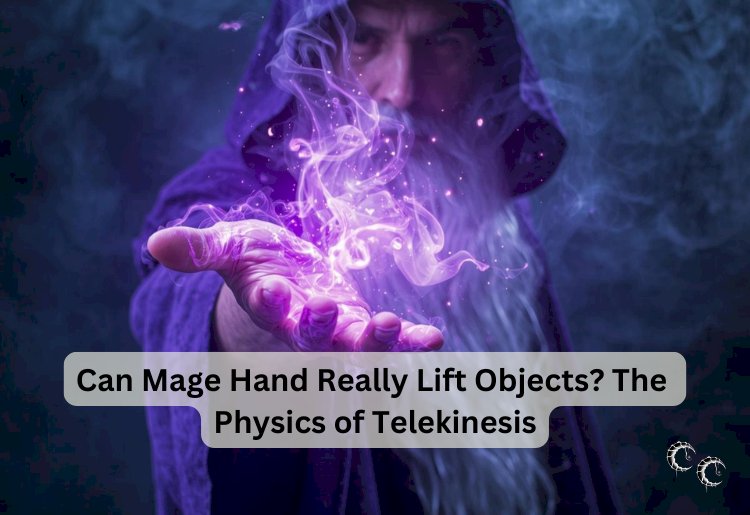
Mage Hand is one of the most iconic cantrips in Dungeons & Dragons. With a flick of the wrist, a ghostly hand appears, able to lift, push, or manipulate objects at a distance. While magical in nature, imagining how Mage Hand might function in the real world invites a fascinating exploration of physics, force, and the limits of telekinesis. Could an invisible hand obeying thought or gesture really move objects, and what would that require?
The first principle to consider is force. In physics, moving an object requires applying sufficient force to overcome its weight and any friction. Lifting a five-pound object demands an upward force equal to or greater than its weight. A telekinetic effect, like Mage Hand, would need to generate this force remotely, potentially through electromagnetic fields, air pressure manipulation, or another unknown mechanism. In D&D, magic supplies the energy without explanation, but any real-world analogue would need a source capable of producing controlled directional force without physical contact.
Mass and distance also matter. Mage Hand can lift objects up to 10 pounds and operate at a distance, often thirty feet or more. This introduces a scaling problem: the farther an object is, the more energy is required to overcome gravitational pull and maintain stability. Additionally, the hand must control the object’s orientation and motion precisely. A simple push or lift is not enough; it must account for rotation, torque, and momentum, especially for irregularly shaped items. Physics dictates that moving an object with precision at a distance requires real-time adjustments and feedback.
Interaction with the environment introduces further complexity. Air resistance, surface friction, and collisions all affect how a telekinetic object moves. For instance, lifting a heavy book off a table requires not only counteracting gravity but also overcoming static friction and preventing the book from tipping or sliding unpredictably. A magical hand might intuitively account for these factors, but a physical model would demand sensors and fine control mechanisms. The precision inherent in Mage Hand highlights the sophistication of the magical force involved, translating intention into smooth motion.
Energy transfer is another consideration. In real-world physics, work requires energy, and lifting an object converts energy into gravitational potential. A Mage Hand that moves continuously or carries multiple objects must supply sufficient energy without depleting itself. In D&D, spell slots or cantrips simplify this by drawing from a character’s magical reservoir, but any real telekinetic analogue would need a high-density energy source capable of rapid, precise energy application. This emphasizes that even minor magical effects require substantial power in practical terms.
Stability and control also come into play. Objects manipulated by Mage Hand rarely wobble or drift unintentionally. Achieving this would require feedback mechanisms to maintain balance, orientation, and velocity. In robotics, similar control is achieved with sensors, gyroscopes, and active adjustments. Telekinesis, as imagined in D&D, accomplishes the same through magical intuition, converting mental commands into perfectly executed motion. The hand’s ability to perform delicate tasks, such as opening doors or retrieving items, suggests a level of control and responsiveness beyond simple brute force.
Finally, the question of force projection without visible means challenges conventional physics. Any attempt to model Mage Hand must address how energy propagates through space to act on objects. Potential analogues include magnetic or acoustic manipulation, directed energy fields, or hypothetical forces not yet understood by science. While current technology cannot replicate telekinesis at the scale depicted in D&D, the principles remain consistent: force, energy, control, and feedback are essential for moving objects remotely, whether by magic or mechanical means.
Mage Hand illustrates a blend of imagination and intuitive physics. It operates within defined limits—weight, distance, and duration—reflecting underlying principles of energy and force, even if those principles are abstracted by magic. By analyzing it through a scientific lens, the spell becomes more than a simple convenience; it highlights the challenges inherent in manipulating matter remotely and encourages creative thinking about force, motion, and control.
Ultimately, Mage Hand succeeds because it simplifies complex physics into a visual and narrative effect. It obeys intention, overcomes gravity, and performs tasks that would otherwise require intricate machinery or impossible energy sources. The spell demonstrates how magic in D&D can mirror real-world challenges while providing a sense of effortless control. Telekinesis, whether imagined or studied, forces us to consider the interplay of energy, motion, and precision, revealing the subtle beauty of physical principles hidden beneath fantastical effects.