Investigating the Biological Feasibility of Godzilla Using Modern Evolutionary Biomechanics and Physics
 Cordelia Cross
Feb 26, 2026 03:46
0
Cordelia Cross
Feb 26, 2026 03:46
0
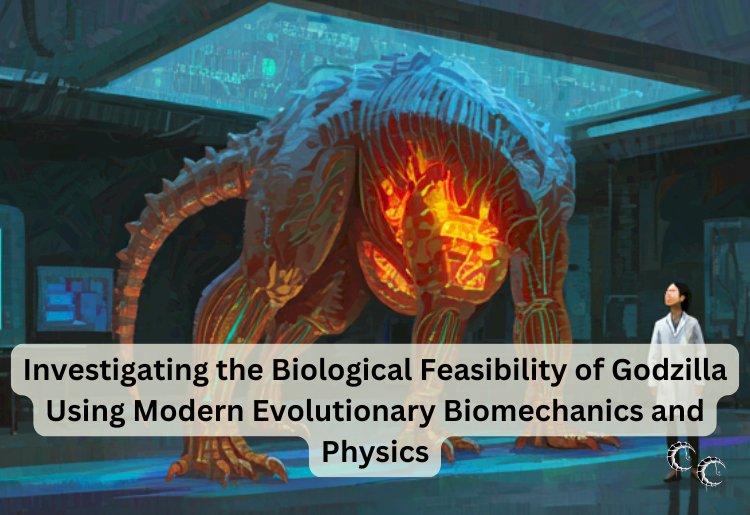
Few cinematic creatures test the limits of physics like Godzilla. At scales ranging from 50 to over 120 meters tall depending on the era, Godzilla is portrayed as a multi kiloton apex predator capable of walking upright, shrugging off military assault, and unleashing atomic breath.
But what happens when we apply evolutionary biomechanics and real physics to this icon?
At what point does biology surrender to the square cube law?
1. The Square Cube Law and Structural Collapse
The square cube law is the primary obstacle to giant organisms.
When an animal increases in size by a factor of n:
• Surface area increases by n squared
• Volume and mass increase by n cubed
Mass grows faster than structural strength.
If we scale a 5 meter tall bipedal reptile to 100 meters tall, that is a 20 times increase in height.
Mass would increase by 20 cubed, or 8000 times.
Bone cross sectional strength would increase by only 20 squared, or 400 times.
The result is catastrophic structural overload.
Godzilla would weigh far more than its skeleton could support if scaled proportionally from known animals.
To survive, Godzilla’s bones would need:
• Dramatically thicker proportions relative to body size
• Extremely dense or composite microstructures
• Possibly internal load distributing lattice architecture
Even then, upright bipedal stance at that mass becomes mechanically unstable.
2. Required Bone Density and Stress Distribution
Let us consider a 100 meter tall Godzilla with a conservative mass estimate of 90,000 metric tons, within the range sometimes cited in film lore.
Ground pressure becomes critical. Elephants distribute weight through wide, column like limbs. A kaiju scale biped would require:
• Massive femoral cross sections
• Thickened cortical bone
• Possibly a trabecular internal structure optimized for compression
Bone compressive strength in mammals is roughly 130 to 200 megapascals. To support a multi kiloton organism upright, either:
• Bone tissue must exceed known biological strength limits
• Or gravity must be lower than Earth’s
Without exotic biochemistry, standard hydroxyapatite based bone would fail under repeated dynamic loading such as walking.
Evolution on Earth has never produced terrestrial animals beyond roughly 100 tons for good reason.
3. Respiration and Oxygen Diffusion Limits
Large animals face another scaling issue. Oxygen delivery.
As body mass increases, diffusion distances increase and metabolic demand scales differently than respiratory surface area.
Dinosaurs likely relied on highly efficient air sac systems similar to birds, maximizing oxygen extraction.
A 90,000 ton organism would require either:
• A radically efficient circulatory system
• Extremely slow metabolism
• Or supplemental internal energy production mechanisms
Traditional lungs would struggle to oxygenate tissue at that scale, especially in a creature capable of intense bursts of activity.
Unless Godzilla’s biology includes non aerobic or nuclear driven energy systems, respiration becomes a severe bottleneck.
4. Heat Dissipation and Thermal Crisis
Large bodies retain heat. Surface area relative to volume decreases as size increases, limiting passive cooling.
Godzilla’s massive bulk would trap metabolic heat. Add to this the cinematic depiction of atomic breath, which implies internal nuclear reactions or plasma generation, and the thermal problem becomes extreme.
Heat must go somewhere.
If Godzilla generates immense internal energy to power atomic breath, then either:
• It has extraordinary heat resistant tissues
• It vents energy through dorsal plates
• Or it operates intermittently to avoid self destruction
Without active cooling, internal temperatures would rise to lethal levels. Biological proteins denature above about 45 degrees Celsius.
To survive, Godzilla’s tissues would require either radical biochemical adaptation or continuous thermal venting.
5. The Physics of Atomic Breath
Atomic breath suggests directed energy projection.
If we interpret it as a superheated plasma stream, energy output would be immense. Sustained plasma requires temperatures of thousands to millions of degrees Celsius depending on composition.
Generating that energy biologically would demand:
• Extreme radiation shielding inside the body
• Internal containment structures
• Energy storage densities beyond known metabolism
No known biological system approaches nuclear level energy release.
The closest real analog is bioluminescence, which is chemically driven and comparatively tiny in scale.
Atomic breath pushes Godzilla firmly into speculative nuclear bioengineering rather than evolutionary plausibility.
6. Movement and Momentum
A 90,000 ton organism moving at even modest speed would generate enormous momentum.
Stopping force scales with mass times velocity. Joint cartilage, tendons, and muscle insertions would experience staggering stresses.
Muscle strength scales with cross sectional area, not volume. As with bones, muscle power does not scale fast enough to keep pace with body mass.
Without disproportionally thick limbs and reduced mobility, Godzilla would move slowly and risk structural injury with each step.
7. Where Reality Breaks
Applying evolutionary biomechanics and physics reveals several breaking points:
• Bone strength cannot scale proportionally without radically altered material properties
• Oxygen delivery becomes inefficient at megafaunal extremes
• Heat dissipation fails under extreme metabolic output
• Nuclear scale energy projection has no biological precedent
The square cube law is not merely inconvenient. It is decisive.
8. Could Any Version Be Plausible
If we adjust certain parameters, plausibility improves slightly:
• Lower planetary gravity
• Aquatic or semi aquatic buoyancy reducing skeletal load
• Ultra slow metabolism
• Bioengineered composite tissues stronger than known bone
Indeed, many interpretations of Godzilla depict it emerging from the ocean. Water buoyancy would drastically reduce structural strain, allowing greater size without immediate collapse.
But fully terrestrial, upright, atomic breath wielding Godzilla on Earth?
That is where physics finally wins.
Final Verdict
Godzilla represents the triumph of spectacle over biomechanics.
The square cube law ensures that a multi kiloton biped cannot scale from ordinary reptilian anatomy without catastrophic structural failure. Heat management and energy generation compound the impossibility.
To exist, Godzilla would require:
• Novel super dense skeletal materials
• Exotic energy metabolism
• Extreme thermal resilience
• Possibly altered gravity conditions
Biology, as we understand it, cannot support such scale on Earth.
But that is precisely why Godzilla endures.
It is not evolution.
It is elemental myth given mass.