Should Social Media Be Completely Off-Limits for Younger Teens?
 Cordelia Cross
Mar 28, 2026 06:40
0
Cordelia Cross
Mar 28, 2026 06:40
0
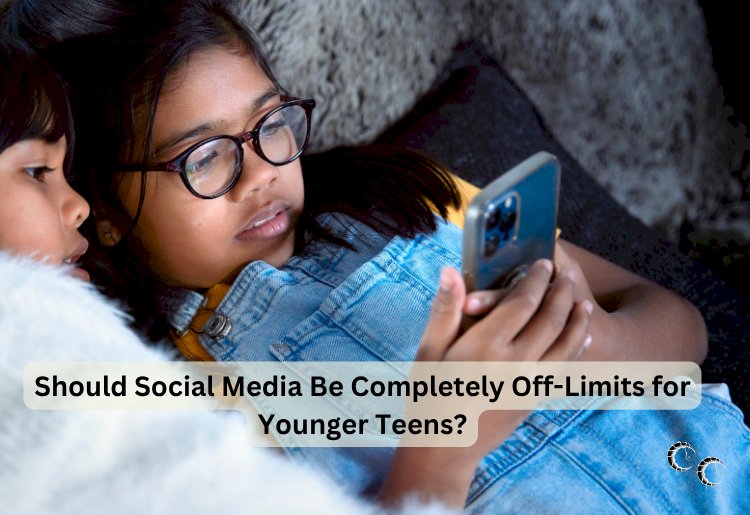
There is a quiet fear that sits just beneath the surface of modern parenting. It is not loud, not always spoken, but it lingers in the background every time a child picks up a phone, opens an app, or steps into a digital space that feels too big, too fast, too difficult to fully control.
Social media has become one of the clearest expressions of that fear.
It moves quickly. It exposes. It connects in ways that feel both powerful and unpredictable. And when younger teens begin to show interest in it, the instinct for many parents is immediate and protective. Shut it down. Keep it out. Avoid it entirely.
It feels like the safest answer.
But the real answer is no.
Social media should not be completely off-limits for younger teens.
Not because it is harmless. Not because it does not come with risks. But because removing it entirely does not remove the reality of it. It simply changes how and where a child will encounter it.
If something becomes forbidden without room for understanding, it does not disappear. It becomes hidden.
And hidden behavior is where risk grows.
A younger teen who is told they cannot have social media at all is not necessarily being protected from it. They are being separated from guidance within it. The curiosity does not go away. The desire to connect, to belong, to participate in what their peers are experiencing remains. And when that curiosity is strong enough, it often finds a way around the boundary.
A friend’s phone. A second account. A platform a parent does not know about. A version of access that exists entirely outside of supervision.
And in that space, there is no conversation. No guidance. No accountability.
That is where social media becomes far more dangerous.
Because it is not just the presence of social media that creates risk. It is the absence of understanding.
When a child is given access in a controlled, age-appropriate way, something very different begins to happen. Social media becomes a shared space rather than a secret one. It becomes something that can be talked about, explored, and understood together.
That shift matters.
Because the goal is not to delay exposure indefinitely. It is to prepare a child to navigate it responsibly. And preparation requires experience, not avoidance.
This does not mean unlimited access. It does not mean handing over a device and stepping back entirely. It means creating a structure that allows for learning while maintaining clear boundaries.
Monitoring is part of that structure.
Not in a way that feels invasive or controlling, but in a way that feels present. A younger teen should not be navigating social media alone. They should know that their activity is visible, that their accounts are connected to a level of oversight that exists not to punish, but to protect.
Passwords may be shared. Screen time may be limited. Platforms may be introduced gradually rather than all at once. Conversations should be ongoing, not reactive. The goal is not to catch mistakes after they happen, but to guide decisions as they are being made.
And that guidance is where the real value lies.
A teen who is allowed to use social media within clear boundaries has the opportunity to learn how it works. Not just the mechanics, but the emotional landscape that comes with it. They begin to recognize what feels safe and what does not. They learn how to respond to messages, how to interpret content, how to step away when something feels overwhelming.
They learn how to think before they post.
They learn that what they share has permanence. That not every moment needs to be public. That attention is not the same as connection. That validation does not have to come from outside.
These are not lessons that can be fully taught through restriction alone.
They require practice.
There is also something important to acknowledge about trust. When social media is introduced in a monitored, age-appropriate way, it creates an opportunity to build it. A teen who knows they can be honest about what they are doing, what they are seeing, what they are experiencing online is far more likely to come forward when something feels wrong.
But that honesty depends on the environment.
If social media is treated as something entirely forbidden, something that exists only in the realm of punishment and restriction, a teen is far less likely to be open about their experiences. They learn quickly what not to say, what not to share, what to keep hidden in order to avoid consequences.
And that silence can be far more concerning than the platform itself.
It is also worth considering the social reality that younger teens are growing up in. Social media is not just entertainment. It is communication. It is how friendships are maintained, how conversations continue outside of school, how social dynamics unfold in real time. Completely removing access can sometimes create a sense of isolation, a feeling of being left out of something that everyone else seems to understand.
That does not mean giving in to every request. It means recognizing that this is part of their world, and helping them learn how to exist within it safely.
Boundaries are essential.
Time limits. Approved platforms. Clear expectations about behavior, privacy, and interaction. These are not restrictions for the sake of control. They are frameworks that allow a teen to explore responsibly. They create a balance between freedom and guidance, between independence and protection.
And within that balance, something important begins to develop.
Judgment.
A teen who has been guided through social media use learns how to make decisions within it. They begin to recognize patterns. They understand what feels appropriate, what feels excessive, what feels unsafe. They develop an internal sense of awareness that cannot be imposed from the outside.
That awareness is what stays with them when the monitoring eventually fades.
Because it will.
At some point, the controls loosen. The oversight becomes less direct. And what remains is not the memory of restriction, but the understanding that was built through experience.
That is the goal.
Not perfect behavior. Not complete avoidance. But the ability to navigate a complex space with a sense of responsibility and self-awareness.
So no, social media should not be completely off-limits for younger teens.
It should be introduced thoughtfully. Monitored appropriately. Discussed openly. Guided consistently.
Because if it is taken away entirely, it does not disappear. It becomes something they access in secret, without support, without boundaries, without the tools they need to use it responsibly.
And that is where the real risk begins.
In the end, it is not about whether a teen will encounter social media. It is about how they will encounter it.
With guidance, or without it.
And the difference between those two experiences is everything.