Should Parents Let Kids Be Bored, or Always Keep Them Entertained?
 Cordelia Cross
Apr 2, 2026 06:34
0
Cordelia Cross
Apr 2, 2026 06:34
0
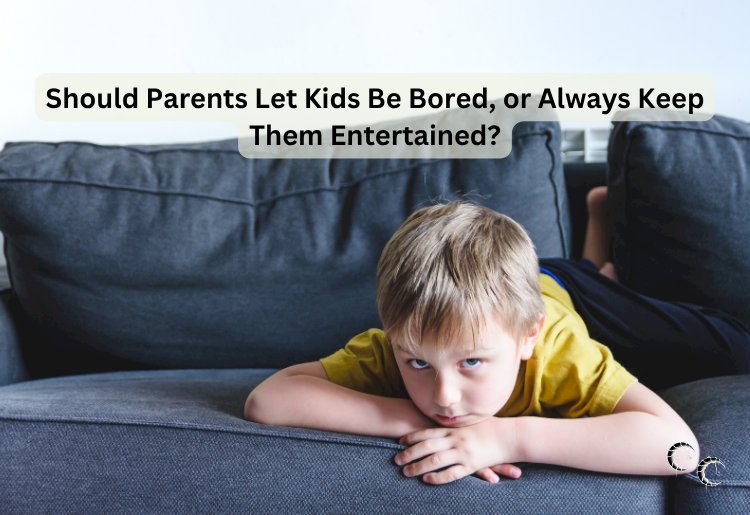
There is a moment that feels almost universal in childhood. The room is quiet, the options feel endless and yet somehow insufficient, and the words come out with a kind of dramatic finality. I’m bored.
It lands heavily, as if it is something that needs to be fixed immediately. As if boredom is a problem waiting for a solution, and the nearest adult is responsible for providing it. And in a world that offers constant stimulation, endless content, and a thousand ways to fill every empty second, it is easy to feel like the answer should be yes. Yes, fill the silence. Yes, provide something better. Yes, keep them entertained.
But the real answer is no.
Children should be allowed to be bored.
Not occasionally. Not reluctantly. But intentionally, consistently, and without the quiet guilt that often follows. Because boredom is not something to be avoided. It is something to be understood. Something to be experienced. Something that, when given space, becomes surprisingly valuable.
There is a misconception that boredom is empty. That it signals a lack of creativity, a lack of engagement, a lack of something important. But boredom is not empty. It is unstructured. And unstructured space is where something deeper begins to take shape.
When a child is constantly entertained, their world becomes reactive. They move from one activity to the next, guided by what is presented to them rather than what they discover on their own. There is always something to watch, something to play, something to consume. And while that can feel productive, even beneficial in small doses, it quietly removes an important skill from the equation. The ability to create something from nothing.
Boredom is often the starting point of imagination.
It is the moment where a child looks around and begins to ask, even if only internally, what now. That question does not always have an immediate answer. It can feel uncomfortable at first. Restless. Aimless. But if that space is not interrupted, if it is allowed to stretch just a little longer than feels convenient, something shifts.
A blanket becomes a fort. A stick becomes a sword. A quiet afternoon becomes a story that unfolds without a script. None of that happens when every moment is pre-filled.
Consider the difference between a child who is handed entertainment and a child who learns to generate it. One waits to be engaged. The other learns how to engage themselves. That difference may seem small in the moment, but over time, it becomes foundational. It shapes how they approach challenges, how they solve problems, how they move through moments of stillness later in life.
There is also something important happening beneath the surface of boredom that is often overlooked. It teaches patience.
In a world that moves quickly, where answers are immediate and distractions are always within reach, patience is becoming a quieter skill. One that is not always practiced in obvious ways. But boredom requires it. It asks a child to sit with a feeling that is not immediately resolved. To move through it rather than around it.
That experience matters.
It builds tolerance for discomfort in a way that is subtle but significant. It teaches that not every feeling needs to be fixed right away. That it is possible to exist in a moment that feels slow or uninteresting and still come out on the other side with something meaningful.
This does not mean that children should be left entirely to their own devices without guidance or interaction. There is value in shared activities, in intentional engagement, in moments of connection that are built through doing something together. The goal is not to remove involvement. It is to remove the pressure to constantly fill every gap.
There is a rhythm that develops when boredom is allowed to exist naturally.
A child may complain at first. They may look to you, expecting you to solve it. And it can be tempting to step in, to offer suggestions, to ease that discomfort quickly. But there is power in holding back just enough to let them figure it out.
“I’m bored.”
And instead of rushing in, a simple response.
“I believe you’ll find something.”
It is not dismissive. It is not cold. It is quiet confidence. A subtle message that they are capable of navigating this space on their own.
And they are.
Over time, something begins to change. The complaints become shorter. The gaps between them grow longer. The need for constant input starts to soften. A child who is allowed to experience boredom regularly becomes less afraid of it. They stop seeing it as something to escape and start seeing it as something that simply exists from time to time.
There is also a deeper layer to consider. When children are always entertained, they are rarely alone with their own thoughts. There is always something filling the space, something shaping their attention, something guiding their focus. But when that external input is removed, even briefly, they begin to develop an internal world.
They think. They imagine. They reflect.
That internal world becomes a source of creativity, but also a source of self-awareness. It is where ideas begin to form, where emotions are processed, where a sense of identity quietly takes root.
Without moments of boredom, that space can become underdeveloped.
Of course, there is a balance. Chronic boredom, the kind that comes from neglect or lack of opportunity, is something entirely different. Children need stimulation, interaction, and experiences that help them grow. The goal is not to leave them without support. It is to avoid overcorrecting in the other direction.
Always entertaining a child can feel like care, but it can also become a form of over-management. A way of controlling their experience so completely that they never have to navigate uncertainty on their own. And while that may create ease in the short term, it can make independence harder to develop in the long run.
There is something quietly powerful about a child who knows how to handle an empty moment.
Who does not immediately reach for a screen, a distraction, a solution provided by someone else. Who can sit, think, wander, create. Who understands that not every moment needs to be filled in order to be valuable.
That kind of independence does not come from constant entertainment. It comes from space.
From pauses.
From the willingness to let a child feel bored without rushing to fix it.
So no, parents should not always keep their children entertained.
They should let them be bored.
They should allow those quiet, uncertain moments to exist without interruption. They should trust that something meaningful is happening beneath the surface, even if it is not immediately visible. They should resist the urge to turn every empty space into something structured, something planned, something guided.
Because boredom is not the absence of something important.
It is often the beginning of it.
And in a childhood that leaves room for boredom, there is also room for creativity, resilience, patience, and self-discovery to grow.