Jurassic Genetics: Could We Actually Bring Dinosaurs Back?
 Cordelia Cross
Mar 29, 2026 10:13
0
Cordelia Cross
Mar 29, 2026 10:13
0
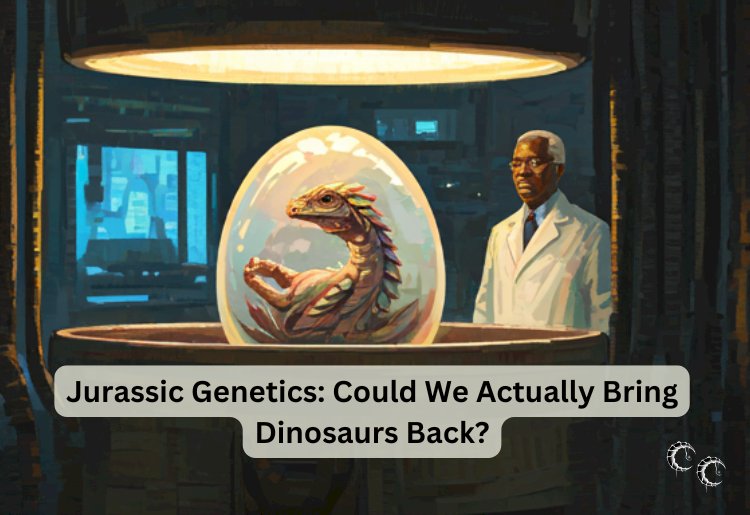
Dinosaurs have never really left the imagination. The idea that we could one day bring them back feels just close enough to science to be taken seriously, even if it sounds like pure fiction. Advances in genetics, cloning, and biotechnology have made it possible to recreate or revive certain traits from extinct species. That raises a natural question. Could the same process ever work for dinosaurs?
To answer that, it helps to separate what we can do from what we would need to do. Modern science has made real progress in studying ancient DNA and even bringing back aspects of long vanished animals. But dinosaurs present a very different kind of challenge.
What It Takes to Bring Back an Extinct Species
At a basic level, de extinction requires usable genetic material. DNA carries the instructions for building and maintaining a living organism. If you can recover enough of that information, you can begin to reconstruct what the organism was and how it functioned.
In some cases, this is partially possible. Scientists have been able to extract DNA from relatively recent extinct animals preserved in ice or dry environments. These samples can sometimes be sequenced and compared to living relatives, allowing researchers to fill in missing pieces.
Once a genome is reconstructed, the next step would involve inserting that genetic information into a living cell and guiding its development. This is already done in limited ways through cloning techniques, though it remains complex and difficult even with modern species.
The DNA Problem
Dinosaurs lived tens of millions of years ago. That timeline creates the biggest obstacle. DNA does not last forever. Over time, it breaks down into smaller fragments until it becomes unreadable.
Even under ideal conditions, DNA has a limited lifespan. After millions of years, the chances of finding intact or usable dinosaur DNA are extremely low. Fossils preserve bones and structures, but they do not reliably preserve genetic material at the level needed for reconstruction.
This means that the starting point for de extinction simply is not available. Without DNA, there is no direct blueprint to follow.
Why Amber Is Not a Solution
A popular idea is that dinosaur DNA could be preserved in ancient insects trapped in amber. It is an appealing concept, but it does not hold up under scientific scrutiny.
While amber can preserve the structure of organisms very well, it does not reliably protect DNA over extremely long periods. Heat, radiation, and chemical processes still break down genetic material. Even if traces remain, they are far too fragmented to reconstruct a full genome.
So while amber fossils are valuable for studying ancient life, they are not a practical source of recoverable dinosaur DNA.
What We Can Do Instead
Even without direct DNA, scientists are exploring alternative approaches that touch on the idea of bringing dinosaurs back in a different form. One of the most interesting paths involves studying the relationship between dinosaurs and modern birds.
Birds are considered the closest living relatives of certain dinosaur groups. Over time, they have evolved and changed, but they still carry genetic traits inherited from their ancestors. By studying these traits, researchers can identify genes that influence features like tails, teeth, and limb structure.
There have been experiments where certain dormant traits in bird embryos are activated or modified, producing features that resemble those of ancient reptiles. This does not create a true dinosaur, but it demonstrates how genetic pathways from the past still exist in modern species.
This approach is sometimes described as reverse engineering rather than resurrection. Instead of bringing back a dinosaur directly, it involves guiding a living organism to express traits that were present in its evolutionary history.
The Complexity of Living Systems
Even if the DNA problem could be solved, there are additional challenges. DNA alone is not enough to recreate an organism. Development depends on complex interactions between genes, cells, and environmental conditions.
Reconstructing those conditions accurately would be extremely difficult. Small differences in development can lead to major changes in the final organism. This means that even a complete genome would not guarantee a perfect recreation.
There are also practical concerns. Dinosaurs lived in ecosystems that no longer exist. Their biology, behavior, and environmental needs are not fully understood. Reintroducing such organisms into the modern world would raise serious questions about safety, ethics, and ecological impact.
Could It Ever Be Possible
With current technology, bringing back true dinosaurs is not realistic. The lack of usable DNA is a fundamental barrier, and even advanced genetic engineering cannot fully replace that missing information.
However, science is not standing still. Techniques in gene editing, synthetic biology, and evolutionary research continue to improve. It is possible that future methods could reconstruct ancient genomes in ways that are not currently feasible.
Even then, the result might not be a perfect replica of a dinosaur as it once existed. It would likely be a hybrid creation, shaped as much by modern science as by ancient biology.
Why the Idea Still Captivates Us
The fascination with dinosaurs is not just about the animals themselves. It is about the idea of reaching back into deep time and making the past tangible again. It represents a boundary between what is known and what feels just out of reach.
That sense of possibility drives both imagination and scientific curiosity. Even if the goal is never fully achieved, the pursuit leads to new discoveries and technologies that have real world applications.
Final Thoughts
Could we actually bring dinosaurs back? With what we know today, the answer is no. The scientific hurdles are too significant, and the necessary genetic material is not available.
But the story does not end there. Research into genetics and evolution continues to reveal how life changes and adapts over time. While true dinosaurs may remain in the past, the science inspired by them is very much alive.
In a way, that may be the more meaningful outcome. The goal is not just to recreate what was lost, but to better understand the processes that shaped it. And in doing so, we continue to push the boundaries of what is possible, one discovery at a time.