Analyzing Schrödinger’s Cat Paradox Through The Lens of Rick and Morty’s Dimensions
 Cordelia Cross
Apr 3, 2026 02:02
0
Cordelia Cross
Apr 3, 2026 02:02
0
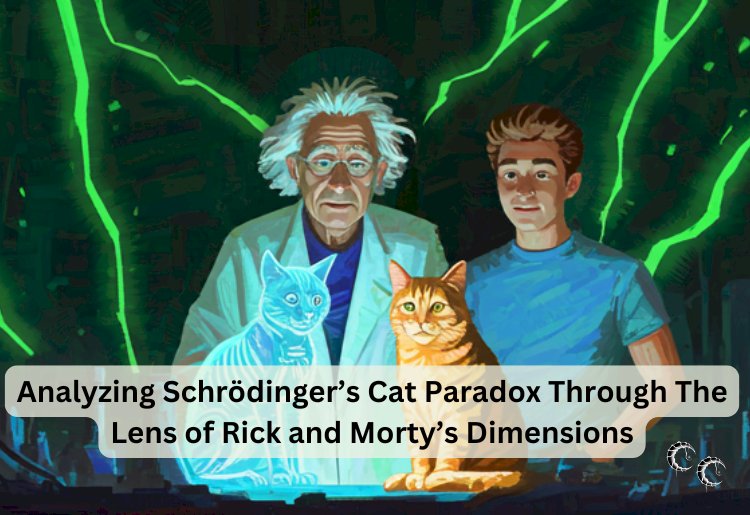
Few ideas in physics are as strangely compelling as Schrödinger’s Cat. A thought experiment where a cat can be both alive and dead at the same time sounds less like science and more like something pulled straight from an animated multiverse. That is exactly why looking at it through the lens of Rick and Morty feels so natural. Both explore the same unsettling question. What does reality look like when multiple possibilities exist at once?
To understand the connection, it helps to start with the original idea. Schrödinger’s Cat was never meant to prove that cats can exist in two states. It was designed to highlight a deeper issue in quantum mechanics. At very small scales, particles do not behave in fixed ways. Instead, they exist in a range of possible states until they are observed.
What the Cat Paradox Really Suggests
The thought experiment places a cat in a sealed box with a mechanism that depends on a random quantum event. If the event occurs, the cat does not survive. If it does not occur, the cat remains alive. According to quantum theory, until the box is opened and observed, the system exists in a superposition of both outcomes.
∣ψ⟩=α∣alive⟩+β∣dead⟩|\psi\rangle = \alpha |\text{alive}\rangle + \beta |\text{dead}\rangle∣ψ⟩=α∣alive⟩+β∣dead⟩
This is not about uncertainty in the usual sense. It is not that we simply do not know the outcome. The theory suggests that both outcomes exist simultaneously as part of the system’s state. Only when an observation is made does the system resolve into one definite result.
This is where things begin to feel less intuitive. In everyday life, objects do not behave this way. A cat is either alive or dead. The paradox exists because quantum rules do not easily scale up to the world we experience.
Enter the Multiverse of Rick and Morty
Rick and Morty approaches reality from a different angle, but one that overlaps in interesting ways. Instead of a single system holding multiple possibilities, the show presents a multiverse where every possible outcome exists in its own separate dimension.
When something can happen, it does happen somewhere. Every choice, every variation, every unlikely event branches into its own reality. Characters can move between these realities, treating them as parallel versions of existence rather than unresolved possibilities.
This creates a key contrast. Schrödinger’s Cat keeps all outcomes within one system until observation. Rick and Morty spreads those outcomes across many systems, each one fully realized.
Superposition Versus Parallel Realities
The difference between these ideas comes down to how possibilities are handled. In quantum mechanics, superposition means that multiple states exist at once within a single framework. The system has not yet chosen a path.
In the multiverse model seen in Rick and Morty, each possibility becomes its own reality. There is no unresolved state. Instead, there are countless resolved states existing side by side.
From a storytelling perspective, the multiverse feels easier to grasp. It replaces ambiguity with abundance. Instead of one unclear outcome, there are many clear ones. From a physics perspective, however, superposition is more subtle and less visually intuitive.
Observation and Collapse
One of the most important parts of Schrödinger’s Cat is the role of observation. When the box is opened, the superposition collapses into a single outcome. This raises a difficult question. What counts as an observation?
In quantum mechanics, observation does not necessarily mean a conscious observer. It refers to any interaction that forces the system into a definite state. Measurement, in this sense, is a physical process.
Rick and Morty sidesteps this issue by treating each outcome as already realized. There is no need for collapse because nothing is unresolved. The characters simply move between different outcomes rather than triggering them.
This difference highlights a deeper philosophical divide. Schrödinger’s Cat focuses on how reality becomes definite. Rick and Morty assumes reality is already split into all possible versions.
Why the Comparison Works
Looking at Schrödinger’s Cat through the lens of Rick and Morty helps make an abstract concept more approachable. The idea of multiple outcomes existing at once is difficult to visualize. The multiverse provides a way to imagine those outcomes as separate but accessible realities.
At the same time, the comparison reveals where the analogy breaks down. Quantum superposition is not the same as parallel universes. It is a mathematical description of a system that has not yet been resolved, not a collection of fully formed worlds.
Still, the overlap is meaningful. Both ideas challenge the notion of a single, fixed reality. Both suggest that what we observe is only one version of what could exist.
Final Thoughts
Schrödinger’s Cat and the dimensional chaos of Rick and Morty approach the same mystery from different directions. One is rooted in the mathematics of quantum mechanics. The other is a creative exploration of infinite possibilities.
Together, they highlight how strange reality can become when we move beyond everyday experience. Whether through superposition or parallel dimensions, the idea that multiple outcomes can exist forces us to rethink what it means for something to be real.
The cat in the box may never truly belong to a multiverse in the way Rick and Morty imagines, but using that perspective makes the paradox easier to engage with. It turns an abstract equation into something you can picture, even if the true nature of reality remains just out of reach.