Is It Okay to Say No to Your Child Without Explaining Why?
 Cordelia Cross
Mar 21, 2026 06:29
0
Cordelia Cross
Mar 21, 2026 06:29
0
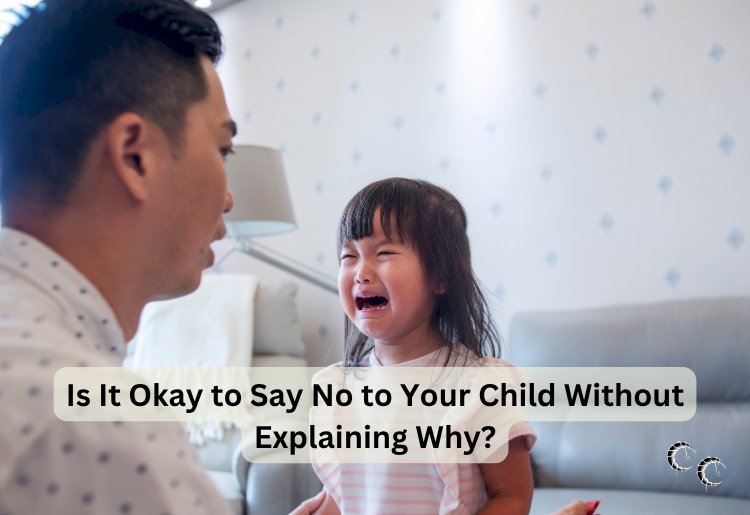
There is a moment every parent or caregiver knows well. A child asks for something, sometimes sweetly, sometimes with urgency, sometimes with the kind of persistence that feels almost strategic. And in that moment, a decision has to be made. Not just about the answer itself, but about how much of yourself you are willing to give to the explanation that may follow.
Is it okay to say no to your child without explaining why?
Yes.
Not because children do not deserve understanding. Not because curiosity should be dismissed. But because boundaries are not always meant to be negotiated, and not every no requires a story to soften it.
There is a quiet misconception woven into modern parenting that every decision must be unpacked, justified, and translated into something a child can fully understand. The idea sounds compassionate on the surface. It feels patient, intentional, thoughtful. And in many cases, it is. But there is a point where explanation stops being guidance and starts becoming something else entirely. Something heavier. Something that invites negotiation where there should be clarity.
A no, when used with intention, is not a rejection. It is a boundary.
Children are constantly learning how the world works, and much of that learning happens through repetition. Through consistency. Through the steady rhythm of knowing what to expect. When every no is followed by a detailed explanation, it can unintentionally signal that the boundary is open for discussion. That if they ask the right question, if they push just a little further, if they wait long enough, the answer might change.
And sometimes, it does.
But not always.
And that inconsistency is where confusion begins to grow.
Saying no without explanation, when done calmly and with presence, teaches something essential. It teaches that not every decision is up for debate. That some boundaries exist simply because they need to. Not as a punishment. Not as a power move. But as a form of structure that holds everything else together.
Consider a simple moment. A child reaches for something fragile, something that could break easily or cause harm. You say no. They ask why. In some situations, there is time to explain. You can kneel down, speak gently, walk them through the reasoning. But in other moments, there is urgency. There is no space for a detailed conversation. The no has to stand on its own.
And that is enough.
Or think about exhaustion. The kind that settles into your bones after a long day. A child asks for something small, something that might seem harmless on the surface. Another snack. Another show. Another story after the last one has already been read. You say no. Not because the request is unreasonable in isolation, but because you have reached the edge of what you can give in that moment.
Do you owe an explanation for that?
Not always.
There is a quiet dignity in acknowledging your own limits without needing to justify them. Children do not need to understand every detail of your capacity in order to respect it. In fact, learning that other people have limits, even when those limits are not fully explained, is part of how empathy begins to form.
This does not mean that explanation has no place. It does. Deeply so. There are moments where taking the time to explain your reasoning builds trust, strengthens understanding, and helps a child make sense of the world around them. Explaining why certain behaviors are unsafe, why certain choices matter, why certain boundaries exist can be incredibly valuable.
But explanation should be a tool, not a requirement.
When it becomes a requirement, it can quietly shift the dynamic. It can create an expectation that every boundary must be justified, that authority must always be proven, that a simple no is not enough unless it is supported by reasoning that satisfies the listener.
And that is not how the world works.
There will be teachers, employers, strangers, systems, and situations that do not pause to explain themselves. There will be moments where the answer is simply no, and there is no further context offered. Teaching a child how to navigate that reality begins with small, everyday interactions.
It begins with a calm, steady no.
There is also something to be said about the emotional tone behind the word itself. A no delivered with frustration, sharpness, or dismissal can feel very different from a no delivered with calm certainty. The absence of explanation does not need to feel cold. It can still carry warmth. It can still be grounded in presence.
“No, not right now.”
“No.”
And then a gentle redirect. A shift in attention. An invitation toward something else.
Children do not always need more words. Sometimes, they need consistency. Sometimes, they need to feel that the boundary is stable, that it will not move just because they push against it. That stability creates a sense of safety, even if they resist it in the moment.
It is also worth recognizing that over-explaining can sometimes come from a place of discomfort. A desire to avoid conflict. A need to be understood. A fear of being seen as unfair or unkind. But parenting is not about avoiding every moment of discomfort. It is about guiding a child through it.
And that includes the discomfort of hearing no.
A child who never hears no without explanation may begin to associate boundaries with negotiation. They may come to expect that every limit can be talked through, reshaped, or even overturned. And while communication is important, so is the ability to accept a boundary without requiring it to be fully explained.
There is a balance here. A rhythm that develops over time.
Sometimes you explain.
Sometimes you do not.
Sometimes the moment calls for patience and conversation. Other times, it calls for clarity and brevity.
What matters is not the presence or absence of explanation in any single moment. It is the overall pattern. The consistency. The sense that the child is both heard and guided, both understood and held within clear boundaries.
Because at its core, saying no is not about control. It is about care.
It is about creating a structure that allows a child to move through the world with a sense of security. It is about teaching them that limits exist, that not every desire will be met, that disappointment is something they can experience and move through.
And they can.
Children are more resilient than we often give them credit for. They may protest, they may question, they may push back. But they also adapt. They learn. They begin to understand the rhythm of yes and no, of permission and limitation.
And within that rhythm, they find their footing.
So yes, it is okay to say no to your child without explaining why.
It is okay because boundaries do not always need to be justified. It is okay because clarity can be more grounding than over-explanation. It is okay because part of growing up is learning that not every answer will come with a reason that feels satisfying.
And it is okay because a well-placed no, spoken with calm certainty, can be one of the most steady, reliable forms of care a child will ever receive.