Could Spider-Man’s Powers Happen? Genetics vs. Comic Logic
 Cordelia Cross
Feb 3, 2026 01:47
0
Cordelia Cross
Feb 3, 2026 01:47
0
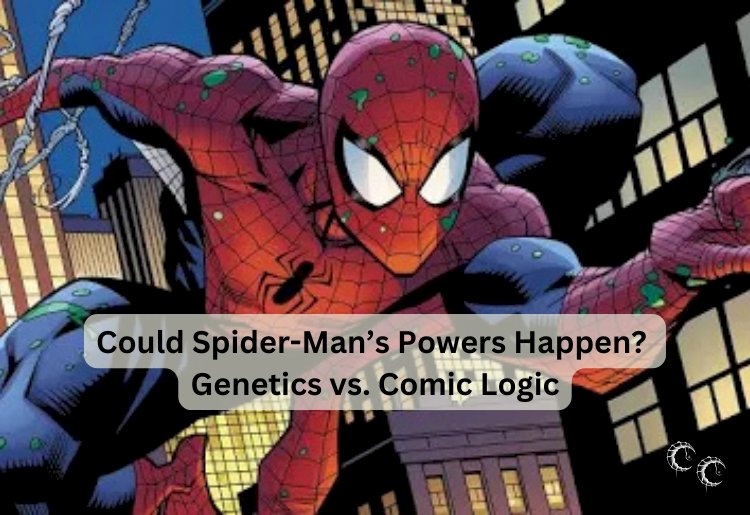
Spider-Man is one of those characters who feels strangely believable, even when you stop and think about how wildly impossible his powers should be. A teenage boy gets bitten by a radioactive spider, wakes up with enhanced strength, wall crawling, reflexes sharp enough to dodge bullets, and a built in danger alarm that basically screams, “Do not go in there.”
It is comic book perfection. It is also a genetic and biological nightmare.
Still, the science behind Spider-Man is fascinating because it sits right at the intersection of real world genetics and pure storytelling logic. If we strip away the cinematic slow motion and the iconic quips for a moment, could anything like Spider-Man’s powers happen in a real human body? Or is it all just wishful thinking wrapped in spandex?
Let’s dig in.
The Bite Problem: Why a Spider Could Not Rewrite Your DNA Overnight
Spider-Man’s origin hinges on one big assumption: a spider bite can fundamentally alter human biology.
In real life, a bite can do a few things. It can inject venom, cause infection, trigger an allergic reaction, or in rare cases create systemic illness. What it cannot do is deliver a clean, stable genetic upgrade package that seamlessly integrates into your body.
For genetic changes to occur in a meaningful way, you would need something like targeted gene therapy. Even then, it would not affect every cell in your body instantly. It would not rewrite your muscles, nerves, and connective tissues overnight. It would not upgrade your skeleton without breaking it.
Human genetics is not a switchboard. It is more like a deeply tangled network of interacting systems. Changing one gene rarely gives you one neat trait. It tends to cause a cascade of side effects.
So the bite itself is already the first place comic logic steps in and science steps out.
Super Strength: The Muscle and Bone Bottleneck
Spider-Man is often portrayed as being able to lift cars, stop trains, and casually throw grown men across a room like they weigh nothing.
The biggest issue here is not muscle strength. Humans can increase muscle mass and power. Strength is not the fantasy. Strength without structural failure is.
To have Spider-Man’s strength, you would need:
-
Muscles capable of generating enormous force
-
Tendons and ligaments that do not tear under that force
-
Bones that do not fracture under compression and torsion
-
Joints that can handle violent acceleration without dislocating
Even elite athletes tear ligaments and fracture bones under normal human limits. Spider-Man would be operating far beyond those limits on a daily basis.
In other words, if you gave a normal human Spider-Man strength, they would destroy themselves the first time they tried to catch a falling bus.
So could genetics create a body with stronger muscles and denser bones? Possibly in theory. But it would require a complete redesign of the human frame, not a simple mutation.
Reflexes and Agility: The Nervous System Challenge
Spider-Man’s agility is almost more impressive than his strength. He reacts instantly, flips mid air with impossible precision, and moves like his brain is running on a different clock speed.
This part actually has a small foothold in reality. Reaction time is tied to nerve conduction speed, sensory processing, and motor coordination. Some people naturally have faster reflexes than others. Training can also improve it significantly.
But Spider-Man operates at a level that would require:
-
Faster neural signaling
-
Enhanced sensory processing
-
Perfect balance and spatial awareness
-
Extreme muscle control
-
A brain that can predict motion almost instantly
The issue is energy. A nervous system that fast would consume a tremendous amount of fuel. The brain already burns a huge portion of the body’s energy, even at rest.
Spider-Man’s brain would need to be a high performance supercomputer, and his metabolism would need to keep up. He would not be eating pizza occasionally. He would be eating constantly.
Wall Crawling: The Real Science Is Almost Here, Sort Of
This is where things get interesting. Spider-Man’s wall crawling is one of the few powers that has inspired real scientific experiments.
In nature, creatures like geckos can climb smooth surfaces using microscopic structures on their feet called setae. These tiny hairs interact with surfaces through weak molecular forces, allowing adhesion without glue.
Scientists have created synthetic materials inspired by this. Some prototypes can stick to surfaces and support weight.
So could a human climb walls like Spider-Man? In principle, yes, but not through genetics alone.
To make it biological, you would need:
-
Specialized skin structures on hands and feet
-
A way to engage and disengage adhesion instantly
-
Enough surface area to support body weight
-
A skin system that does not shred or wear out constantly
Even if the adhesion existed, Spider-Man would need enormous grip strength and forearm endurance. Climbing a wall is not a gentle activity. It is brutal on the body.
Wall crawling is the closest power to something we could approximate technologically, but biologically it remains extremely unlikely.
Spider Sense: The Power That Breaks Physics
Spider sense is iconic. It is also the least scientifically plausible ability in the entire package.
Spider-Man reacts to danger before it happens. He dodges attacks he has not seen. He senses threats from behind him. He responds to invisible incoming projectiles.
In real life, humans can detect subtle cues, changes in sound, air pressure, and movement. Our brains are excellent at predicting danger, especially when trained. Soldiers and athletes often develop instincts that feel almost supernatural.
But spider sense is not instinct. It is precognition.
To have a true spider sense, Spider-Man would need to detect information from the environment faster than normal sensory channels allow. That would mean:
-
A new sensory organ
-
A way to process incoming threats without conscious awareness
-
A mechanism for detecting danger without direct input
That is not genetics. That is new physics.
Spider sense exists because it is narratively useful. It makes Spider-Man feel agile and reactive, even in situations where he should be outmatched. It is also a brilliant metaphor for anxiety and heightened awareness, which is part of why it resonates emotionally.
Web Shooting: The Chemistry Is Not the Main Problem
There are two versions of Spider-Man: organic webbing and web shooters.
The organic version is pure biological fantasy. Producing that much web fluid would require enormous internal glands, raw material intake, and a storage system that does not rupture under pressure. It would also require a way to eject webs with precision, strength, and consistency.
The web shooter version is more realistic, because it shifts the impossible part into engineering.
But even then, the chemistry would be extremely challenging. Spider-Man’s webs are:
-
Strong enough to stop vehicles
-
Elastic enough to swing from
-
Sticky enough to attach instantly
-
Fast curing
-
Biodegradable
-
Lightweight
-
Compact enough to fit in small cartridges
That combination is basically a materials scientist’s fever dream.
We do have high strength fibers and adhesives. We have polymers that cure quickly. But nothing in real life has all of those properties at once, especially not in a small, wearable device that works reliably under extreme conditions.
Radiation and Mutation: Why Comic Science Feels Real Anyway
Spider-Man’s origin uses radiation because it was a cultural symbol of transformation. In the mid twentieth century, radiation represented both fear and possibility. It was mysterious and powerful, which made it perfect for storytelling.
In reality, radiation damages DNA. It causes cancer, tissue destruction, and cell death. It does not produce beneficial mutations on demand.
The reason comic book science feels believable is because it uses real scientific vocabulary. Genetics, radiation, mutation, evolution. These words carry authority. Even when the logic is fantasy, the language makes it feel grounded.
That is why Spider-Man’s origin still works. It is not scientifically accurate, but it is emotionally and culturally coherent.
If Spider-Man Were Real, What Would He Actually Look Like
If we tried to build a realistic Spider-Man using biology alone, the result would not be a lean teenager in a suit. It would be something closer to a specialized athlete with extreme genetic advantages and heavy physiological tradeoffs.
A more realistic version might include:
-
Dense bones and reinforced connective tissue
-
Extremely high metabolism and constant calorie needs
-
Enlarged heart and lungs for oxygen delivery
-
Enhanced proprioception and balance
-
Unusual skin adaptations for climbing
-
Reduced lifespan due to bodily strain
In other words, the powers would come with a cost. Real biology always charges a price.
Why Spider-Man’s Powers Matter Even If They Are Impossible
The science is fun to analyze, but Spider-Man is not beloved because his powers are plausible. He is beloved because his powers are symbolic.
Spider-Man represents sudden responsibility. He is gifted with abilities he did not ask for, and he has to decide what kind of person he will become. His strength is not just physical. It is moral.
The web is not just a tool. It is a lifeline, a way to connect, to save, to swing forward.
Even spider sense is not just a superpower. It is the feeling of being hyper aware in a dangerous world, constantly bracing for what might happen next.
Conclusion
Could Spider-Man’s powers happen through genetics? Not in the way comics portray them. A spider bite cannot rewrite human biology overnight, and most of his abilities would require massive structural changes to the body or even entirely new sensory systems.
But could parts of Spider-Man exist in a future shaped by advanced materials science, bioengineering, and wearable technology? That is where things get exciting. Wall climbing surfaces, high strength fibers, and enhanced reflex training are already real in some form.
Spider-Man may not be scientifically possible today, but he is not meaningless fantasy either. He is a vision of what happens when human potential, imagination, and responsibility collide.
And honestly, that is the kind of science fiction that never gets old.