Real-Life Black Holes vs. Star Trek’s ‘Wormholes'
 Cordelia Cross
Oct 16, 2025 05:12
0
Cordelia Cross
Oct 16, 2025 05:12
0
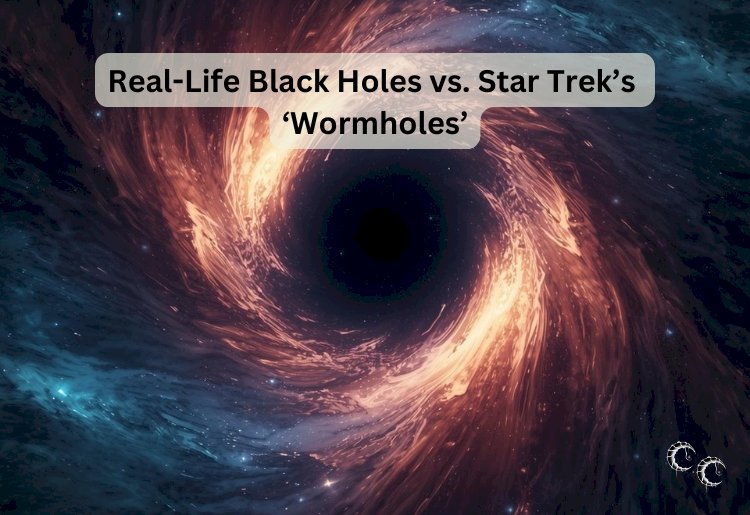
Black holes are among the most mysterious and fascinating objects in the universe. Formed from the collapse of massive stars, they are regions where gravity is so intense that not even light can escape. In contrast, science fiction, particularly Star Trek, introduces wormholes as shortcuts through space, allowing instantaneous travel across vast distances. Comparing real black holes with the fictional concept of wormholes reveals both the scientific realities of extreme gravity and the imaginative leaps that make interstellar storytelling possible.
A black hole’s defining feature is its event horizon, the point beyond which nothing can return. Matter and energy pulled past this boundary are trapped by gravity, creating singularities where density becomes infinite and known physics breaks down. The gravitational pull of black holes warps spacetime dramatically, bending light and distorting nearby objects. Observing them requires indirect methods, such as monitoring accretion disks or the motion of surrounding stars, because the black hole itself emits no light. This makes them extreme, lethal environments rather than convenient cosmic highways.
Wormholes in Star Trek, by contrast, are depicted as stable tunnels connecting two distant points in space. They allow ships to traverse thousands of light-years in moments, bypassing the speed-of-light limitation imposed by relativity. From a physics standpoint, wormholes are theoretical solutions to Einstein’s equations of general relativity, but they present formidable challenges. Maintaining a traversable wormhole requires exotic matter with negative energy density to prevent collapse and stabilize the throat of the tunnel. Such matter has never been observed, and even small perturbations could destabilize the structure, making instantaneous travel a far-fetched concept with current understanding.
The difference between black holes and wormholes lies not just in physics but in function. Black holes are sinks; they pull matter in and prevent escape. Wormholes are bridges, connecting points without the need to traverse intervening space. Black holes in science fiction are sometimes repurposed as dramatic obstacles, hazards, or sources of immense energy. Wormholes serve a narrative purpose of convenience, enabling storytelling that spans galaxies without requiring realistic travel times. Both concepts play with spacetime curvature, but they do so with fundamentally different intentions: one as a natural consequence of gravity, the other as a speculative tool for interstellar mobility.
Energy and tidal forces further distinguish the two. Black holes generate intense tidal forces near their event horizons, stretching and compressing matter in a process called spaghettification. Approaching a black hole is catastrophic for any material object. Wormholes, as depicted in Star Trek, allow safe passage without such destructive effects. Any realistic wormhole would require extraordinary control over spacetime to mitigate gravitational stresses, an engineering challenge that dwarfs any technology currently imaginable. Fiction simplifies or ignores these hazards to focus on exploration, diplomacy, and adventure.
Time dilation also plays a role in the comparison. Near a black hole, gravitational time dilation becomes extreme; observers far away would see events near the horizon unfold slowly. Wormholes, in contrast, bypass the relativistic consequences of distance, effectively allowing instantaneous travel without the subjective passage of time. This highlights a key difference between narrative convenience and physical reality: black holes obey strict relativistic constraints, while wormholes are shaped by story needs and imaginative license.
Despite these differences, the two concepts share a common fascination: they challenge human intuition about space, time, and the limits of the universe. Black holes push the boundaries of observation and theory, offering insights into gravity, quantum mechanics, and cosmic evolution. Wormholes inspire imagination, encouraging thought experiments about causality, connectivity, and the potential for interstellar civilization. Both invite us to consider what is possible within and beyond the laws of physics.
Ultimately, real-life black holes and Star Trek’s wormholes occupy different realms of understanding. Black holes are tangible consequences of gravity and stellar evolution, governed by precise mathematics and observable effects. Wormholes are speculative constructs, designed to enable exploration and storytelling while hinting at theoretical possibilities. Comparing them illuminates the tension between scientific reality and narrative imagination, showing how our fascination with the cosmos can inspire both rigorous study and limitless creativity. Both remind us that space is vast, strange, and full of mysteries waiting to be explored, whether by telescope, spacecraft, or the flights of our imagination.