Could Dune Sandworms Exist Using Geological Principles of Subterranean Heat and Vibration
 Cordelia Cross
Feb 24, 2026 12:42
0
Cordelia Cross
Feb 24, 2026 12:42
0
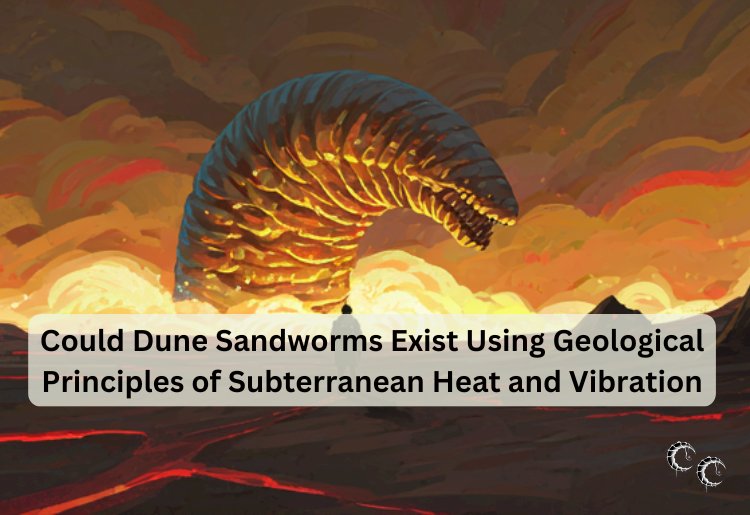
Few creatures in science fiction feel as mythic and geological as the sandworms of Dune, adapted from Dune. Shai Hulud is portrayed not merely as an animal, but as a force of nature. It senses rhythmic vibrations across vast distances and moves beneath desert sands like a living tectonic event.
But could something of that scale plausibly exist under real geological conditions? Could subterranean friction and vibration supply enough energy to sustain a massive organism without destabilizing the crust itself?
To answer that, we have to treat the sandworm not as myth, but as a thermodynamic system.
1. Scale and Energy Requirements
The largest sandworms in Dune are depicted as hundreds of meters long and tens of meters in diameter. Even conservatively, such an organism would mass thousands to tens of thousands of tons.
Biological systems obey scaling laws. As organisms increase in size, volume and mass increase faster than surface area. This creates enormous metabolic and thermal management challenges.
To move through sand, a sandworm would need to displace granular material continuously. Sand behaves as a complex medium, sometimes solid, sometimes fluid. Pushing through it requires sustained mechanical work.
The energy required would scale roughly with:
• Cross sectional area of the body
• Depth below surface
• Density and compaction of sand
At hundreds of meters in length, locomotion would demand immense power output, far beyond that of any terrestrial animal.
2. Could Subterranean Friction Power It
One speculative idea is whether friction itself could provide usable energy.
When objects move through sand or along tectonic boundaries, friction generates heat. On geological scales, tectonic friction during earthquakes can release enormous energy.
However, friction is a dissipative process. It converts kinetic energy into heat. It does not generate new usable biological energy.
For a sandworm to “run” on friction, it would need to harvest heat gradients or mechanical stress from its environment and convert that into biochemical energy. On Earth, organisms near hydrothermal vents do exploit geothermal energy indirectly through chemosynthesis.
But desert sand layers lack the intense geothermal gradients found at tectonic boundaries or mid ocean ridges.
Unless Arrakis like planets possess unusually high subsurface heat flux, friction alone would not sustain a megafaunal organism. It would instead overheat both the worm and the surrounding substrate.
3. Heat Dissipation Through Tectonic Strata
Let us assume the worm generates internal heat through metabolism and external heat through friction with sand.
The next problem is thermal management.
Rock and sand have relatively low thermal conductivity compared to metals. Heat generated within a massive organism would dissipate slowly, especially if buried tens of meters below the surface.
If the worm moves rapidly, friction at its surface could raise local temperatures significantly. At sufficient scale, this could:
• Melt surrounding silica into glass
• Create localized sintering
• Trigger structural collapse of tunnels
To prevent this, the worm would require either:
• Extremely slow, efficient locomotion
• A body surface adapted to minimize friction
• Internal cooling systems capable of redistributing heat
Without active heat regulation, a creature of that size would risk cooking itself or vitrifying its surroundings.
4. Vibration Based Locomotion and Sensing
One of the most distinctive traits of sandworms is their sensitivity to rhythmic vibrations.
In reality, seismic waves travel efficiently through granular and rocky substrates. Many animals already detect vibrations. Elephants sense distant ground tremors. Certain insects detect minute substrate oscillations.
Scaling that up is not impossible in principle. A massive organism could theoretically possess highly specialized mechanoreceptors tuned to low frequency vibrations.
Locomotion through vibration is more complicated.
To move by “swimming” through sand, the worm would need to fluidize the substrate ahead of it. Granular physics shows that vibrations can temporarily reduce friction between particles, causing sand to behave more like a liquid.
If a massive organism generated powerful oscillations along its body, it could potentially induce localized fluidization, reducing resistance.
However, generating such oscillations would require enormous energy input. And repeated high amplitude vibrations would likely destabilize surrounding geological layers.
In essence, the worm would behave like a continuous micro earthquake.
5. Structural Constraints of the Crust
Earth’s crust can withstand stress, but sustained movement of a multi thousand ton organism beneath shallow desert layers would create:
• Subsurface voids
• Collapse zones
• Surface subsidence
Over time, the terrain would become unstable.
Unless the planetary crust were unusually thick, dry, and homogeneous, repeated passage of such creatures would leave extensive geological scars.
In Dune, this is partly depicted in the shifting desert and massive surface disruptions. From a geological standpoint, large scale burrowing could be plausible in deep unconsolidated sand seas, but not in compacted rock strata.
6. The Metabolic Question
The most difficult barrier is biological metabolism.
On Earth, energy density in biological fuels is limited. Even the largest animals rely on vast caloric intake relative to their mass. A sandworm of extreme size would require an ecosystem capable of supporting its caloric demands.
Unless it derived energy from a planetary scale chemical cycle, its food source would need to be immense and continuous.
Geothermal chemosynthesis is one theoretical pathway, but deserts lack the necessary chemical gradients unless the planet has unusually active subsurface volcanism.
Without an exotic biochemistry or a radically different planetary environment, sustaining such biomass would strain known biological limits.
7. Could It Exist on a Different Planet
If we relax Earth based constraints and imagine a planet with:
• Higher geothermal flux
• Deep, thick layers of unconsolidated sediment
• Lower gravity reducing structural stress
• Abundant subsurface chemical energy
Then the concept becomes less absurd.
Lower gravity would reduce weight and frictional force. Greater geothermal gradients could support chemosynthetic metabolisms. Thick, dry sedimentary basins would allow large scale burrowing without immediate crustal collapse.
Under those conditions, Shai Hulud transitions from impossible to highly speculative but not entirely outside physics.
Final Verdict
Using Earth geological principles alone, sandworms at the scale depicted in Dune face enormous challenges:
• Friction does not generate sustainable metabolic energy
• Heat dissipation would be a severe constraint
• Vibration based locomotion would demand extreme power
• Subsurface structural integrity would be compromised
However, on a planet with different gravity, geothermal flux, and sediment structure, a giant subterranean organism becomes more plausible within speculative biology.
Shai Hulud remains cinematic myth. But when examined through seismic physics and thermal geology, the idea reveals something fascinating.
The barrier is not imagination.
It is energy.