AI, Accountability, and the Lost Art of Saying
 Cordelia Cross
May 13, 2026 10:47
0
Cordelia Cross
May 13, 2026 10:47
0
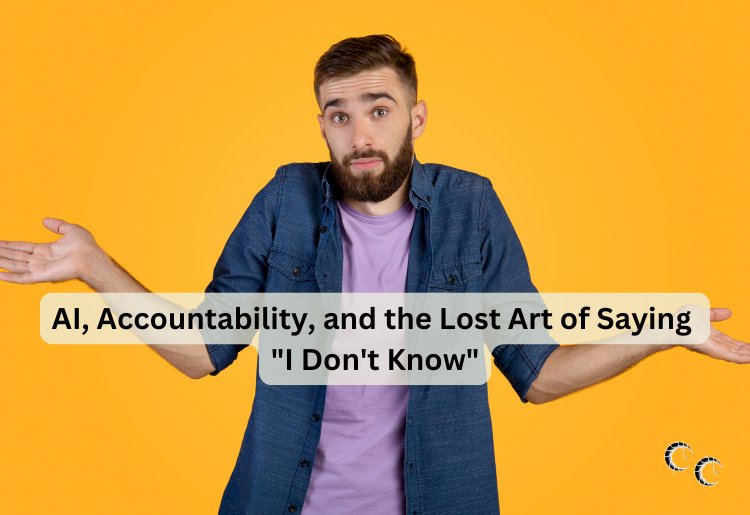
There was a time when admitting you didn't know something was considered a sign of honesty.
Now, with artificial intelligence sitting a few clicks away, there is a strange new pressure to have an answer for everything.
Need a quick explanation? AI can help.
Need to summarize a complicated topic? AI can help.
Need to understand something you've never studied before? AI can help.
And that is genuinely amazing.
But there is a hidden question underneath all of this convenience.
What happens when having access to answers makes people less comfortable admitting when they don't actually know something?
The Pressure to Always Be Right
Humans have always struggled with admitting uncertainty. Nobody enjoys saying, "I'm not sure," especially in conversations where they want to appear knowledgeable.
The difference now is that the barrier between curiosity and confidence has almost disappeared.
Someone can ask a question, receive a polished response, and repeat that information moments later as if they spent years studying the subject.
The result?
Sometimes people aren't sharing knowledge. They're sharing borrowed confidence.
AI makes it easier than ever to explore new ideas, but it also makes it easier to skip the uncomfortable step of learning, questioning, and understanding.
That step matters.
When AI Becomes a Shortcut Instead of a Tool
A calculator didn't make people stop understanding math.
A map didn't make people stop learning where places are.
But every tool changes how we think.
AI is different because it works with language, reasoning, and information. It doesn't just give an answer. It gives an answer that sounds confident, organized, and complete.
That confidence can be persuasive, even when the information is incomplete or wrong.
The danger isn't using AI.
The danger is forgetting that using a tool doesn't automatically make someone an expert.
Knowing how to ask a question is a skill.
Knowing when to question the answer is an even bigger one.
The Importance of Saying "I Don't Know"
"I don't know" is an underrated phrase.
It creates room for curiosity.
It invites conversation.
It allows someone else to share what they know.
It prevents a discussion from turning into a competition where everyone is trying to prove they are the smartest person in the room.
Someone who says, "I don't know much about that, but I'd like to learn," is often far more trustworthy than someone who confidently explains a topic they barely understand.
Knowledge grows through curiosity, not pretending.
How This Changes Our Conversations
The way people interact with each other depends heavily on trust.
When someone admits uncertainty, it signals honesty. It tells others, "I'm here to understand this with you."
When someone presents AI-generated information as personal expertise, it can create a different dynamic. Conversations become less about exchanging ideas and more about defending statements.
That can lead to frustration.
It can make people less willing to ask questions.
It can even make genuine experts feel ignored when confident guesses receive the same attention as carefully researched information.
A healthy conversation needs humility.
Not everyone needs to be the person with the answer.
Sometimes the most valuable person in the room is the one willing to ask the right question.
AI Should Make Us More Curious, Not More Certain
The best use of AI isn't replacing curiosity.
It's expanding it.
A person who uses AI well doesn't say, "I have all the answers now."
They say, "I have a better starting point."
That difference matters.
AI can introduce people to new subjects, explain complicated ideas, and help them explore topics they might never have encountered otherwise. But it should be the beginning of learning, not the end.
The goal isn't to become someone who knows everything.
That's impossible.
The goal is to become someone who knows how to learn, how to question, and how to recognize the limits of what they understand.
The Future Belongs to the Curious
The ability to say "I don't know" might become even more important as technology becomes more advanced.
When information is everywhere, wisdom comes from knowing what to trust.
When answers are instant, patience becomes valuable.
When everyone can sound knowledgeable, genuine understanding becomes easier to recognize.
AI is not making curiosity obsolete.
If anything, it is making curiosity more important than ever.
The people who benefit most from this technology won't be the ones who pretend they know everything.
They will be the ones brave enough to say, "I don't know yet."
Because "yet" changes everything.