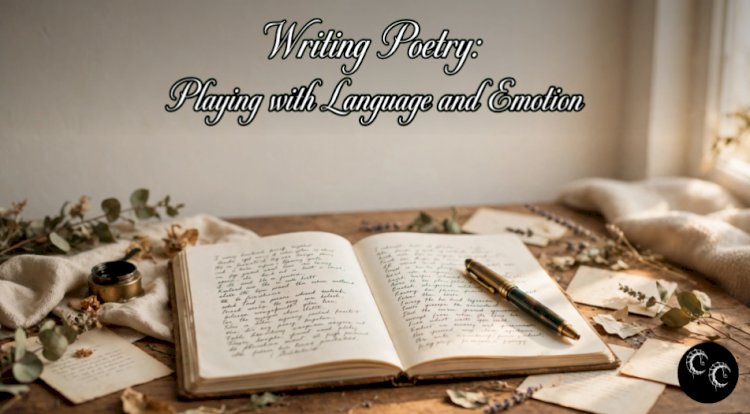
Writing Poetry: Playing with Language and Emotion
 Cordelia Cross
Aug 3, 2026 01:05
0
Poetry has a unique way of expressing things that ordinary conversation sometimes struggles to capture. A single line can hold an entire memory, a complicated emotion, or a feeling you have carried for years without knowing how to explain it. Through rhythm, imagery, and carefully chosen words, poetry turns everyday experiences into something meaningful.
The beautiful thing about writing poetry is that there is no single correct way to do it. You do not need a perfect vocabulary, a background in literature, or an ability to make every line rhyme. Sometimes the most powerful poems begin with a simple observation, an unexpected thought, or a feeling that refuses to stay quiet.
Poetry is about discovering what language can do when you allow yourself to experiment.
Start With a Feeling, Not a Perfect Line
One of the easiest ways to begin writing poetry is to focus on an emotion rather than trying to create an impressive opening sentence.
Think about something you have experienced recently. Maybe it was the comfort of sitting in a quiet room after a difficult day, the excitement of starting something new, or the strange sadness that comes with remembering a place you can no longer return to.
Instead of immediately trying to turn that experience into a poem, write down what you remember. Notice the details, the thoughts that appeared, and the physical sensations connected to the moment.
Perhaps loneliness feels like an empty chair at the dinner table. Maybe happiness resembles sunlight moving slowly across the kitchen floor. These descriptions give emotions a physical presence, allowing readers to experience something rather than simply being told how to feel.
You do not need to explain everything. Sometimes a single image can communicate more than an entire paragraph.
Experiment With the Sound of Words
Poetry is not only about meaning. It is also about sound.
Read your words aloud and pay attention to how they move. Some combinations feel soft and gentle, while others sound sharp, energetic, or uncomfortable. The sounds themselves can influence the mood of a poem.
Repeating certain consonants can create rhythm, while longer vowel sounds can make a line feel slower and more reflective. Short, abrupt words can introduce tension or urgency.
You do not need to memorize technical terms to experiment with these effects. Simply listen to your writing.
Try describing the same moment in two different ways. One version might use flowing, gentle language, while the other uses short, fragmented sentences. Even if both versions describe the same event, they can create completely different emotional experiences.
This is where poetry becomes playful. Words stop being just tools for communication and become materials you can shape, rearrange, and explore.
Forget About Rhyming for a While
Rhyme can be wonderful, but it can also become a distraction when you are learning to write poetry.
Sometimes writers begin with a meaningful idea and then force the next line to rhyme, even when the result sounds unnatural. The poem starts serving the rhyme scheme instead of the emotion.
Free verse offers another approach. It allows you to experiment with line breaks, rhythm, repetition, and imagery without following a strict pattern.
For example, consider these lines:
The rain kept falling.
I watched the window
until the room
felt quieter than my thoughts.
There is no formal rhyme scheme, but the spacing and rhythm influence how the moment unfolds.
You can always experiment with rhyme later. The important thing is to discover the natural voice of your poem before worrying about making every line fit a particular structure.
Use Imagery to Bring Emotions to Life
One of poetry's greatest strengths is its ability to connect abstract feelings with concrete experiences.
Love, grief, hope, fear, and nostalgia can be difficult to describe directly. Imagery gives these emotions something readers can recognize.
Instead of writing that someone feels anxious, you might describe a clock ticking too loudly in an otherwise silent room. Instead of explaining that a relationship has ended, you might describe two coffee cups sitting untouched on opposite sides of a table.
These details allow readers to participate in the meaning of the poem. They bring their own memories and experiences to the images, creating a personal connection with the writing.
The trick is to choose details that feel specific and genuine. You do not need an elaborate metaphor in every line. Sometimes an ordinary object becomes powerful simply because of the memory attached to it.
Play With Metaphors and Unexpected Comparisons
Metaphors allow you to describe one thing through the qualities of another. They can make familiar experiences feel new by encouraging readers to see them from a different perspective.
Time might become a river that carries memories downstream. Regret might resemble a room you keep returning to even though you know nothing has changed inside it.
The most interesting comparisons often come from following an unexpected connection.
Ask yourself what an emotion looks like, sounds like, or would become if it were a physical object. What color would uncertainty have? What would hope feel like in your hands? If a memory could speak, would it whisper or shout?
There are no fixed answers. The point is to explore possibilities and discover images that express something meaningful to you.
Do not worry if your first comparisons seem strange. Sometimes an unusual image opens the door to an idea you would never have reached through straightforward description.
Let Your Own Experiences Shape Your Voice
It can be tempting to imitate poets you admire. Reading other people's work is an excellent way to learn about rhythm, imagery, structure, and emotional expression. However, your writing becomes more distinctive when you allow your own perspective to influence the language.
Pay attention to the things you naturally notice. Perhaps you remember conversations word for word but forget what people were wearing. Maybe you are drawn to changing seasons, crowded streets, family traditions, or the quiet details of ordinary routines.
These preferences can become part of your poetic voice.
Your experiences do not need to be extraordinary to inspire meaningful writing. An ordinary morning, a difficult conversation, or a familiar walk can contain enough emotional detail for an entire poem.
Authenticity comes from paying attention to what matters to you rather than trying to sound like someone else.
Use Line Breaks to Control Emotion
Unlike prose, poetry allows you to control where a thought pauses, continues, or changes direction through the placement of individual lines.
A line break can create suspense by delaying an important word. It can emphasize a particular image or give a sentence a different emotional rhythm.
Consider the difference between placing an entire thought on one line and breaking it into smaller pieces.
A long line may feel conversational and flowing. Short lines can create hesitation, uncertainty, or a sense of isolation.
Line breaks also encourage readers to slow down. A pause can give an image more room to resonate, while an unexpected continuation can change how the preceding words are understood.
Experiment with different arrangements. Move the breaks around and read the poem aloud. You may discover that the words themselves have not changed, but their emotional effect has.
Give Yourself Permission to Write Bad First Drafts
One of the biggest obstacles to creative writing is the expectation that every sentence should be good immediately.
When you constantly judge your words as you write them, experimentation becomes difficult. You begin choosing safe phrases instead of exploring more interesting possibilities.
Allow your first draft to be messy. Write the awkward metaphor, the overly dramatic sentence, or the thought that does not quite make sense yet.
You can revise everything later.
The first draft is where you discover what you want to say. Revision is where you figure out how to say it.
During editing, look for unnecessary words, familiar clichés, and lines that explain something the imagery has already communicated. Read the poem aloud and notice where the rhythm feels forced.
Sometimes the strongest revision involves removing a line rather than adding another one.
Find Inspiration in Everyday Life
Poetry does not require waiting for a dramatic emotional experience or a sudden burst of inspiration.
You can find ideas by keeping a small notebook, collecting interesting phrases, or writing down observations throughout the day.
Notice the way sunlight changes a room in the afternoon. Listen to the rhythm of a train moving through a station. Pay attention to an expression someone uses during a conversation.
These details may not seem important at first, but they can become the starting point for something much larger.
You can also give yourself simple writing challenges. Describe a familiar place without naming it. Write a poem using only sensory details. Explain an emotion without using its name. Write about a memory from the perspective of an object that was present.
Creative restrictions can make writing more interesting because they encourage you to find new ways of expressing familiar ideas.
Remember That Poetry Does Not Need to Explain Everything
Some of the most memorable poems leave space for uncertainty.
Writers sometimes feel compelled to explain every image, clarify every emotion, and make sure readers understand exactly what each line means. While clarity matters, excessive explanation can remove the mystery that makes poetry engaging.
Readers do not always need a complete answer. They need something meaningful to connect with.
An image can suggest several interpretations at once. A poem about an empty house might be about grief, growing older, a relationship ending, or the passage of time. Different readers may discover different meanings, and those interpretations can coexist.
Trust your images and give your readers room to experience them.
Final Thoughts
Writing poetry is an opportunity to explore the relationship between language and emotion. It allows you to slow down, notice the details of your life, and express experiences that might otherwise remain difficult to describe.
You do not need to write beautifully every time. You do not need to rhyme, follow strict rules, or produce something profound with every attempt. What matters is your willingness to experiment, pay attention, and discover what happens when you approach familiar experiences from a different perspective.
Start with a feeling. Follow an interesting image. Play with the sound of a sentence. Let yourself write something imperfect and see where it leads.
Sometimes a poem begins with a carefully chosen metaphor. Sometimes it begins with a single sentence you cannot stop thinking about.
And sometimes, all it takes is finding the right words for something you have felt all along.