Can a Pocket Dimension Exist? The Physics Behind D&D's Bag of Holding
 Cordelia Cross
Jun 15, 2026 01:44
0
Cordelia Cross
Jun 15, 2026 01:44
0
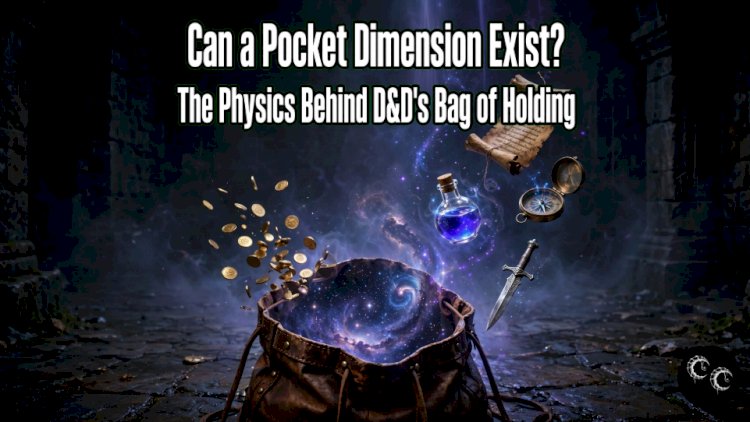
Can a Pocket Dimension Exist? The Physics Behind D&D's Bag of Holding
There are a lot of magical items in Dungeons & Dragons that would completely change the modern world if they existed.
A sword that glows? Cool.
Boots that let you fly? Incredible.
A ring that makes you invisible? Society would have questions.
But the humble Bag of Holding might be one of the most disruptive magical objects imaginable.
From the outside, it looks like a normal bag. Inside, however, it can hold far more than its physical dimensions should allow. You can stuff an unreasonable amount of adventuring equipment into it, carry it around without apparently being crushed under the weight, and somehow retrieve exactly what you need when you reach inside.
Physics has a few thoughts about this.
Unfortunately, most of them begin with, "Absolutely not."
But that does not mean the idea is completely useless from a theoretical physics perspective. The concept of a pocket dimension touches some genuinely fascinating ideas about spacetime, higher dimensions, topology, and the strange possibilities hidden inside mathematical descriptions of the universe.
So could a pocket dimension actually exist?
Maybe not in the convenient D&D way. But the question gets much stranger once we start looking at what modern physics says about dimensions.
What Exactly Is a Pocket Dimension?
Before getting into the physics, we need to define what we mean.
A pocket dimension is generally imagined as a separate region of space that can somehow be accessed from our own universe through a small opening. The entrance might be a bag, doorway, portal, closet, or suspiciously convenient hole in the floor.
The important part is that the inside is much larger than the outside.
That is exactly what makes a Bag of Holding so interesting.
The bag does not appear to contain a giant amount of material in ordinary three-dimensional space. Instead, the opening acts like a doorway into another region of spacetime.
In fantasy terms, you are not putting a 200-pound pile of equipment inside a tiny bag.
You are putting it somewhere else.
The bag is essentially an entrance.
That distinction is where the physics gets interesting.
Dimensions Are More Complicated Than They Sound
When we talk about dimensions, most of us are thinking about three familiar spatial dimensions: length, width, and height.
Then we add time and get four-dimensional spacetime.
But some theoretical physics models propose that the universe may have additional dimensions beyond those four.
String theory is one of the best-known examples.
Depending on the specific version of string theory, the mathematics requires more dimensions than the four we directly experience. These additional dimensions are generally proposed to be hidden or compactified at incredibly small scales.
That does not mean there is a giant invisible hallway running parallel to your bedroom.
The additional dimensions in these theories are typically described through complicated mathematical structures that are very different from simply adding another direction to a map.
Still, the basic idea is fascinating.
Our everyday experience may not contain every dimension required by the underlying mathematics of the universe.
And that gives science-fiction writers an enormous playground.
Could an Extra Dimension Hold an Entire Room?
Here is where things get tricky.
The existence of additional dimensions in a mathematical theory does not automatically mean those dimensions could contain a secret warehouse.
If extra dimensions exist, they may be incredibly small and inaccessible at human scales. They may also behave according to physical laws that prevent matter from moving through them in the way science fiction imagines.
So a Bag of Holding cannot simply be explained by saying, "It uses the fifth dimension."
That sounds cool.
It is not an explanation.
To make the bag work, we would need some mechanism that connects our ordinary three-dimensional space to another region of spacetime and allows matter to move between them.
Now we are talking about geometry.
Enter Spacetime Geometry
General relativity gives us a fascinating framework for thinking about space.
Space is not necessarily a rigid box containing the universe. Spacetime can curve in response to energy and matter.
Massive objects such as stars and planets alter the geometry of spacetime around them. Under extreme conditions, spacetime can become incredibly distorted.
This opens the door to some strange mathematical possibilities.
A pocket dimension could theoretically be imagined as a separate region of spacetime connected to ours through some kind of geometric structure.
The closest popular analogy is a wormhole.
The Bag of Holding as a Wormhole
Imagine taking a sheet of paper and drawing two points far apart.
On the flat sheet, the points are separated by a long distance. But if you fold the paper so the points touch, you can create a much shorter path between them.
Again, this is only an analogy, and actual spacetime does not behave exactly like a piece of paper.
But the basic idea is useful.
A wormhole is a hypothetical structure that could connect distant regions of spacetime. If one end were located inside a tiny bag and the other opened into a much larger region, you could theoretically have something that resembles a Bag of Holding.
The outside would not need to contain the entire interior.
It would simply provide access to it.
From that perspective, the bag is less like a container and more like a doorway with terrible branding.
The Problem With Keeping the Door Open
Unfortunately, theoretical wormholes have a major problem.
We do not know how to create or maintain a stable, traversable wormhole.
Some theoretical models suggest that exotic forms of matter or negative energy conditions could be necessary to keep a wormhole open. Physics does have situations involving negative energy densities, but that is very different from having a convenient pile of exotic matter capable of supporting a person-sized portal.
A magical Bag of Holding would therefore need to solve an enormous engineering problem.
It would have to create a stable connection between two regions of spacetime, prevent that connection from collapsing, and allow matter to pass through safely.
And it would need to do all of this while apparently costing less than a decent backpack.
Fantasy economics are truly incredible.
There Is Another Problem: Gravity
Suppose the bag really does open into a separate region of spacetime.
What happens to gravity?
If the interior is somewhere else in the universe, the objects inside would be affected by the gravitational environment of that location.
If the pocket dimension is completely isolated, then the bag would need some way to establish what happens to gravity inside.
This becomes especially important if you put something massive into the bag.
A pile of gold coins has mass.
A suit of armor has mass.
A fully equipped adventurer has quite a bit of mass.
If the Bag of Holding somehow prevents all of that mass from affecting the outside world, it is effectively separating the interior gravitational system from the exterior.
That is not something ordinary containers do.
The bag is doing some serious spacetime accounting.
The Weight Problem Is Even Stranger
One of the most useful features of a Bag of Holding is that the bag does not become impossibly heavy simply because you put a large amount of equipment inside.
That is where conservation laws become interesting.
If the objects inside still have their normal mass, then the gravitational influence of that mass has to exist somewhere.
The simplest explanation is that the objects are not actually occupying the same spacetime region as the person carrying the bag.
Their mass is located somewhere else.
This is another reason the pocket-dimension explanation works so well conceptually.
The bag is not breaking the rules of mass.
It is relocating where the mass exists.
Of course, we would still need to explain how the connection between the two regions works.
Physics is very good at asking follow-up questions.
Could the Inside Be Larger Than the Outside?
This is one of the strangest parts of the idea.
Normally, when you build a container, its internal volume is limited by its physical dimensions.
But spacetime geometry does not necessarily have to behave like a cardboard box.
General relativity allows for geometries that can be extremely counterintuitive. Under certain mathematical constructions, a region can have properties that do not match our everyday assumptions about distance and volume.
That does not prove that you can create an infinite closet inside a shoebox.
It does, however, demonstrate that "the inside must always be smaller than the outside" is not a fundamental law of physics in the simplistic way we might assume.
Geometry can get weird.
Very weird.
What About a Portable Hole?
The portable hole creates an even more interesting version of the problem.
Instead of storing objects inside a bag, you place a circular piece of fabric on the ground and suddenly have an opening into somewhere else.
This is basically a doorway.
If the hole leads to a separate region of spacetime, the fabric itself could simply function as the boundary between the two regions.
The real challenge would be stabilizing that boundary.
You would need to prevent the portal from collapsing, control what happens at its edges, and ensure that the transition between the two spaces does not produce catastrophic gravitational or energetic effects.
Because if the portal is connecting two different regions of spacetime, you are not just making a hole in the floor.
You are modifying geometry.
That is a much bigger home renovation.
Could String Theory Actually Make This Possible?
This is where it is important not to oversell what string theory says.
String theory involves additional dimensions in its mathematical framework, but it does not currently provide a proven recipe for constructing pocket dimensions, Bags of Holding, or magical portals.
The extra dimensions in string theory are typically compactified in ways that make them extremely small and inaccessible at ordinary scales.
So the statement "string theory proves pocket dimensions exist" would be incorrect.
A more accurate statement is that some theoretical models of physics allow mathematical structures involving additional dimensions, and those ideas give science fiction interesting ways to imagine spaces that behave differently from our familiar three-dimensional environment.
The mathematics is real.
The Bag of Holding is still fantasy.
For now.
The Information Problem Comes Back
There is another issue that shows up whenever we talk about moving objects through portals or teleportation.
Information.
A physical object is not just a vague collection of matter. Its exact structure matters.
If you place a complicated object into a pocket dimension, the object needs to remain physically intact. That means the portal cannot simply scramble the information describing its position and internal structure.
For ordinary objects, that might not sound difficult.
For a living person, it becomes much more complicated.
Your body contains trillions of cells and an enormous number of interacting molecules. A portal that safely transports you would have to preserve the physical structure of your body while moving you between regions of spacetime.
If the process simply opens a doorway and lets you walk through, that problem becomes much easier conceptually.
Nothing is being scanned or reconstructed.
You are just walking.
That makes the wormhole-style interpretation much more appealing than a teleportation-style interpretation.
Time Could Become a Problem Too
Here is where things get particularly strange.
If a pocket dimension is connected to another region of spacetime, the relationship between the two locations could potentially involve differences in time.
General relativity allows time to pass at different rates under different gravitational conditions and relative motions.
A hypothetical wormhole could therefore create bizarre questions about synchronization between its two ends.
You might step into the bag at noon and emerge somewhere where the corresponding time is not exactly what you expected.
Fantasy usually ignores this because nobody wants their adventuring party to spend three sessions discussing relativistic clock synchronization.
But if we are trying to make the physics work, we have to at least acknowledge it.
A truly functional pocket dimension would need some way to keep its entrance and interior temporally consistent.
The Most Plausible Fantasy Explanation
If we wanted to give a Bag of Holding the most scientifically inspired explanation possible, it might work something like this:
The bag contains an engineered or magical boundary connecting ordinary space to a stable pocket of spacetime. The interior has a much larger volume than the exterior because the geometry of that region is not constrained by the bag's physical dimensions. Objects placed inside remain physically intact and retain their mass, but their mass is located within the pocket rather than the surrounding environment.
The bag therefore behaves less like a container and more like a controlled portal.
That does not make it scientifically realistic.
But it gives the magic a consistent internal logic.
And consistency is often more important than realism in fantasy.
Why This Is Such a Great D&D Idea
The Bag of Holding works because it solves one of the oldest problems in adventuring: inventory management.
You can carry an unreasonable amount of stuff without dragging a wagon behind you everywhere.
But from a worldbuilding perspective, the item raises fascinating questions.
Where is the interior?
How large is it?
Does time pass normally?
Does gravity work?
Can living creatures survive inside?
What happens if the bag is torn?
What happens if two pocket dimensions interact?
What happens if you put one magical storage item inside another?
D&D has answers for some of these questions, but the fun part is imagining what those rules might mean if we tried to explain them through actual physics.
The result is basically a fantasy version of theoretical physics with a backpack.
Could a Pocket Dimension Actually Exist?
Based on what we currently know, there is no experimental evidence showing that humans can create or access a stable pocket dimension like the one described by a Bag of Holding.
Extra dimensions appear in some theoretical models, but their physical existence has not been established in the way ordinary spatial dimensions have. Wormholes are mathematically permitted in certain solutions to general relativity, but traversable wormholes remain hypothetical. We also do not have a known method for stabilizing one, creating one, or turning one into convenient adventuring storage.
So no, you probably should not start looking for a wizard to enchant your backpack.
But the idea is not completely disconnected from serious physics.
Modern theories already force us to think about space as something much stranger than an empty stage. Geometry can curve. Dimensions can appear in theoretical models in ways we cannot directly experience. Quantum mechanics challenges our assumptions about information and physical states. General relativity allows spacetime to behave in ways that would sound like fantasy if we had not written down the mathematics first.
The universe is weird enough without a Bag of Holding.
But if one ever does show up, I have only one question.
Who is going to be brave enough to put another Bag of Holding inside it and find out what happens?
Actually, never mind.
That sounds exactly like something the rogue would do.