20 Things Every Fantasy Reader Has Thought at 2 A.M
 Cordelia Cross
Aug 14, 2026 01:28
0
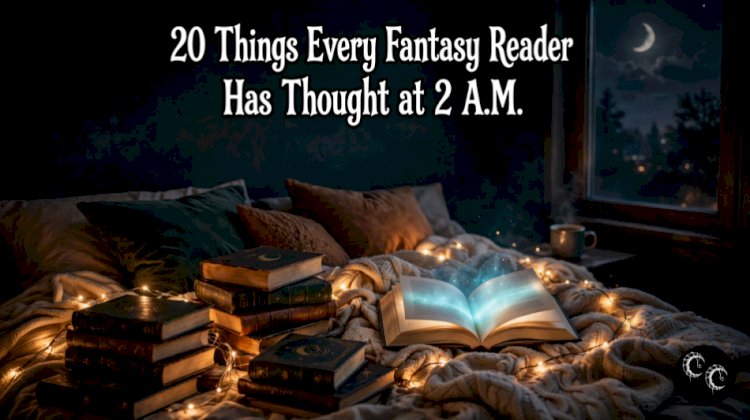
There is a very specific kind of magic that happens when you're reading a fantasy novel late at night. The house is quiet, your eyes are getting heavy, and you promised yourself three chapters ago that you would go to sleep after this one. Yet here you are, emotionally attached to a fictional kingdom, suspicious of a character who smiled a little too innocently, and absolutely convinced that the author is hiding something important in a sentence on page 47.
Fantasy readers know the struggle. We don't simply read books. We move into imaginary worlds, adopt fictional people as family, and occasionally consider whether we'd survive for more than five minutes in a universe where dragons exist.
And at 2 A.M.? All logic disappears.
Here are 20 thoughts every fantasy reader has probably had while sacrificing a perfectly reasonable bedtime for one more chapter.
1. "I Could Absolutely Live in This Fantasy World."
Look at those enchanted forests! The magnificent castles! The little villages with magical bakeries and mysterious shops selling potions!
Suddenly, your ordinary life feels painfully lacking in wonder. Why do you have to pay bills when you could be wandering through a medieval market, searching for a rare spell book and befriending a suspiciously intelligent fox?
Of course, you are conveniently forgetting that this world also contains murderous monsters, political assassinations, dangerous magic, and approximately seventeen ways to die before breakfast.
But the scenery is gorgeous, so you're willing to overlook a few minor inconveniences.
2. "I Would Have Figured Out That the Villain Was Evil."
You noticed the suspicious behavior. You questioned the mysterious backstory. You even highlighted the strangely ominous sentence that everyone else seemed to ignore.
Obviously, you would have figured it out.
Never mind that the villain was charming, helpful, and apparently committed to saving the kingdom. You saw through the deception immediately.
Well, you saw through it approximately three chapters after the protagonist trusted them with everything, but that is completely beside the point.
You are now convinced that if you ever enter a fantasy novel, you'll be the one person who survives because you trust absolutely nobody.
3. "Why Is Everyone Ignoring the Obvious Prophecy?"
The ancient prophecy has been mentioned twelve times. The mysterious symbols appeared in the first chapter. The protagonist keeps having strange dreams, and every character with magical knowledge looks deeply concerned whenever anyone brings them up.
Yet somehow, nobody is connecting the dots.
Meanwhile, you're lying in bed with your book practically pressed against your face, mentally rearranging every sentence to uncover its hidden meaning.
The chosen one is clearly connected to the lost heir. The lost heir is probably connected to the forbidden magic. And the forbidden magic is almost certainly connected to that strange little object introduced before chapter five.
You have a theory.
You have several theories, actually.
And you will be personally offended if the author proves every single one of them wrong.
4. "I Can Fix the Villain."
Ah, yes. The classic fantasy reader delusion.
This character has committed unspeakable crimes, betrayed their closest allies, and probably destroyed at least one village. But they have beautiful eyes, a tragic childhood, and a habit of looking vaguely miserable whenever nobody is watching.
Clearly, all they need is someone who understands them.
You are prepared to volunteer.
Their redemption arc is going to be spectacular. Their emotional growth will be breathtaking. Their eventual apology will be so sincere that you'll forgive them for things you would never tolerate from a real person.
And if they happen to be enemies with the protagonist? Even better.
You have already imagined six scenes in which they argue, develop inconvenient feelings, and slowly discover that perhaps they aren't so different after all.
The author has not promised you a redemption arc.
You have decided it exists anyway.
5. "If This Character Dies, I Am Never Recovering."
You knew the risks when you started reading a fantasy series. There are wars, dangerous quests, forbidden magic, and characters who keep saying things like, "When this is all over, we'll finally rest."
That last sentence should have been a warning.
Now your favorite character is walking into a suspiciously dangerous situation, and you're beginning to panic.
They have a tragic backstory. They have unresolved feelings. They just made a joke about surviving the battle.
Absolutely not.
You are mentally preparing a strongly worded letter to the author, even though the character is still alive and you haven't finished the chapter.
You might be overreacting.
But just in case, you're emotionally saying goodbye now.
6. "Why Does Nobody Talk About the Worldbuilding Enough?"
Forget the romance for a moment. Forget the dramatic betrayal.
You want to know how the kingdom actually works.
Who collects taxes? How do magical laws operate? What happens when someone accidentally sets their kitchen on fire with an illegal spell? Do dragons have legal rights? Is there a licensing system for enchanted weapons?
And, perhaps most importantly, how does the economy function when people can teleport?
You came for an adventure, but now you're mentally designing the political structure of a fictional empire.
The author gave you three paragraphs about the royal council, and you have somehow turned them into a twenty page research project.
You regret nothing.
7. "I Would Definitely Be the Side Character Who Knows Too Much."
Let's be honest. You probably wouldn't be the chosen one.
You don't particularly want to fight an ancient evil, carry a cursed artifact, or discover that your mysterious birthmark means you're destined to save the universe.
You would rather be the slightly eccentric librarian who knows where the forbidden books are kept.
You'd offer the protagonist a cup of tea, provide one suspiciously specific piece of information, and return to your reading while the kingdom descends into chaos.
Occasionally, you'd make a sarcastic comment about the royal family.
Honestly, that sounds like a much better life than being hunted by an immortal sorcerer.
8. "There Is No Way That Character Is Actually Dead."
You have reached the scene.
The dramatic confrontation has happened. The character has fallen. Someone is crying. The narration has become unbearably emotional.
And yet, you refuse to believe it.
There was no body, was there?
Even if there was, you are prepared to question the circumstances. Perhaps the magic system allows resurrection. Maybe someone switched identities. Perhaps the character has a secret twin who has never been mentioned in the entire series.
You are not in denial.
You are simply aware that fantasy authors are sneaky.
You turn the page with the cautious optimism of someone who has already written three possible explanations for an impossible survival.
9. "The Map Is Probably More Important Than I Think."
You know that map at the beginning of the book?
The one you glanced at briefly before starting chapter one?
You are now studying it like an investigator examining evidence at a crime scene.
Why is that mountain range shaped so strangely? Why does the river stop at the edge of the map? What is that tiny island nobody has mentioned? Why is there an unexplored region in the north?
Surely none of these details are accidental.
You zoom in on the illustration, mentally calculate travel distances, and wonder whether the protagonist could reach the mysterious ruins before the next full moon.
You have become the kingdom's unofficial cartographer.
And you still haven't finished the chapter.
10. "I Need to Know What Happens, but I Don't Want the Book to End."
This is one of the cruelest contradictions in reading.
You desperately need answers. Who betrayed the royal family? Will the protagonist master their magic? Is the mysterious stranger actually the missing prince?
You need to know everything immediately.
But you also know that every page brings you closer to the end.
And what happens when you finish?
You have to leave the world.
The characters will stop having new conversations. The kingdom will no longer surprise you. That cozy little corner of the fictional universe you've been visiting every night will suddenly feel very far away.
So you read faster, then slower, then faster again.
You are simultaneously trying to finish the book and preserve it forever.
11. "Why Is the Forbidden Library Always Locked?"
Every fantasy world has one.
A mysterious library containing ancient knowledge, dangerous spells, forgotten histories, and probably the answer to every question the protagonist has ever asked.
Naturally, it is forbidden.
Naturally, there are approximately nine guards stationed outside.
Naturally, the protagonist will eventually break in.
And naturally, you are already planning your own visit.
You would be extremely careful, of course. You'd take notes, respect the ancient manuscripts, and definitely avoid touching anything glowing ominously on a pedestal.
You'd also spend six hours reading the books nobody else has bothered to open.
Honestly, you would probably forget why you came in the first place.
12. "That Minor Character Is Definitely Going to Betray Everyone."
They have appeared in four scenes.
They have said approximately twelve sentences.
They have been unfailingly polite, helpful, and suspiciously interested in the protagonist's plans.
You do not trust them.
Not even a little.
The more everyone else praises their loyalty, the more convinced you become that they're secretly working for the enemy. Perhaps they have a hidden connection to the royal family. Maybe they're using the protagonist to obtain a powerful artifact.
Or maybe they're simply a nice person who happens to work in the palace.
No.
You have highlighted their dialogue and written a question mark in the margin.
When the betrayal finally happens, you will be insufferable.
When it doesn't, you will quietly pretend you never suspected anything.
13. "I Could Learn Magic If Someone Would Just Give Me a Spellbook."
Surely magical ability is mostly a matter of practice.
You can learn complicated recipes, remember fictional family trees, and follow a story with seventeen competing kingdoms. How difficult could a few spells possibly be?
You would begin with something simple. Lighting a candle. Floating a book. Summoning a cup of tea directly into your hand.
Nothing dangerous.
Then, naturally, you would become curious about the more advanced spells.
Before long, you're imagining an entire magical education, complete with enchanted notebooks, a private study, and a mentor who disapproves of your habit of asking too many questions.
The fact that you have never demonstrated any magical ability does not concern you.
You simply haven't found the right spellbook yet.
14. "The Main Couple Needs to Communicate."
They have survived assassins, escaped an enchanted prison, fought an army of monsters, and crossed a frozen wasteland together.
But apparently, telling each other how they feel is impossible.
One character assumes the other doesn't care. The other character is convinced their feelings would be a burden. Both are miserable, and neither seems capable of asking one simple question.
You are exhausted.
You want to reach into the book, place them both in a room, and refuse to let them leave until they have a sensible conversation.
You have drafted their dialogue in your head.
You have identified the exact moment when everything could have been resolved.
You are now more emotionally invested in their communication skills than the fate of the kingdom.
And if they finally confess their feelings three pages before the book ends?
You will scream into your pillow.
15. "I Would Absolutely Adopt That Magical Creature."
The protagonist has encountered a small, mysterious creature with glowing eyes, tiny wings, and a tendency to steal shiny objects.
Everyone else is concerned.
You are already choosing a name.
It doesn't matter that the creature might be poisonous. It doesn't matter that it lives in an enchanted forest full of dangerous predators. It doesn't matter that the protagonist has been warned repeatedly not to approach it.
Look at its little face.
Obviously, it needs a home.
You are now imagining a comfortable nest, a collection of tiny toys, and a special place for it to sleep beside your bed.
You have also decided that the creature will eventually save the entire kingdom.
It will be adorable, heroic, and extremely well loved.
16. "The Author Cannot Possibly Leave Me on This Cliffhanger."
You have reached the final page of a chapter.
The protagonist has just discovered a devastating secret. Someone has opened a mysterious door. A familiar character has said something that changes absolutely everything.
And then the chapter ends.
You stare at the page.
You look at the clock.
You remember that you have responsibilities in the morning.
You turn the page anyway.
This is not a decision. It is a reflex.
You could stop reading, but then you'd have to spend the next several hours wondering what happens. You could go to sleep, but your brain would simply recreate the scene in increasingly dramatic variations.
There is only one solution.
One more chapter.
You know how this ends, and yet you continue to participate in your own downfall.
17. "I Need to Know the Entire History of This Ancient Curse."
The curse has been mentioned once.
One character made a vague reference to an old legend, and another immediately changed the subject.
That's all it took.
You are now convinced that the curse is central to the entire story.
Who created it? Why does it affect certain families? Can it be broken? Does it have anything to do with the strange dreams the protagonist keeps having?
You want ancient records, historical accounts, contradictory legends, and at least one extremely suspicious footnote.
A single paragraph of exposition will not satisfy you.
You need the full history, including the political consequences, the original spellcaster's childhood, and what everyone was eating at the time the curse was created.
If the author releases a companion book containing three hundred pages of fictional history, you will buy it immediately.
18. "This Would Be So Much Easier If Everyone Had a Group Chat."
Imagine the possibilities.
The royal council could coordinate their plans without sending messengers across the kingdom. The protagonist could warn their friends about the approaching army. The mysterious mentor could explain the prophecy without speaking in riddles for forty consecutive minutes.
And the romantic leads?
They could simply send a message instead of disappearing into the woods whenever an honest conversation becomes necessary.
Of course, there would be problems.
Someone would leak the secret battle plans. The villain would somehow gain access to the group chat. The dragon would accidentally set the communication device on fire.
Still, you feel strongly that a little modern technology would solve at least half the plot.
You are not trying to ruin the atmosphere.
You are trying to save everyone approximately six chapters of unnecessary confusion.
19. "I Should Probably Start the Next Book Immediately."
The first book has ended.
You are emotionally devastated, deeply satisfied, and somehow more confused than when you began.
There are still unanswered questions. The villain has escaped. The protagonist has discovered a new power, and the final chapter introduced a mysterious figure who appears to know everything.
Naturally, you need the sequel.
Immediately.
It doesn't matter that the next book is considerably longer. It doesn't matter that you have other books waiting on your shelf. It doesn't matter that your sleep schedule has become a distant memory.
You need answers.
You need closure.
You need to know whether the protagonist is going to survive the next installment, even though you already suspect the author is planning something terrible.
You open the sequel.
The first sentence introduces a new mystery.
You sigh.
You keep reading.
20. "Maybe I Should Just Live in a Library Forever."
At some point during a particularly good fantasy novel, you begin to wonder whether a quiet life surrounded by books might be the ultimate dream.
A library with enormous windows, comfortable reading chairs, endless shelves, and a small enchanted fireplace sounds wonderful.
Perhaps there's a secret room containing rare manuscripts. Perhaps the librarian knows every forgotten legend. Perhaps the building rearranges itself depending on what you're looking for.
You could spend your days reading, drinking tea, and occasionally helping a lost adventurer find the right volume of ancient spells.
There would be no deadlines, no awkward small talk, and absolutely no need to explain why you stayed awake until 2 A.M. reading about a fictional war.
Then you remember that you're already living a version of this dream, just without the enchanted fireplace.
You pull your blanket a little closer, open the next chapter, and decide that tomorrow's responsibilities can wait another ten minutes.
Probably.
Final Thoughts
Being a fantasy reader means carrying entire worlds around in your imagination. It means becoming emotionally invested in characters who don't exist, worrying about kingdoms that aren't real, and developing suspiciously detailed opinions about the best way to defeat a fictional dark lord.
It also means occasionally looking at the clock at 2 A.M. and wondering how you managed to read another hundred pages without noticing.
But that's part of the magic.
A great fantasy story gives you somewhere to escape, someone to root for, and a thousand little mysteries to unravel. It makes ordinary evenings feel extraordinary and turns a simple book into a place you can visit whenever you need a little wonder.
And honestly, if staying up too late means discovering a new favorite character, solving a prophecy before the protagonist does, or finding a fictional dragon you would absolutely adopt, maybe the occasional lost hour isn't such a terrible price to pay.
Just remember to set the book down eventually.
The kingdom will still be in danger tomorrow.
And knowing fantasy authors, things will probably be even worse.