How Pokémon Types Reflect Real Biology and Chemistry
 Cordelia Cross
Oct 30, 2025 05:45
0
Cordelia Cross
Oct 30, 2025 05:45
0
Pokémon are often thought of as fantastical creatures with abilities that defy natural laws, yet a closer look reveals that their types reflect underlying principles of biology, chemistry, and ecology. Fire, Water, Grass, Electric, Poison—each type corresponds to traits or behaviors observed in the natural world. Exploring these connections shows how Pokémon, while fictional, draw inspiration from scientific concepts.
Fire-type Pokémon are perhaps the most obvious example. Their association with heat, combustion, and energy mirrors real-world biology and chemistry. Certain organisms, like bombardier beetles, produce heat and chemical reactions for defense, while fire-adapted plants rely on controlled burning to reproduce. Biochemistry explains how exothermic reactions release energy, which can be imagined as the basis for fire-based attacks in Pokémon. Even dragons and salamanders in folklore have biological analogs that inspire these fiery traits.
Water-types reflect fluid dynamics and aquatic adaptations. Fish, amphibians, and marine mammals exhibit specialized physiology for swimming, respiration, and thermal regulation. Water-type moves like Surf or Hydro Pump can be interpreted as exaggerated depictions of fluid mechanics, where controlled movement of water generates force. Osmoregulation, hydrodynamics, and pressure adaptation provide a scientific lens for understanding why Water-types are effective in aquatic environments.
Grass-types correspond to plants and photosynthetic organisms, highlighting principles of energy conversion and ecological interactions. Moves like Vine Whip or Leaf Blade reflect physical structures in plants—flexible yet strong stalks and leaves—that can exert mechanical force. Photosynthesis explains energy acquisition, while secondary metabolites such as toxins or flavors correspond to Poison-type traits. Grass-types often occupy defensive or supportive roles, reflecting the foundational ecological importance of plants.
Electric-types draw directly from physics. The storage and discharge of electrical energy in Pokémon like Pikachu echoes how bioelectric organisms, such as electric eels, generate voltage through specialized cells called electrocytes. Conductivity, voltage gradients, and energy transfer all underlie Electric-type abilities. Even lightning-based moves can be seen as an imaginative amplification of natural electrical phenomena, grounded in the principles of energy and charge movement.
Poison and Bug types illustrate chemistry and biological defense mechanisms. Many insects produce toxins or irritating compounds to deter predators, while plants synthesize alkaloids, cyanogenic glycosides, or other chemicals for survival. Poison-type moves mimic these biochemical defenses, and Bug-types often combine physical and chemical strategies, echoing real-world predator-prey dynamics. The interplay between offense and defense in these Pokémon reflects evolutionary pressures observed in nature.
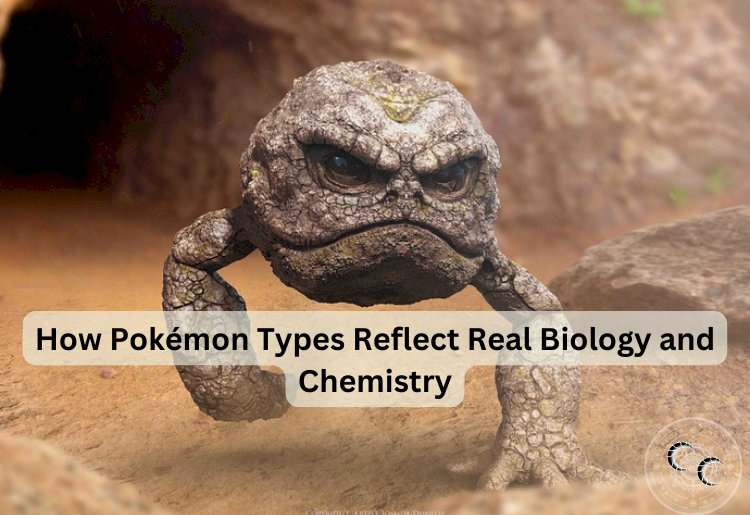
Rock, Ground, and Steel-types reveal insights from geology and materials science. Their durability, density, and resistance mirror physical properties of minerals and metals. Ground-types reflect organisms that burrow or manipulate soil, while Steel-types evoke metallic structures with high tensile strength. These types highlight the ways natural and synthetic materials influence survival strategies and structural adaptations.
Finally, the interactions between types mirror ecological principles. Fire is strong against Grass but weak against Water; Electric is strong against Water but weak against Ground. These relationships reflect real-world interactions: predators exploit vulnerabilities, chemical reactions have reactivity rules, and environmental factors determine competitive advantage. Type matchups, while simplified, mimic energy flow, ecological balance, and cause-and-effect patterns observed in biology and chemistry.
In essence, Pokémon types are not arbitrary. They encode lessons about physiology, chemistry, and ecology, translating scientific principles into imaginative gameplay. Each type embodies traits drawn from real organisms, energy systems, or material properties, while their interactions illustrate broader ecological dynamics.
By viewing Pokémon through a scientific lens, players can appreciate the thoughtful connections between fantasy and reality. Types, moves, and weaknesses are more than game mechanics; they are stylized reflections of natural laws, evolutionary strategies, and chemical interactions. Pokémon may inhabit a world of magic and imagination, but their foundation rests firmly in the patterns and principles of the real world.