Teleportation in D&D vs. Quantum Physics
 Cordelia Cross
Sep 12, 2025 04:43
0
Cordelia Cross
Sep 12, 2025 04:43
0
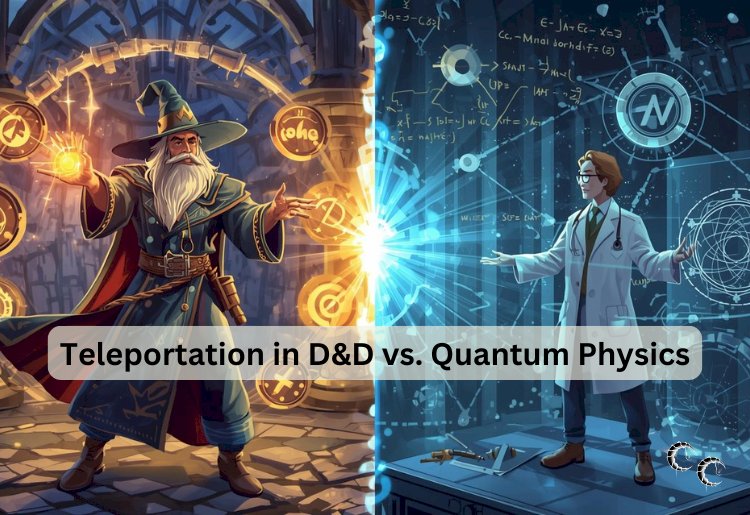
Teleportation is one of the most alluring spells in Dungeons & Dragons. With a word or gesture, a character disappears from one location and instantly reappears in another, bypassing walls, chasms, and entire landscapes. The fantasy is exhilarating, yet it sparks a deeper question: could such instantaneous movement ever make sense in the framework of real-world physics, particularly quantum mechanics? Exploring teleportation through the lens of science reveals fascinating parallels, limitations, and imaginative possibilities.
In D&D, teleportation is portrayed as a precise, controlled displacement. Characters retain their physical integrity, memories, and equipment without harm. This resembles the concept of quantum teleportation, which, in physics, involves transmitting the state of a particle from one location to another without physically moving the particle itself. Quantum teleportation relies on entanglement, a phenomenon where particles share a linked state, and measurement, which allows the reconstruction of information at a distant location. While in reality this applies only to subatomic particles, the conceptual similarity to magical teleportation is striking.
The energy requirements of teleportation are another critical factor. Moving matter instantaneously would demand immense energy if approached as a literal disassembly and reassembly of atoms. Each human body contains approximately 7 × 10^27 atoms, each with unique positions and quantum states. Reconstructing them perfectly at a new location without error is far beyond current technological capabilities. In D&D, magic bypasses these limitations; the spell acts as a mechanism that preserves continuity and integrity without the need for conventional energy or molecular precision.
Accuracy and risk are inherent in both magical and scientific teleportation. In D&D, errors occur if the caster lacks knowledge of the destination, leading to misplacement or catastrophic outcomes. In quantum physics, teleportation fidelity is limited by noise, decoherence, and imperfect measurements, meaning that information transfer is never perfectly guaranteed. Both systems highlight the importance of precise control and knowledge; magical teleportation emphasizes intention and familiarity, while quantum teleportation emphasizes entanglement quality and measurement accuracy.
Constraints on teleportation further illustrate parallels. Spells in D&D often have limits: range, the size of the creature or object, or environmental interference. Similarly, quantum teleportation is constrained by distance, the necessity of classical communication to reconstruct information, and the requirement for an established entangled state. The resemblance between magical and scientific constraints underscores a shared principle: even the most extraordinary movement is bounded by rules, whether those rules are mystical or physical.
Teleportation also raises questions about identity and continuity. In D&D, characters experience no interruption in consciousness. In physics, true quantum teleportation of a macroscopic object would involve destruction of the original and reconstruction at a distant location, raising philosophical concerns about whether the reassembled entity is truly the same individual. Magic sidesteps this dilemma, preserving both body and mind, offering a narrative convenience that maintains player agency and immersion while sidestepping real-world paradoxes.
Environmental interactions are another consideration. Teleportation can bypass obstacles, terrain, and hazards in D&D, yet it does not circumvent the broader context of the physical world. Similarly, in quantum mechanics, teleportation does not transport matter through space; it transmits information that allows reconstruction, meaning that the underlying medium still plays a crucial role. Understanding these distinctions illuminates both the limits of magic and the subtle elegance of physics, showing how each system frames the impossible in its own terms.
Ultimately, teleportation bridges imagination and scientific curiosity. While magical teleportation in D&D operates without concern for energy, molecular precision, or entanglement, quantum physics offers a glimpse into the principles that could make such phenomena conceivable at a fundamental level. Both invite reflection on movement, space, and the limits of knowledge. Players and scientists alike are drawn to teleportation because it challenges intuition, stretches the imagination, and transforms our understanding of presence and displacement.
Teleportation remains a compelling concept precisely because it sits at the intersection of fantasy and reality. In D&D, it is a tool, a narrative device, and a spectacle. In quantum physics, it is a rigorous exploration of information, state, and entanglement. Comparing the two illuminates the tension between possibility and impossibility, showing how magic can simplify what science approaches with complexity. It is a reminder that some of the most thrilling ideas in gaming and physics are those that stretch our minds while respecting rules, whether written by wizards or by the universe itself.