How to Write a Villanelle: Structure, Repetition, and Examples
 Cordelia Cross
Aug 15, 2026 03:27
0
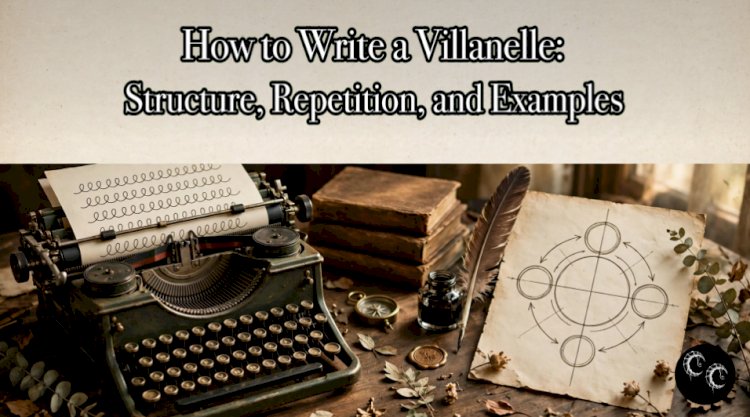
A villanelle is a nineteen line poem with a specific pattern of rhymes and repeated lines. It consists of five three line stanzas called tercets, followed by one four line stanza called a quatrain.
The defining feature is its two alternating refrains. These are two lines that return throughout the poem, creating a circular, almost songlike effect.
The form originated from French poetic traditions, although the highly structured villanelle familiar to modern readers developed over time. Today, it is especially associated with poems that explore powerful emotions and ideas that seem to resist resolution.
A villanelle can feel musical, obsessive, mournful, playful, or even unsettling. Its repetition makes it particularly effective when a speaker is wrestling with a thought they cannot escape.
Think of it as a poem that keeps coming back to the same two ideas, but each time, the surrounding lines change what those ideas mean.
1. Understand the Villanelle's Structure

The villanelle follows a precise structure, but you do not need to memorize everything immediately. Start with the basic pattern.
-
19 lines total
-
Five tercets, each containing three lines
-
One final quatrain, containing four lines
-
Two refrains, traditionally called A1 and A2
-
Two rhyme sounds, usually represented as A and B
The rhyme scheme is:
ABA / ABA / ABA / ABA / ABA / ABAA
Here is what that means in practice:
|
Stanza |
Rhyme pattern |
Repeated lines |
|---|---|---|
|
Tercet 1 |
ABA |
Lines 1 and 3 introduce the refrains |
|
Tercet 2 |
ABA |
A1 returns |
|
Tercet 3 |
ABA |
A2 returns |
|
Tercet 4 |
ABA |
A1 returns |
|
Tercet 5 |
ABA |
A2 returns |
|
Final quatrain |
ABAA |
Both refrains return at the end |
The first line of the poem becomes the first refrain, or A1. The third line becomes the second refrain, or A2.
These two lines alternate as the final lines of the following tercets. In the concluding quatrain, both refrains appear again, with A1 repeated as the final line.
It is this carefully controlled pattern that gives the villanelle its distinctive rhythm.
2. Choose Your Two Refrains Carefully

Your refrains are the heart of your villanelle. Because each one appears several times, they need to be memorable enough to survive repetition without becoming meaningless.
A good refrain often expresses a central conflict, a desire, a fear, or a belief that the speaker cannot quite resolve.
For example, imagine writing a poem about memory.
Your first refrain might be:
The house remembers what I have forgotten.
Your second refrain might be:
The wind still whispers through the empty room.
Both lines establish a mysterious atmosphere. They also leave plenty of room for interpretation as the poem develops.
Or perhaps you want to write about ambition:
I chase the dawn beyond the hill.
The morning waits beyond my reach.
These lines suggest longing, distance, and persistence. As the poem progresses, the surrounding lines can make the speaker seem hopeful, desperate, determined, or exhausted.
When choosing refrains, ask yourself three questions:
-
Can this line carry more than one meaning?
-
Does it sound natural when spoken aloud?
-
Will its meaning deepen or change as the poem progresses?
Avoid choosing a line solely because it rhymes beautifully. You will repeat it many times, so it needs emotional and musical staying power.
3. Learn the Repetition Pattern
The villanelle's repetition pattern can look confusing on paper, but it becomes much easier when you see how the refrains move through the poem.
Here is the traditional arrangement:
Tercet 1
A1
B
A2
Tercet 2
B
A1
B
A2
Tercet 3
A
B
A1
A2
That simplified display is not the actual line arrangement, so let's make the complete pattern clearer with a numbered guide.
|
Line |
What belongs there |
|---|---|
|
1 |
A1 |
|
2 |
B rhyme |
|
3 |
A2 |
|
4 |
A rhyme |
|
5 |
B rhyme |
|
6 |
A1 |
|
7 |
A rhyme |
|
8 |
B rhyme |
|
9 |
A2 |
|
10 |
A rhyme |
|
11 |
B rhyme |
|
12 |
A1 |
|
13 |
A rhyme |
|
14 |
B rhyme |
|
15 |
A2 |
|
16 |
A rhyme |
|
17 |
B rhyme |
|
18 |
A1 and A2 |
|
19 |
A2 and A1, with A1 as the final line |
The key thing to remember is that the two refrains alternate through the five tercets, then meet in the final quatrain.
More precisely, the correct traditional pattern is:
-
Tercet 1: A1, b, A2
-
Tercet 2: a, b, A1
-
Tercet 3: a, b, A2
-
Tercet 4: a, b, A1
-
Tercet 5: a, b, A2
-
Quatrain: a, b, A1, A2
The uppercase letters represent the repeated refrain lines, while lowercase letters represent other lines that follow the same rhyme sounds.
One important correction to the numbered guide above: the final quatrain ends with A1 and A2, in that order. If you are learning the form, follow this stanza pattern rather than trying to memorize every line number separately.
4. Choose Your Rhyme Sounds

A villanelle traditionally uses only two rhyme sounds throughout the poem. That restriction can be challenging, especially if you want your writing to sound natural rather than like a rhyming exercise.
Start by choosing two sounds that suit the mood of your poem.
For a poem about loss, you might choose the A rhyme sound found in light, night, and flight, paired with a B rhyme sound such as name, flame, and same.
For a poem about uncertainty, you could use A words such as door, more, and shore, with B words such as rain, remain, and again.
Before you start drafting, create a small rhyme bank.
|
A rhyme |
B rhyme |
|---|---|
|
light |
rain |
|
night |
remain |
|
flight |
again |
|
sight |
stain |
|
bright |
refrain |
|
height |
chain |
Not every word in your rhyme bank needs to appear in the finished poem. The point is to give yourself options before you get halfway through a stanza and discover that your only remaining rhyme is something like poltergeist.
Also, perfect rhymes are not the only consideration. The words should fit your poem's meaning and sound natural when read aloud. A forced rhyme can pull a reader out of an otherwise beautiful moment.
5. Write the Supporting Lines Around Your Refrains

Once you have your refrains and rhyme sounds, you can begin building the rest of the poem.
The supporting lines should develop the poem's ideas instead of merely filling spaces between repeated phrases.
Imagine that your first refrain is:
The garden keeps the secrets of the dead.
And your second refrain is:
Beneath the roses, nothing disappears.
You might begin with an image of an overgrown garden, then gradually introduce clues about the past. Perhaps a broken gate suggests abandonment. Perhaps the roses have grown over a forgotten path. Perhaps the speaker is returning to a place they once tried to escape.
Each stanza should add something new, even though the refrains remain unchanged.
A useful progression might look like this:
-
Stanza 1: Introduce the setting and the central mystery.
-
Stanza 2: Suggest what has been lost or concealed.
-
Stanza 3: Reveal the speaker's personal connection.
-
Stanza 4: Increase the emotional tension.
-
Stanza 5: Complicate what the speaker believes.
-
Final quatrain: Bring the central conflict to an emotional or thematic turning point.
You do not have to follow this progression exactly. A villanelle about joy, obsession, nature, or a humorous everyday frustration might develop in a completely different way.
What matters is that the poem moves forward emotionally, even as its language circles back.
6. Read a Famous Villanelle
One of the most famous examples of the form is Do Not Go Gentle into That Good Night by Dylan Thomas.
The poem uses two refrains that urge resistance against death and passivity. As the poem progresses, the repeated lines gather emotional force, particularly because the speaker's plea becomes increasingly personal.
Thomas demonstrates an important lesson: repetition works best when the emotional context changes around it.
The refrain does not need to change its wording to change its meaning. A line can sound like a general statement in the opening stanza and feel like a desperate plea by the end.
Another well known example is One Art, by Elizabeth Bishop. It explores loss through a recurring statement that initially sounds controlled and almost reassuring. As the poem develops, that composure becomes increasingly complicated.
Both poems show that a villanelle can use formal precision to explore emotional instability.
7. An Original Villanelle Example
Here is an original example that demonstrates the form. It explores the feeling of waiting for someone who may never return.
The Light Beneath the Door
The house grows quiet as the evening falls, A restless wind moves softly through the trees, I hear your footsteps whisper in the halls.
The clock repeats its warning from the walls, The curtains stir without a passing breeze, The house grows quiet as the evening falls.
I trace the faded writing on the walls, And hold my breath at every creaking breeze, I hear your footsteps whisper in the halls.
The moonlight climbs the staircase, pale and small, The shadows gather underneath the eaves, The house grows quiet as the evening falls.
I tell myself I never cared at all, Yet still I wait beside the silent trees, I hear your footsteps whisper in the halls.
Perhaps the years have changed these empty halls, Perhaps the heart believes what it perceives, The house grows quiet as the evening falls, I hear your footsteps whisper in the halls.
Notice how the repeated lines create a circular feeling. The speaker's surroundings remain familiar, but the emotional tension grows as the poem continues.
The refrain about the house becoming quiet sounds like a description at first. By the end, it feels more like a reluctant acknowledgment that the person the speaker awaits may never come back.
The repeated footsteps become similarly ambiguous. Are they real, remembered, or imagined? The form allows that uncertainty to linger.
8. Common Villanelle Mistakes to Avoid
Writing within a strict form takes practice, and a few problems tend to appear when you are getting started.
Forcing the rhyme. If you are twisting your sentences into unnatural shapes just to fit a rhyme, reconsider your word choices. A rhyme should support the thought, not control it completely.
Repeating lines without developing the idea. Refrains should gain emotional or thematic depth as the poem progresses. If every stanza says exactly the same thing in exactly the same emotional register, the repetition may become monotonous.
Ignoring the poem's natural rhythm. A villanelle does not have to follow a single meter in every example, but reading it aloud will help you notice awkward phrasing and unintended stumbling points.
Overexplaining the central emotion. Trust your images. A poem about grief does not need to announce that the speaker is grieving in every stanza. A half empty room, a familiar scent, or an untouched cup can communicate just as much.
Treating the structure as more important than the poem. The form matters, but the purpose of the form is to serve the writing. If your poem is technically correct but emotionally lifeless, keep revising.
9. A Simple Exercise for Writing Your First Villanelle
If you want to try writing one yourself, begin with a small, manageable subject. Choose an idea that naturally invites repetition, such as waiting for a message, remembering a childhood home, fearing change, or trying to let go of an old regret.
Then follow these steps:
-
Write two possible refrain lines.
-
Choose your two rhyme sounds and create a rhyme bank.
-
Copy the traditional stanza pattern into your notebook.
-
Draft the supporting lines, focusing on images and emotional progression.
-
Read the poem aloud and revise any lines that feel forced.
-
Check that all nineteen lines follow the correct pattern.
Do not worry if your first attempt feels awkward. A villanelle asks you to solve several problems at once, and your first draft is where you discover which parts of the puzzle need attention.
You can even write the poem in prose first, identify its two strongest recurring statements, and then reshape the material into the villanelle structure.
The goal is not to prove that you can obey a set of rules. It is to discover what those rules allow you to express.
Final Thoughts
A villanelle is a poem about returning. It returns to words, to sounds, to memories, and to the thoughts that keep finding their way back into our minds.
Its strict structure can feel restrictive at first, but that limitation can become a creative advantage. By returning to the same two lines, you give the reader a chance to experience how meaning changes through context, emotion, and time.
Start with two lines that matter to you. Give them room to breathe. Let the surrounding stanzas challenge them, deepen them, or reveal something you did not initially understand.
And when you reach the final refrain, ask yourself one last question: does the repeated line mean the same thing now that it did when the poem began?
If the answer is no, you may have found the heart of your villanelle.