Writer's Block Memes for Anyone With an Unfinished Manuscript
 Cordelia Cross
Aug 12, 2026 03:21
0
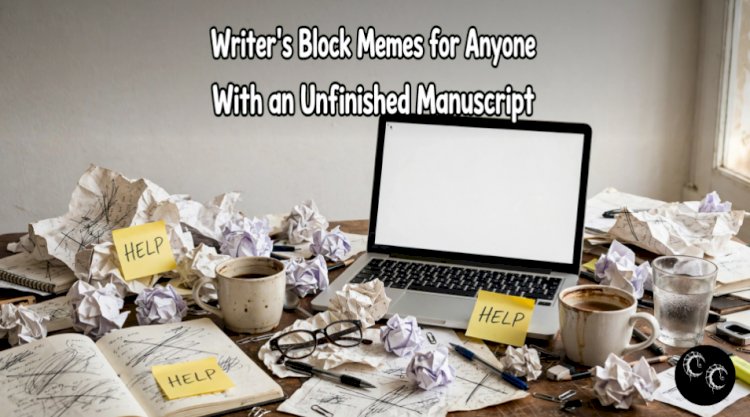
There are two kinds of writers in this world: writers who are working on their manuscripts and writers who are thinking about working on their manuscripts while reorganizing their entire bookshelves, researching medieval candle-making techniques, and watching one very important video about how ravens behave in winter.
If you have an unfinished manuscript gathering digital dust in a folder named FINAL DRAFT ACTUALLY FINAL, welcome. You are among friends.
Writer's block has a special talent for turning a perfectly reasonable writing session into a three hour existential crisis. One minute, you are excited about your characters and their beautiful, carefully plotted journey. The next, you are staring at a blinking cursor as though it personally betrayed you.
And because sometimes the only way to survive the writing process is to laugh at it, here are some writer's block memes for anyone who has ever abandoned a manuscript temporarily, permanently, or just long enough to start a completely different novel.
1. The Blinking Cursor of Doom

The meme:
Me: Today, I will write 2,000 words.
My laptop, displaying a blank document: Interesting. Tell me more about this ambition.
There is nothing quite as intimidating as a blank page when you know exactly how much you want to write and absolutely none of the words are cooperating.
You have the plot. You have the characters. You even have a playlist specifically designed to make you feel like a tortured literary genius.
And yet, the cursor continues blinking.
Mocking you.
Judging you.
Possibly unionizing against you.
The worst part is that you can spend an entire afternoon thinking about your story without actually putting a single sentence into the document. In your head, the prose is gorgeous. On the screen, it is one unfinished paragraph and a typo you have somehow read seventeen times without noticing.
2. When Research Becomes Your Entire Personality

The meme:
Me: I need to write the next chapter.
Also me, four hours later: I now know the exact migration patterns of medieval European ravens.
Research is a wonderful tool for writers. Unfortunately, it is also an extremely convenient hiding place.
You begin with a quick question about historical clothing. That leads to a search about fabric production, which leads to medieval trade routes, which somehow leads you to a fascinating discussion about eighteenth century funeral customs.
Meanwhile, your protagonist is still standing in a doorway waiting for you to finish the sentence you abandoned yesterday.
But surely the chapter cannot continue until you understand the precise historical context of the character's breakfast.
Surely.
The manuscript will be grateful for your dedication someday. Probably.
3. The Sudden Urge to Rewrite Chapter One

The meme:
Me, 40,000 words into my novel: I should probably fix that opening paragraph.
Me, six hours later: I have rewritten the first chapter, changed the protagonist's name, and somehow made the entire plot worse.
Writers have a special relationship with beginnings. They are familiar, comfortable, and full of possibilities. You already know what happens in chapter one, so revising it feels productive.
Writing chapter seventeen, on the other hand, requires confronting the terrifying possibility that you have no idea how to get your characters out of the situation you put them in.
So naturally, you return to the opening.
Again.
You adjust a sentence. Then a paragraph. Then the entire opening scene. Before long, your manuscript has three different versions of the first chapter and a middle section that has not been touched since the previous season.
At this point, your opening chapter has received more attention than some bestselling novels.
Your ending would like a word.
4. When Your Characters Refuse to Cooperate

The meme:
Me: You have three options, and all of them move the plot forward.
My main character: What if I made a terrible decision that creates twelve new problems instead?
Sometimes your characters feel less like imaginary people and more like unruly houseguests who have taken over your manuscript.
You outline a sensible plan. Your protagonist ignores it.
You arrange a perfectly timed romantic confession. Your love interest decides this is an excellent moment to discuss the weather.
You introduce a suspicious stranger who is supposed to reveal an important clue. Your protagonist immediately trusts them for absolutely no reason.
And now you have forty pages of consequences to untangle.
The truly ridiculous part is that you may find yourself defending your characters' decisions. Yes, the protagonist made an objectively terrible choice, but you understand why they did it. No, they cannot simply apologize and move on because they have emotional baggage, complicated motivations, and seventeen chapters of personal history.
You created these people.
You are also apparently their exhausted parent.
5. The Magical Word Count Disappearing Act

The meme:
Yesterday: 1,500 beautiful new words.
Today: Deleted 1,700 words because apparently I cannot be trusted with language.
Few experiences are more humbling than watching your word count go backward.
You sit down intending to add a scene, reread the previous chapter, decide the dialogue is terrible, delete two paragraphs, rewrite them, dislike the rewrite, and eventually remove the entire scene.
Your word count has dropped by 600 words.
Your confidence has dropped by approximately 6,000.
And somehow, despite spending three hours editing, you have less manuscript than when you started.
Of course, those deleted words might genuinely improve the story. Sometimes cutting unnecessary material is exactly what a manuscript needs.
But that does not mean you will not stare at the statistics afterward like someone who has just witnessed a financial disaster.
6. When You Suddenly Have Fifteen New Novel Ideas

The meme:
My unfinished manuscript: Please. I am begging you to finish me.
My brain: Anyway, here is an incredible idea for a seven book fantasy series.
The timing is always suspicious.
You can spend weeks struggling to develop a single scene, convinced that your creative abilities have permanently abandoned you. Then, just as you sit down to make progress, your brain produces an entirely new story.
And it is brilliant.
It has compelling characters, a fascinating premise, a devastating plot twist, and an ending that practically writes itself.
Naturally, you must open a new document immediately.
Your current manuscript is now competing with a paranormal mystery, a historical romance, a dark academia thriller, and a fantasy trilogy featuring an emotionally complicated dragon.
You promise yourself you will return to the original project after writing down a few notes.
Three hours later, you have designed a fictional language for the dragon.
The original manuscript remains unfinished.
7. The Elaborate Procrastination Ritual

The meme:
I cannot possibly write until I have:
-
The correct beverage.
-
The correct playlist.
-
The correct lighting.
-
The correct notebook.
-
The correct emotional atmosphere.
-
A snack that reflects the protagonist's current character development.
There is a particular kind of writer who cannot begin writing until the environment is absolutely perfect.
The desk must be clean. The drink must be fresh. The playlist must match the scene's emotional intensity. The room temperature must be acceptable to the creative process.
If one thing is wrong, the entire writing session is compromised.
And once everything is finally perfect, you realize you have spent forty minutes preparing to write.
At this point, the only reasonable solution is to make another cup of tea.
Perhaps two.
Creativity is a delicate creature, after all.
8. When You Forget How Words Work

The meme:
Me, writing an emotionally devastating scene: She looked at him.
Me, rereading the sentence: Looked? LOOKED? What does looked even mean?
Writer's block does not always arrive as a complete inability to write. Sometimes, it arrives as a sudden and deeply personal distrust of ordinary vocabulary.
You have used the word said approximately nine thousand times, and now it looks suspicious.
You write walked and immediately wonder whether your character should stride, wander, shuffle, stumble, drift, or move with the grim determination of someone approaching their own doom.
Then you encounter the word the and briefly question whether it belongs in the English language.
The thesaurus becomes your closest companion.
Your sentence becomes increasingly elaborate until your character is no longer walking down a hallway. They are traversing the narrow passageway with hesitant, almost spectral determination.
You delete the sentence.
They walk down the hallway.
Sometimes the simplest word is the correct one. Sometimes you simply need to go to bed.
9. The Midpoint Crisis

The meme:
Me at 10,000 words: This story will change my life.
Me at 25,000 words: This is the greatest thing I have ever written.
Me at 40,000 words: What is this story? Who are these people? Why is everyone in a forest?
The middle of a novel is where optimism goes to be tested.
You have passed the exciting opening. You have introduced the characters, established the conflict, and convinced yourself that the plot is heading somewhere meaningful.
Then you reach the middle.
The initial excitement has worn off, the ending still feels impossibly distant, and the characters have begun having conversations that do not seem to accomplish anything.
You start questioning every decision you made.
Was the villain interesting? Does the subplot matter? Why did you introduce that mysterious artifact if nobody has mentioned it in twelve chapters?
And most importantly, why does everyone keep ending up in a forest?
The midpoint is where your story stops being a shiny new idea and becomes an actual writing project. Unfortunately, actual writing projects require work.
Rude.
10. The Fear of Writing the Wrong Thing

The meme:
Me: I need to write a bad first draft.
Also me: But what if the bad first draft is bad?
This is one of the great paradoxes of writing.
You know that first drafts are supposed to be messy. You have heard successful authors explain that imperfect pages are part of the process. You understand, intellectually, that you can revise a bad sentence.
And yet, every time you write one, your brain treats it as evidence that you were never meant to be a writer.
The scene feels awkward. The dialogue sounds unnatural. The description is repetitive. The pacing is questionable.
You decide to stop and think about how to improve it.
Then you think about improving it for the next four days.
The problem is not that your first draft is imperfect. The problem is expecting yourself to produce polished prose while you are still figuring out what happens next.
Your first draft is allowed to be awkward. It is allowed to be clumsy. It is allowed to contain a sentence that makes absolutely no sense outside the context of your increasingly desperate imagination.
It just needs to exist.
11. When You Need to Know Everything Before You Begin

The meme:
Me: I cannot write chapter three until I understand the complete political history of this fictional kingdom.
Also me: The kingdom has no name yet.
Worldbuilding can be a wonderful part of writing, especially if you love fantasy, science fiction, historical fiction, or elaborate fictional settings.
But sometimes, worldbuilding becomes an excuse to avoid the uncomfortable business of writing the actual story.
You need a map. Then you need a timeline. Then you need to establish the monarchy's succession laws, the national currency, the trade agreements, and the exact number of days it takes to travel between two villages.
Eventually, you have created a civilization with a detailed economic system, three ancient religions, and a fascinating agricultural policy.
Your protagonist has not spoken a single line of dialogue.
The world is ready for publication.
The novel is still waiting for its first chapter.
12. The Midnight Burst of Inspiration

The meme:
Me at 2:13 a.m.: I have solved the entire plot, fixed the character arcs, and discovered the perfect ending.
Me at 9:00 a.m.: What does this note mean?
Writers often seem to receive their best ideas at the least convenient possible times.
You are brushing your teeth when the perfect ending arrives. You are halfway through falling asleep when you finally understand your antagonist's motivation. You are standing in the grocery store when you discover the missing connection between two subplots.
Your brain apparently believes inspiration should occur whenever you are least prepared to record it.
So you grab your phone and type a note that seems perfectly clear at the time.
"KEY. MOTHER. RED ROOM. NOT DEAD??"
The next morning, you stare at the note and wonder whether you were writing a novel or attempting to communicate with extraterrestrial life.
Still, occasionally those midnight revelations really do unlock a story. Keep a notebook or voice memo app nearby, and record enough detail that your future self has a fighting chance.
Your future self would appreciate complete sentences.
13. When You Start Comparing Your Draft to Published Books

The meme:
Me, reading a beautifully polished novel: This author is a genius.
Me, looking at my unfinished draft: I should probably take up pottery.
It is difficult to remember that the polished novel in your hands may have gone through several drafts, professional editing, extensive revisions, and countless decisions you will never see.
You are comparing your behind the scenes creative process to somebody else's finished product.
Of course your manuscript feels rough by comparison. It is still being built.
You are looking at the scaffolding and wondering why the building does not resemble the finished photograph.
The next time you catch yourself doing this, remember that reading a wonderful book can be evidence of what writing can achieve, not evidence that you should stop trying.
You are allowed to admire another author's work without using it as a weapon against your own.
14. The Manuscript You Swear You Will Finish This Weekend

The meme:
Friday night: I am going to finish this manuscript by Sunday.
Saturday morning: I deserve a slow start.
Saturday afternoon: I should probably clean the kitchen.
Saturday evening: There is a new series I want to watch.
Sunday night: Next weekend. Definitely next weekend.
There is a special optimism that appears whenever a writer announces a deadline to themselves.
Suddenly, an entire novel seems achievable in a weekend. You calculate your remaining word count, divide it by the available hours, and construct a schedule that would challenge a professional marathon runner.
The plan is beautiful.
The plan is ambitious.
The plan does not account for meals, sleep, laundry, work, family, unexpected errands, or the fact that writing 5,000 good words is not the same thing as typing 5,000 words while slowly losing your grip on reality.
A deadline can be helpful, but a realistic one is usually more useful than an inspirational fantasy involving three consecutive nights of minimal sleep.
Your manuscript will still be there on Monday.
Hopefully with a few new paragraphs.
15. When You Finally Open the Manuscript Again

The meme:
Me, avoiding my manuscript for three months: I cannot face this thing.
Me, opening it again: Wait. I actually like these characters.
This might be the most satisfying moment of all.
After days, weeks, or months of avoiding your manuscript, you finally open the document again. You expect to be horrified by everything you wrote.
Instead, you discover a scene you genuinely like. A line of dialogue makes you smile. A character feels more interesting than you remembered. A plot point you thought was terrible turns out to have potential.
Suddenly, the manuscript does not look quite so impossible.
You might still need to revise the opening. You might have forgotten a minor character's name. You may need to spend twenty minutes figuring out why the protagonist is carrying a sword in one chapter and has apparently forgotten it exists in the next.
But the story is still there.
It has been waiting for you.
And maybe, just maybe, you can find your way back into it.
16. The Writer's Block Survival Kit

The meme:
Things I need to defeat writer's block:
-
A fresh notebook.
-
A new pen.
-
A beverage.
-
An inspirational quote.
-
A completely unreasonable amount of chocolate.
-
To write literally one sentence.
Sometimes the solution to writer's block is not a grand creative breakthrough. It is making the task smaller.
Instead of demanding that you finish a chapter, write one paragraph. Instead of solving the entire plot, write down three possible things that could happen next. Instead of fixing every problem in the manuscript, choose one scene and make it a little clearer.
You can also try writing out of order. If the scene you are excited about happens twenty chapters later, write it anyway. You can connect the pieces during revision.
And if you genuinely need a break, take one without treating it as a personal failure. Rest is part of a sustainable creative life.
The important thing is to distinguish between a break that helps you recharge and an endless cycle of avoidance that leaves you feeling worse.
Sometimes you need a walk.
Sometimes you need a snack.
Sometimes you need to write one terrible sentence just to remind yourself that the manuscript is not in charge of you.
Final Thoughts
If your manuscript is unfinished, congratulations. You have joined a very large and extremely relatable club of writers who have discovered that having a story idea and actually completing a story are two entirely different experiences.
You might have a half written fantasy novel, a mystery with seventeen suspicious characters, a romance that has been stuck on the same confession scene for six months, or a literary masterpiece currently residing in a folder you are afraid to open.
Whatever the case, your unfinished manuscript does not mean you have failed.
It means you have a work in progress.
You are allowed to write slowly. You are allowed to change your mind. You are allowed to take breaks, abandon a scene that is not working, and discover that the story you started writing is not quite the story you want to tell.
And when all else fails, remember the most important rule of writing:
You cannot edit a blank page, but you can absolutely edit a terrible paragraph.
Now open that manuscript.
Write one sentence.
And for the love of all things literary, do not start another fantasy trilogy until you have at least looked at chapter two.