10 Reasons Why The Legend of Zelda: Ocarina of Time Is Still Popular 28 Years Later
 Cordelia Cross
Jun 2, 2026 08:29
0
Cordelia Cross
Jun 2, 2026 08:29
0
Some games age gracefully. Others get old, creaky, and start showing every bit of their original design underneath the nostalgia.
Then there is The Legend of Zelda: Ocarina of Time, a game released in 1998 that somehow continues to be discussed, replayed, analyzed, speedrun, referenced, and argued about nearly three decades later. For a game that originally ran on Nintendo 64 hardware, that kind of staying power is pretty ridiculous.
There are plenty of newer games with prettier graphics, larger worlds, more elaborate combat systems, and enough side quests to consume an alarming portion of your life. Yet Ocarina of Time still has something that many modern games struggle to recreate: a sense of adventure that feels personal.
So why is Ocarina of Time still popular 28 years later?
1. It Helped Redefine 3D Adventure Games
Moving The Legend of Zelda from a top down 2D world into a fully 3D environment was not exactly a small undertaking. Nintendo had to figure out how players would move, fight, explore, interact with objects, navigate spaces, and understand where they were supposed to go without the convenience of a flat screen showing nearly everything at once.
The result became a blueprint for countless adventure games that followed.
The world of Ocarina of Time feels designed around discovery. You move through Hyrule, encounter strange characters, stumble into caves, find hidden areas, solve environmental puzzles, and gradually learn how the world fits together. It does not simply throw a giant map at you and tell you to figure it out.
For its time, the game was doing something remarkably ambitious.
2. Hyrule Feels Like Somewhere You Actually Went
Modern open world games can be enormous. Sometimes they are so enormous that getting from one objective to another feels like commuting.
Ocarina of Time is much smaller by modern standards, but that works in its favor.
Hyrule Field, Kokiri Forest, Kakariko Village, Lake Hylia, Death Mountain, the Gerudo Desert, and the other locations are distinct enough that players tend to remember them individually. You can picture where you are and associate certain areas with particular characters, puzzles, enemies, or moments from the story.
That familiarity is part of the magic.
You do not need a gigantic map when the world itself becomes memorable.
3. The Dungeons Are Still Ridiculously Good
The dungeons are one of the biggest reasons Ocarina of Time remains relevant.
Each dungeon has its own visual identity, enemies, puzzles, mechanics, and progression. More importantly, they generally introduce ideas that encourage you to think differently about how you interact with the environment.
You might spend several minutes staring at a room wondering what the developers possibly expect you to do, only to discover that the answer involves something you picked up an hour earlier.
And yes, some of us have spent entirely too long looking for the one tiny thing we somehow managed to overlook.
The dungeons give the game structure without making exploration feel meaningless. You venture out into the world, find new tools, learn new abilities, and then discover how those things change the way you interact with the environment.
4. The Characters Are Weird in the Best Possible Way
One reason Hyrule sticks in people's memories is that it is populated by characters who are considerably stranger than the average fantasy adventure cast.
There is something wonderfully bizarre about the people Link encounters. They are dramatic, funny, mysterious, unsettling, adorable, or occasionally all four at once.
Characters like Malon, Saria, Sheik, the Great Fairy, the various shopkeepers, the Gorons, the Zora, and the eccentric residents of Hyrule give the world personality.
They also make the game feel less like a sequence of objectives and more like a place inhabited by actual people.
Even characters who have relatively small roles can become memorable because of a single interaction or ridiculous visual design.
That is difficult to manufacture.
5. The Time Travel Mechanic Gives the Story Weight
The transition between Young Link and Adult Link is one of the game's most memorable ideas.
It is not simply a visual change.
Hyrule itself changes.
Places you visited as a child can look completely different later. Characters age. Certain areas become dangerous. Things that seemed harmless earlier can take on a completely different meaning.
That creates a sense of consequence.
The player gets to experience the world before and after a major event rather than simply being told that everything changed. You actually see it.
For a game released in 1998, that was an incredibly effective storytelling device.
6. The Music Is Impossible to Separate From the Experience
Even people who have not played Ocarina of Time in years can probably recognize some of its music.
The soundtrack does more than provide background noise. Music helps define locations and moods throughout the game, from the peaceful atmosphere of Kokiri Forest to the unsettling sounds of the Shadow Temple.
Then there is the ocarina itself.
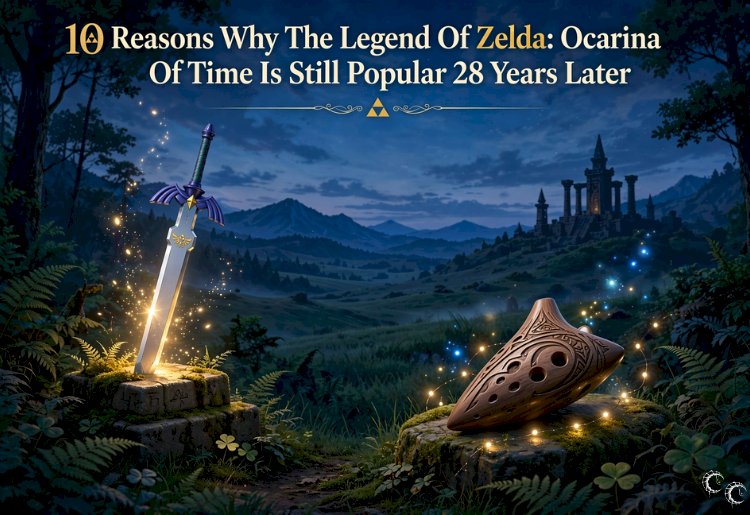
The game turns music into a gameplay mechanic, allowing melodies to become tools that affect the world around Link. Songs are not just something you listen to. You learn them, remember them, and use them.
That makes the soundtrack unusually connected to the actual experience of playing.
You are not just hearing the music.
You are doing something with it.
7. It Has the Perfect Amount of Mystery
One of the best things about older games is that they often leave room for players to figure things out themselves.
There was no massive online walkthrough ecosystem waiting to explain every puzzle five minutes after release. If you were stuck, you had to experiment, talk to characters again, try different items, or simply wander around until something clicked.
That sense of mystery still works today.
There are secrets, hidden items, optional areas, strange interactions, and little details scattered throughout the game. Even when you already know where something is, there can be a certain satisfaction in watching someone else discover it for the first time.
The game trusts the player to explore.
That is becoming increasingly valuable in an era where games often explain everything before you have the opportunity to wonder about it.
8. It Is Surprisingly Easy to Pick Up and Play
For all the game's importance to 3D gaming, its basic structure remains approachable.
You explore.
You fight.
You solve puzzles.
You collect items.
You discover new areas.
You occasionally get attacked by something that makes you question why you walked into that room.
The controls are straightforward enough that new players can learn the basics without needing to study a twenty page manual. The progression also provides a natural learning curve, gradually introducing mechanics and abilities before asking the player to combine them.
That simplicity is part of why the game remains playable.
You do not need to understand the history of gaming to enjoy it.
You can simply pick up the controller and start exploring.
9. Nostalgia Definitely Helps
We should probably admit this one.
Nostalgia is powerful.
For people who played Ocarina of Time when it originally released, returning to it can bring back memories of childhood, bedrooms, family rooms, old televisions, weekends spent gaming, and the feeling of discovering something completely new.
But nostalgia alone does not explain the game's continued popularity.
If it did, every popular game from the 1990s would still have the same cultural staying power.
Nostalgia gets people through the door.
The design is what keeps the conversation going.
Younger players who were not even alive when the original game was released continue to discover it, which says something about how well its core ideas have survived.
10. It Still Feels Like an Adventure
This might be the biggest reason of all.
Ocarina of Time does not feel like a checklist.
There are objectives, of course, but the game creates a feeling that something interesting could be around the next corner. You might find a secret. You might discover a new character. You might stumble into a mini game. You might find an item that completely changes how you approach the world.
That feeling is difficult to quantify.
It is also one of the reasons people continue returning to older games.
Modern technology can create enormous worlds, incredible graphics, realistic physics, and complex systems. None of those things automatically creates a sense of adventure.
Ocarina of Time understood that adventure is partly about uncertainty.
You are supposed to wonder what is next.
Nearly Three Decades Later, It Still Works
There is no question that Ocarina of Time shows its age. The graphics are unmistakably from another era, some mechanics feel clunky compared with modern standards, and certain design decisions have not aged quite as gracefully as others.
That does not make the game irrelevant.
If anything, its imperfections make its longevity more interesting.
The game succeeded because it understood the fundamentals of exploration, progression, atmosphere, storytelling, puzzle design, and discovery. Those things do not become obsolete simply because technology improves.
Twenty eight years later, people are still talking about Hyrule Field, arguing about dungeons, remembering songs, discussing characters, watching speedruns, discovering glitches, and introducing new players to the game.
That is an impressive legacy for a Nintendo 64 cartridge.
The graphics may belong to 1998, but the adventure itself never really left.