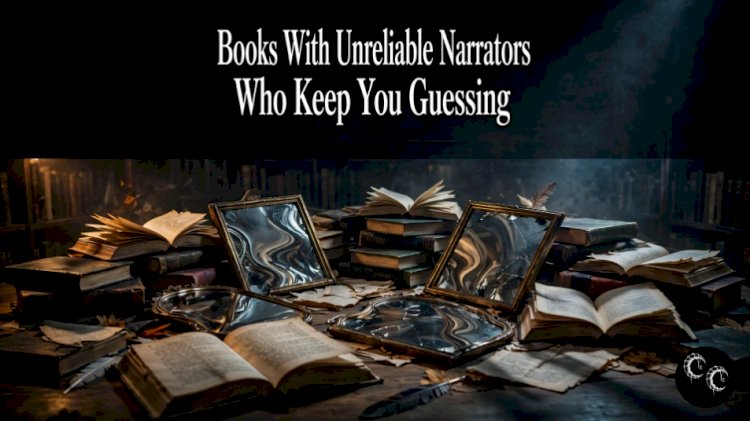
Books With Unreliable Narrators Who Keep You Guessing
 Cordelia Cross
Jul 30, 2026 02:27
0
There is something wonderfully unsettling about reading a book and realizing you might not be able to trust the person telling you the story.
At first, everything seems straightforward. The narrator introduces the characters, explains what happened, and gives you just enough information to understand the situation. You settle in, start forming opinions, and convince yourself that you know where the story is going.
Then something feels a little off.
A detail does not quite add up. Someone remembers an event differently. The narrator skips over a moment that seems strangely important. Suddenly, you are questioning everything you thought you knew.
Welcome to the world of unreliable narrators.
These are the storytellers who leave you guessing whether they are lying, mistaken, hiding something, or simply unable to see themselves clearly. Some deliberately manipulate the truth. Others believe their own version of events so completely that they never realize how much they are leaving out.
And the best examples make you question not only what happened, but how easily you can be persuaded to believe a story simply because someone tells it confidently.
If you love psychological twists, suspicious characters, and books that make you want to flip back several chapters to check a tiny detail, these reads deserve a place on your list.
1. Gone Girl by Gillian Flynn

Few modern thrillers have made readers question their assumptions quite like Gone Girl.
When Amy Dunne disappears on her wedding anniversary, suspicion quickly falls on her husband, Nick. The investigation unfolds alongside diary entries and competing accounts of their marriage, creating a story in which every new detail seems capable of changing your understanding of the people involved.
What makes this novel so effective is the way it plays with perspective. Marriage looks different depending on who is describing it, and the difference between what people present to the world and what they actually think can be enormous.
Gillian Flynn understands that a convincing lie often contains just enough truth to feel believable. As the story develops, you begin to question the narrators, their motives, and even your own eagerness to decide who is guilty.
This is an excellent choice if you enjoy dark psychological suspense, complicated relationships, and twists that force you to reconsider earlier scenes.
Best for: Readers who love manipulative characters and stories that constantly rearrange the evidence.
2. The Silent Patient by Alex Michaelides

Alicia Berenson is a celebrated painter who stops speaking after her husband is found murdered. She is placed in a secure psychiatric facility, where criminal psychotherapist Theo Faber becomes determined to understand what happened.
The setup is immediately intriguing. Why has Alicia remained silent? What led to the murder? And can Theo uncover the truth when his patient refuses to explain her side of the story?
The novel uses the mystery surrounding Alicia's silence to keep readers searching for answers. Theo's perspective guides much of the investigation, while the information revealed along the way encourages you to develop theories of your own.
It is the kind of book that makes you feel clever for noticing a suspicious detail, only to wonder whether you have been looking in the wrong direction all along.
If you enjoy psychological thrillers that build toward a major revelation, this one is an easy recommendation.
Best for: Readers who want a tightly plotted mystery with a strong emphasis on perception and hidden motives.
3. The Murder of Roger Ackroyd by Agatha Christie

Agatha Christie helped establish many of the conventions that mystery writers still use today, and The Murder of Roger Ackroyd remains one of her most famous examples of a story that challenges the reader's assumptions.
When wealthy Roger Ackroyd is murdered, Hercule Poirot investigates a case filled with secrets, suspicious relationships, and potential motives. The story is narrated by Dr. James Sheppard, who becomes involved in the investigation.
What makes the novel so fascinating is its relationship with the reader. You are not simply trying to work out which character committed the crime. You are also relying on a narrator to decide which details matter and how events should be understood.
Christie uses that trust in clever ways, demonstrating that the information a narrator provides can be technically accurate while still leading you toward the wrong conclusion.
Because the book's central mystery is so famous, it is best approached without reading spoilers or detailed plot summaries first.
Best for: Classic mystery fans who enjoy fair clues, careful misdirection, and a story that rewards close attention.
4. We Have Always Lived in the Castle by Shirley Jackson

Some unreliable narrators are frightening because they knowingly deceive you. Others are unsettling because they experience the world in ways you cannot fully understand.
Merricat Blackwood, the narrator of Shirley Jackson's gothic novel, lives with her sister Constance and their uncle in an isolated family home. A tragedy has left the family separated from much of the surrounding community, and Merricat has developed her own rituals and explanations for the world around her.
Her voice is one of the book's greatest strengths. She can sound innocent, playful, suspicious, and deeply disturbing, sometimes within the same passage.
As you learn more about the Blackwood family, it becomes increasingly difficult to distinguish between Merricat's fears, her imagination, and the facts she may be reluctant to confront.
Jackson never needs to explain everything directly. Instead, she allows the atmosphere and the narrator's unusual perspective to create a sense of unease that lingers long after you finish reading.
Best for: Readers who enjoy gothic fiction, psychological complexity, and narrators whose understanding of reality is difficult to pin down.
5. The Girl on the Train by Paula Hawkins

Rachel takes the same train every day, watching the houses and people along the route as she travels. One couple in particular captures her attention, and she begins imagining what their lives might be like.
Then something happens that draws her into a mystery far more complicated than she expected.
Rachel's account is shaped by memory gaps, emotional turmoil, and her struggle to make sense of events. Other perspectives gradually add competing versions of the story, leaving readers to decide which details are reliable and which may have been misunderstood.
The novel explores how easily an incomplete picture can become a convincing personal narrative. Rachel sees fragments of other people's lives and fills in the blanks, much as readers do when trying to solve the mystery.
That makes the book particularly engaging because the investigation is not just about discovering what happened. It is also about understanding how people construct stories from the limited evidence available to them.
Best for: Fans of domestic suspense, shifting perspectives, and mysteries built around missing information.
6. The Secret History by Donna Tartt

Richard Papen arrives at an elite college in Vermont and becomes fascinated by a small group of students studying under an eccentric classics professor. Their world seems intellectually rich, exclusive, and almost separate from ordinary life.
But the novel reveals its central crime early on, shifting the focus from discovering what happened to understanding why it happened and how the characters live with the consequences.
Richard is an especially interesting narrator because he tells the story retrospectively, with the benefit of hindsight. Yet that does not mean his account is free from distortion.
He is capable of idealizing the people around him, overlooking uncomfortable truths, and presenting events in ways that make his own involvement easier to understand or excuse.
His narration invites you into the group's world while quietly exposing the gap between how the characters imagine themselves and what their actions reveal.
This is a slower, more atmospheric read than a conventional thriller, but the psychological tension is exceptional.
Best for: Readers who enjoy literary suspense, morally complicated characters, and stories about obsession, privilege, and self deception.
7. Rebecca by Daphne du Maurier

A young woman marries the wealthy Maxim de Winter and moves into his imposing country estate, Manderley. But the house seems to belong to someone else: Maxim's first wife, Rebecca, whose presence continues to influence nearly everyone around her.
The unnamed narrator is inexperienced, insecure, and painfully aware of how she compares herself with the woman who came before her. As she tries to understand her new home and her husband's past, she begins to suspect that the story she has been told is incomplete.
What makes Rebecca so compelling is the way information is filtered through the narrator's anxieties. Her assumptions shape what she notices, whom she trusts, and how she interprets other people's behavior.
You may find yourself sharing her suspicions, only to realize that the emotional atmosphere of Manderley has influenced your judgment as much as it has influenced hers.
This is a brilliant example of how a narrator can be unreliable without being deliberately dishonest. Sometimes, the truth becomes difficult to see because fear has already decided what it expects to find.
Best for: Readers who love gothic mysteries, atmospheric settings, and secrets hidden beneath seemingly respectable appearances.
8. The Catcher in the Rye by J. D. Salinger

Holden Caulfield is one of literature's most recognizable narrators, largely because his voice feels so immediate and personal.
He tells the story of a few turbulent days in his life, describing the people he meets, the places he visits, and his growing frustration with the world around him.
Holden frequently judges other people as dishonest or phony, yet his own account reveals contradictions, emotional blind spots, and moments when his behavior does not match his stated beliefs.
That tension is what makes him such an interesting narrator. He may sincerely believe he understands the people around him, but his descriptions often reveal more about his fears and disappointments than about the people he criticizes.
Readers can disagree about how much Holden understands himself, and that ambiguity is part of the novel's lasting appeal.
Rather than offering a conventional mystery with a single hidden answer, the book asks you to interpret a character whose perspective is both revealing and limited.
Best for: Readers interested in voice driven fiction, emotional contradictions, and narrators whose self perception deserves a closer look.
9. Piranesi by Susanna Clarke

Piranesi lives in an extraordinary House filled with endless halls, enormous statues, and ocean tides that move through its lower levels. He carefully records his surroundings and believes he understands the world he inhabits.
His journals create an unusual reading experience because you discover the House through his observations. At first, his descriptions seem precise and dependable, even when the setting itself feels impossible.
But as details emerge, the relationship between his understanding of the world and the larger reality becomes increasingly complicated.
Piranesi is not a conventional deceptive narrator. His limitations are more closely connected to what he knows, what he remembers, and what he has been led to believe.
That distinction makes the mystery particularly satisfying. You are not simply looking for a lie. You are trying to understand the boundaries of a person's knowledge when their entire world has been shaped by incomplete information.
The novel combines mystery, fantasy, and philosophical questions about memory, identity, and the stories people use to make sense of their lives.
Best for: Readers who enjoy atmospheric literary fantasy and mysteries that unfold through journals, observations, and gradual revelations.
10. Before I Go to Sleep by S. J. Watson

Christine Lucas wakes each morning without most of her memories of the years that have passed. She relies on the explanations of the people around her while trying to piece together her identity and understand her own life.
As she begins keeping a journal, she gradually discovers details that do not fit neatly with what she has been told.
The premise creates an immediate question: how can you trust your understanding of reality when you cannot reliably remember what happened yesterday?
Christine's perspective makes the reader share her uncertainty. Information that seems settled can become questionable, and even familiar relationships begin to feel mysterious.
The tension comes from the possibility that the truth may be more complicated than any single account suggests.
This novel is particularly effective if you like stories in which the narrator's limitations are central to the plot rather than simply a trick used to surprise the reader.
Best for: Readers who enjoy suspense driven by memory, identity, and uncertainty about whom to trust.
11. The Remains of the Day by Kazuo Ishiguro

Not all unreliable narrators belong in thrillers. Sometimes, the most revealing examples are people who are convinced they are telling their stories honestly.
Stevens, an English butler, looks back on his years of service and reflects on professionalism, loyalty, and the meaning of a life devoted to work. His narration is measured and controlled, shaped by his belief that dignity requires emotional restraint.
Yet as his memories unfold, readers begin to notice the distance between Stevens's interpretation of his past and what his own account suggests.
He may minimize painful experiences, avoid confronting difficult choices, or describe events in ways that protect the values he has spent his life defending.
The novel's tension is quiet rather than dramatic. There is no need for an elaborate twist because the reader gradually recognizes what the narrator struggles to acknowledge.
It is a powerful exploration of how people can mislead themselves without consciously intending to deceive anyone.
Best for: Readers who appreciate subtle psychological fiction and narrators whose blind spots reveal more than direct confession ever could.
12. American Psycho by Bret Easton Ellis

Patrick Bateman appears to have everything associated with success in his world: money, status, expensive clothes, and access to exclusive restaurants and social circles.
He also narrates a deeply disturbing story in which the distinction between appearance and reality becomes increasingly difficult to establish.
Bateman's voice is chilling partly because of its emotional detachment. He can describe superficial details with extraordinary precision while revealing an alarming lack of empathy for the people around him.
As the novel progresses, the reader must consider how much of his account can be taken literally and how much may reflect his distorted perception of himself and the world.
The uncertainty is central to the book's unsettling effect. It exposes a culture obsessed with appearances while making the act of interpreting the narrator itself deeply uncomfortable.
This is a graphic, violent, and deliberately provocative novel, so it is not suitable for every reader. Those interested in disturbing literary satire, however, may find its use of unreliable narration particularly striking.
Best for: Readers comfortable with challenging material who want dark satire and an extreme exploration of distorted identity.
13. We Need to Talk About Kevin by Lionel Shriver

Eva Khatchadourian writes letters to her estranged husband as she tries to make sense of a devastating act committed by their son, Kevin.
Through these letters, she revisits her marriage, motherhood, and the events that shaped their family. Her account is intensely personal, filled with observations, doubts, resentment, and attempts to understand what happened.
But Eva is not a neutral witness to her own life. Her memories are influenced by grief, guilt, and the need to explain an experience that may never have a satisfying explanation.
Readers must consider whether she is accurately recognizing troubling patterns, interpreting the past through what she knows now, or doing some combination of both.
The novel's power comes from its refusal to make the reader comfortable. It raises difficult questions about parental responsibility, hindsight, and how much anyone can truly know about another person.
It is emotionally demanding, but its narrative structure offers a fascinating example of how a deeply personal account can be both illuminating and incomplete.
Best for: Readers who appreciate morally complex psychological fiction and stories that leave difficult questions unresolved.
What Makes an Unreliable Narrator So Effective?
The most memorable unreliable narrators are not always the ones who tell obvious lies. In fact, a narrator who simply invents everything can be less interesting than one who tells the truth selectively.
A character might leave out important details because they are ashamed. They might misinterpret someone's behavior because they are jealous. They might remember events inaccurately, or describe their own actions in a way that makes them seem more reasonable than they really were.
Sometimes, the narrator knows exactly what they are doing. Other times, they are just as confused as the reader.
That is what makes these books so engaging. You are not merely receiving a story. You are constantly evaluating the person telling it.
Pay attention to the moments when a narrator becomes defensive, contradicts an earlier statement, avoids a direct question, or seems unusually certain about something they could not reasonably know.
Notice how other characters respond to them, too. A narrator's description of someone may be dramatically different from the way that person behaves.
Most importantly, ask yourself what the narrator wants you to believe.
The answer can reveal as much about the story as the events themselves.
Final Thoughts
Reading a book with an unreliable narrator is a little like having a conversation with someone who might be leaving out the most important part.
You listen carefully. You form an opinion. You start to trust the person speaking, only to notice something that makes you reconsider everything.
And suddenly, you are no longer reading passively. You are investigating.
The books on this list approach unreliable narration in different ways. Some use dramatic twists and hidden motives. Others explore memory, insecurity, self deception, and the complicated ways people understand themselves.
Whether you prefer a fast paced psychological thriller or a slow burning literary mystery, there is something especially satisfying about a story that trusts you to question what you are being told.
My advice? Choose one that sounds intriguing, avoid reading spoilers, and resist the temptation to look up explanations when something feels strange.
Let the uncertainty do its work.
Because sometimes the most interesting mystery in a book is not what happened.
It is whether the person telling you the story understands what happened at all.