How Practical Effects Differ From CGI in Horror Movies
 Cordelia Cross
Aug 18, 2026 07:56
0
There is something wonderfully unsettling about a horror movie monster that looks like it could be standing right there in the room with you. Maybe its skin glistens under the light, its movements feel just a little too human, or its grotesque features make you instinctively look away. And then there are those enormous digital creatures, impossible transformations, and supernatural nightmares that seem to defy the laws of reality.
Both can be terrifying, but they often achieve their scares in very different ways.
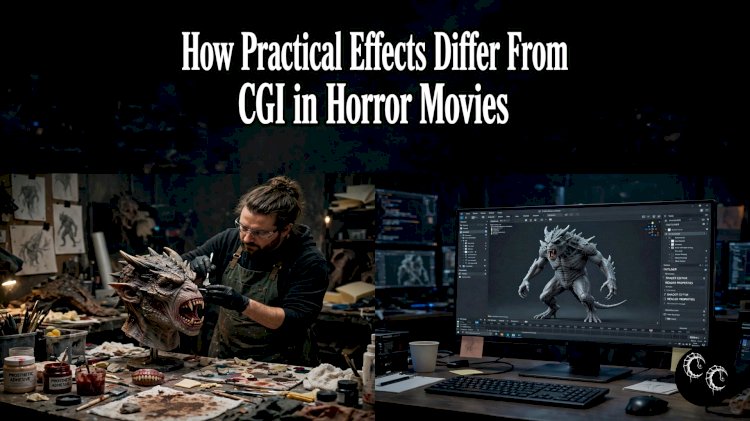
Practical effects and computer generated imagery, commonly known as CGI, are two of the biggest tools filmmakers use to bring horror to life. One creates physical things that actors can interact with on set. The other builds or alters images digitally. Each has its own strengths, limitations, and special kind of movie magic.
So what makes them different, why do horror filmmakers choose one over the other, and which technique actually creates the most frightening results?
Let's take a closer look behind the blood, guts, monsters, and movie magic.
What Are Practical Effects?
Practical effects are physical effects created directly in the real world rather than generated entirely on a computer.
Think rubber monster masks, elaborate creature costumes, prosthetic makeup, mechanical puppets, fake blood, breakaway furniture, and carefully constructed sets. If an actor can physically touch it during filming, there is a good chance a practical effect is involved.
Practical effects have a long history in horror cinema. Before modern digital tools became widely available, filmmakers relied on ingenious craftsmanship to create creatures and gruesome scenes that audiences had never seen before.
Artists sculpted monsters from clay, molded prosthetics from latex or silicone, built animatronic creatures with moving parts, and used clever camera tricks to make ordinary objects appear supernatural.
The results could be extraordinary.
In John Carpenter's The Thing, for example, practical creature effects transformed an isolated Antarctic research station into a nightmare of mutating flesh and grotesque alien forms. The creatures look tangible because physical models, prosthetics, puppetry, and mechanical effects were used to bring many of those moments to life.
Practical effects also have a wonderfully unpredictable quality. A rubbery creature can twitch in an unsettling way. A prosthetic face can wrinkle under the light. A mechanical monster can move with a clumsy, unnatural rhythm that makes it even creepier.
Sometimes, a tiny imperfection is precisely what makes a practical effect so memorable.
What Is CGI?
CGI stands for computer generated imagery. It involves creating or manipulating visual elements with computer software rather than building every element physically.
In horror movies, CGI can be used to create enormous demons, impossible creatures, supernatural transformations, ghostly apparitions, digital blood, collapsing buildings, and environments that would be impractical or dangerous to construct.
It can also enhance footage that was filmed in the real world. A filmmaker might use CGI to remove wires, extend a set, add extra limbs to a creature, or make a practical monster appear larger and more threatening.
One major advantage is flexibility.
A digital creature can change shape, move in impossible ways, or exist in an environment that would be incredibly expensive to build. Artists can adjust its appearance, movement, lighting, and scale without having to reconstruct a physical prop every time something changes.
Movies such as It use digital visual effects alongside other filmmaking techniques to help bring supernatural horror to the screen. CGI can make a character's appearance change in disturbing ways or create movements that a human performer could not safely achieve.
Digital effects are especially useful when a filmmaker wants to show something that could not realistically exist in front of a camera.
However, CGI quality depends heavily on the skill of the artists, the time available, the lighting, and how convincingly the digital elements are integrated into the surrounding footage.
When those elements do not blend together, audiences may notice that something looks artificial. In horror, that can interrupt the illusion and weaken a scare.
The Biggest Difference: Physical Presence Versus Digital Possibility
At their core, practical effects and CGI solve different creative problems.
Practical effects give filmmakers something physical to photograph. CGI gives them the freedom to create or alter images digitally.
That distinction affects how a scene looks, how actors perform, how the camera captures the action, and how audiences experience the horror.
A practical creature exists in the same physical environment as the actors. It casts real shadows, interacts with actual objects, and responds to the lighting on set. Even when the creature is operated by puppeteers or hidden mechanisms, its physical presence can help the scene feel grounded.
CGI offers a different kind of realism. A digital monster can move in ways that would be impossible for a physical model. It can stretch its body, disappear into smoke, grow extra limbs, or transform into something completely different.
The challenge is making those movements feel believable within the movie's world.
Practical effects tend to excel when filmmakers want a tangible, immediate presence. CGI often excels when they need scale, transformation, or impossible movement.
Neither approach automatically produces a better result. The effectiveness comes down to how well the technique serves the scene.
Why Practical Effects Can Feel So Disturbing
Horror relies heavily on what audiences can see, hear, and imagine. Practical effects can make frightening images feel unusually immediate because they occupy real space.
Imagine watching a character slowly peel away a layer of their own skin. If the scene uses detailed prosthetic makeup, the actor's movements physically interact with the artificial skin, and the camera captures the textures and shadows as they change.
The result can feel uncomfortably real.
Practical effects also allow actors to react to something tangible. An actor facing a mechanical creature can look directly at it, touch it, or physically struggle against it. Their performance is shaped by the object actually in front of them.
That interaction can make a scene feel more spontaneous.
There is also something fascinating about the textures of practical horror. Wet looking silicone, cracked latex, artificial teeth, rough prosthetic surfaces, and carefully applied fake blood can create a sense of bodily vulnerability that is difficult to describe but easy to recognize.
The effect does not need to be perfectly realistic, either. Sometimes, a creature that looks almost human but not quite human is far more disturbing than a polished digital monster.
Practical effects can also create memorable visual surprises. When filmmakers use physical props and ingenious camera angles, audiences may struggle to understand how a particular effect was accomplished.
That sense of mystery can make the horror linger long after the scene ends.
Why CGI Can Create Nightmares Practical Effects Cannot
Practical effects have physical limitations. A monster can only be as large, flexible, fast, or complicated as its construction and operation allow.
CGI has a much broader range of possibilities.
Digital artists can create creatures with dozens of moving limbs, bodies that dissolve into insects, faces that transform in seconds, or supernatural entities that occupy entire buildings.
These effects are especially useful for cosmic horror, supernatural horror, and stories involving creatures whose very existence challenges human understanding.
Consider the idea of a person whose body suddenly becomes unnaturally elongated, whose face splits open in impossible directions, or whose shadow begins moving independently of them.
A physical prop might achieve part of the effect, but CGI can extend the transformation far beyond the limits of anatomy and mechanics.
Digital effects also allow filmmakers to control movement with extraordinary precision. A creature can move at a speed that would be impossible for an actor in a costume, or its anatomy can change in ways that create an entirely new silhouette.
When executed well, CGI can make audiences feel as though the familiar rules of reality have broken down.
That is particularly valuable in horror, where the unknown often becomes more frightening when it refuses to obey the rules we understand.
The Role of Lighting, Texture, and Camera Work
One reason some horror effects look convincing while others feel artificial has little to do with whether they were made physically or digitally. Lighting, camera work, and texture are just as important.
A practical creature can look unconvincing if it is brightly lit from the wrong angle, photographed too clearly, or framed in a way that reveals its limitations.
Likewise, a digital creature can look remarkably believable when its lighting matches the environment, its surface reflects light naturally, and its movements feel connected to the physical world.
Darkness is particularly useful in horror because it limits what the audience can see. Filmmakers can reveal a creature gradually, allowing shadows and partial glimpses to create suspense.
But darkness is not a magic fix. If an effect is poorly integrated into the scene, simply dimming the lights will not necessarily make it convincing.
Texture matters, too. Skin, fabric, metal, bone, and other surfaces all respond to light differently. Digital artists work to reproduce those properties, while practical effects artists build them into the physical materials they use.
The camera itself can influence the illusion. A close up may reveal tiny details that make a practical effect feel disturbingly real, while a wider shot may better showcase the scale of a digital creature.
Ultimately, the audience does not experience the production technique in isolation. They experience the finished image, sound, performance, and editing as one complete moment.
Practical Effects Versus CGI: The Main Tradeoffs
Although both techniques can create impressive results, they involve different practical considerations.
Practical effects
Practical effects require physical materials, skilled fabrication, and often considerable preparation before filming begins. Complex prosthetic makeup may take hours to apply, while animatronic creatures can require specialized mechanical systems and multiple operators.
They also have physical limitations. A creature that looks amazing in a close up may be difficult to operate in a wide shot, and a complicated effect may need to be rebuilt or repaired between takes.
However, the resulting object can be photographed directly, giving filmmakers genuine physical textures, shadows, and interactions.
CGI
CGI requires digital artists, specialized software, rendering resources, and time for creating and refining the visual effects. Complicated digital sequences can involve many stages, including modeling, animation, simulation, lighting, and compositing.
Digital effects can also become expensive, particularly when a film contains numerous complex shots or requires extensive revisions.
Their major advantage is flexibility. Artists can change the appearance and movement of a creature without rebuilding a physical object, and they can create imagery that would be impractical to produce on a real set.
Neither method is automatically cheaper. A simple practical effect may cost far less than a complicated digital sequence, while a demanding animatronic creature may be more expensive than a relatively straightforward CGI shot.
The best choice depends on the specific effect, the production schedule, and the filmmakers' creative goals.
Why Many Horror Movies Use Both
Here is where things get particularly interesting: practical effects and CGI do not have to compete.
Many horror filmmakers combine the two techniques to achieve results that neither could accomplish as effectively on its own.
Imagine a creature attack. A practical creature head might be used for close up shots, allowing the actors to interact with its physical features. CGI could then extend its body, add impossible movements, or remove the visible mechanisms used to operate the prop.
Similarly, a performer might wear detailed prosthetic makeup while digital effects enhance the transformation around their face and body.
The practical elements provide physical texture, while CGI expands what the scene can show.
This combination is sometimes called a hybrid effects approach, and it can be especially effective when the audience should never be able to tell exactly where the physical effect ends and the digital work begins.
The two techniques can also solve different problems within the same scene. Practical blood effects might handle the immediate physical action, while digital compositing cleans up the shot or adds details that would be difficult to produce safely.
The goal is not to prove that one technique is superior. It is to create a convincing illusion that supports the story.
Classic Horror and the Art of Practical Effects
Practical effects have helped define some of horror's most enduring moments.
John Carpenter's The Thing remains a celebrated example of practical creature craftsmanship. Its grotesque transformations and unsettling body horror demonstrate how physical materials and mechanical ingenuity can turn familiar anatomy into something deeply alien.
David Cronenberg's The Fly also showcases the power of practical effects through its increasingly disturbing transformation sequences. The changing appearance of the main character makes the horror feel gradual, personal, and difficult to escape.
In An American Werewolf in London, practical makeup and transformation effects helped make the werewolf sequence unforgettable. The physical changes unfold with an emphasis on bodily discomfort rather than simply cutting to a finished monster.
These films illustrate an important point: practical effects can contribute to storytelling as much as spectacle.
The creature's appearance, the progression of its transformation, and the way it interacts with the world all help communicate the story's themes.
Practical effects are not merely objects placed in front of a camera. In the hands of talented artists, they become part of the film's emotional language.
Modern Horror and the Evolution of CGI
Digital effects have expanded what contemporary horror can show, especially when stories involve supernatural phenomena, complex transformations, or creatures that cannot be built realistically.
Films such as The Ring and It demonstrate how digital techniques can support eerie imagery and supernatural threats, often working alongside makeup, physical props, cinematography, and editing.
Modern visual effects can also make subtle changes that viewers may not consciously notice. A face might move in an unnatural way, a background might become slightly distorted, or an ordinary environment might gradually feel wrong.
These small alterations can be more effective than a huge digital monster appearing on screen.
At the same time, audiences have become familiar with computer generated imagery through films, television, video games, and online media. That familiarity can make some digital creatures easier to recognize as artificial, particularly when their movement or lighting does not feel convincing.
This does not mean CGI has become less useful. It means filmmakers must be thoughtful about how and when they reveal digital effects.
A monster shown for only a few seconds may be far more frightening than one displayed continuously in perfect detail.
Sometimes, what the audience imagines is more disturbing than anything a computer could render.
Which Technique Is Better for Horror?
There is no universal winner, because practical effects and CGI create different kinds of possibilities.
Practical effects often shine in close up body horror, creature makeup, physical transformations, and scenes where actors need something tangible to interact with. They can give horror a tactile quality that makes the impossible feel disturbingly real.
CGI excels at impossible movement, large scale supernatural threats, elaborate digital transformations, and scenes that would be difficult or unsafe to create physically.
Hybrid effects can bring together the strengths of both approaches, allowing filmmakers to maintain physical realism while expanding the visual possibilities.
But there is another factor worth considering: the scare itself.
A beautifully constructed monster will not necessarily frighten an audience if the scene has no tension. A digital ghost can be terrifying if its appearance is unexpected and its behavior feels deeply wrong. A simple practical prop can become unforgettable when paired with unsettling sound design, careful pacing, and a performance that makes the audience believe something terrible is happening.
Horror depends on anticipation, uncertainty, atmosphere, and emotional investment as much as it depends on visual effects.
The most effective technique is the one that serves those elements.
Final Thoughts
Practical effects and CGI are two different ways of making the unreal feel real.
Practical effects give filmmakers physical objects, tangible textures, and creatures that occupy the same space as the actors. CGI provides creative freedom to build impossible worlds, reshape bodies, and bring supernatural nightmares to life.
Both techniques have limitations, and both can produce extraordinary results when used thoughtfully.
For horror fans, the most exciting part is that neither approach needs to disappear. Practical effects continue to evolve, digital artists keep finding new ways to create convincing imagery, and filmmakers can combine both techniques to produce scenes that are more disturbing than either method might achieve alone.
The next time a horror movie makes you recoil from a creature, pay attention to what actually frightens you. Is it the wet texture of its skin? The unnatural way it moves? The sense that it could reach out and touch the character? Or is it the impossible transformation that makes you question what a human body can become?
You might discover that the most memorable horror effects are not necessarily the most realistic or the most technically complicated.
They are the ones that make you forget you are watching a movie, even if only for a moment.