Your Store Is Full of Inventory, But You’re Still Running Out of the Things People Want
 Cordelia Cross
Aug 11, 2026 08:11
0
Cordelia Cross
Aug 11, 2026 08:11
0
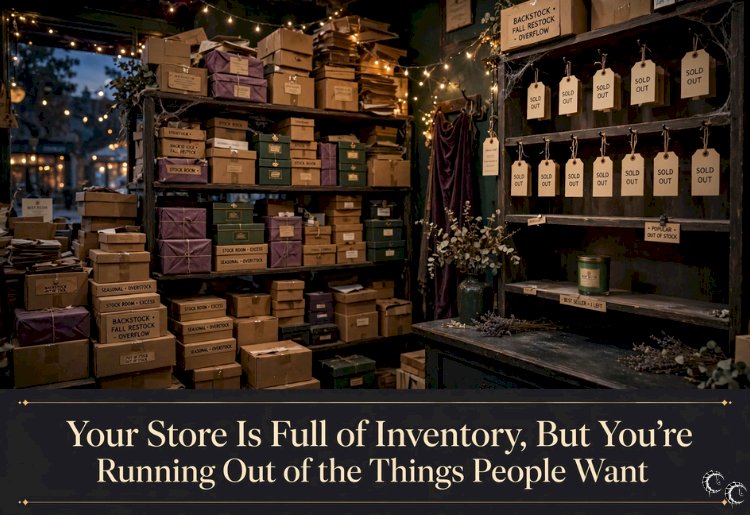
There is a particular kind of retail frustration that makes you want to stare at your inventory report and ask it what, exactly, it thinks it is doing. The warehouse is full, the shelves are crowded, and the numbers suggest that you have plenty of product. Then a customer walks in looking for the item they actually want, and somehow that is the one thing you are out of. Meanwhile, there are boxes of other products sitting untouched in the back room, taking up space and tying up money.
It sounds like a contradiction, but it is one of the more common inventory problems businesses face. Stockouts and overstock can happen at the same time because having a lot of inventory does not necessarily mean having the right inventory. A business can have more than enough products overall while consistently running short on the products that generate the most demand.
That is where things get complicated. If you only look at your total inventory value, the business may appear perfectly healthy. Look closer at individual products, however, and an entirely different story can emerge.
Your Inventory Is Not One Giant Pile
It is easy to think about inventory as one big number. You have 20,000 units in stock, so surely you are in good shape. The problem is that customers are not interested in your inventory total. They want a particular shirt, a particular replacement part, a particular size, or the exact product they saw advertised.
Having 20,000 units does not help much if 15,000 of them are products nobody is currently interested in buying.
This is why stockouts and overstock often appear together. One group of products may be selling faster than the business can replenish them, while another group barely moves at all. The company has invested heavily in inventory, but that investment is distributed in a way that does not match actual customer demand.
The result can be especially frustrating because the obvious solution to a stockout seems to be ordering more. Yet ordering more without understanding why the shortage happened can make the overstock problem worse. If the business responds to every shortage by simply increasing its overall purchasing, it may end up with even more slow moving inventory while still struggling to keep popular products available.
Sometimes the Problem Starts With Buying
A buying problem is usually easier to identify than a forecasting problem because it involves decisions that were made despite information that was already available.
Imagine a product has been selling more slowly every month. Inventory reports show that units are sitting longer before being sold, customer demand has declined, and there is no major seasonal event expected to change that pattern. Yet the purchasing team continues ordering roughly the same quantity because that is what they have always ordered.
That is a buying problem.
The issue is not necessarily that the business lacks data. It may be that the people making purchasing decisions are not using the data effectively.
Buying decisions can also be influenced by supplier discounts, minimum order quantities, relationships with vendors, or the fear of running out. A supplier might offer an attractive price if a business purchases several hundred additional units, and on paper, the discount looks like a smart move. But if those units sit in storage for a year, the business has not necessarily saved money. It has simply exchanged a lower purchase price for storage costs, tied up cash, and the risk of eventually having to discount the product.
Sometimes purchasing teams also rely too heavily on intuition. Experience absolutely matters, but experience can become a problem when it turns into "we have always done it this way." Customers change, markets change, and products change. A buying strategy that worked beautifully two years ago can become completely wrong without anyone realizing it.
Forecasting Is a Different Beast
Forecasting problems can be harder to spot because a business can make a perfectly reasonable purchasing decision and still get the outcome wrong.
Forecasting is essentially an educated prediction about future demand. Businesses look at historical sales, seasonal patterns, promotions, market trends, customer behavior, and other information to estimate what people are likely to buy. It is useful, but it is not magic.
Customers have an annoying habit of doing unexpected things.
A product can suddenly become popular because someone posts about it online. A competitor can run out of stock and send its customers elsewhere. A trend can appear almost overnight. Weather can change demand. An economic shift can make people spend differently than they did the previous year.
If your team made a purchasing decision based on reasonable information and customer behavior changed afterward, you may be dealing with a forecasting problem rather than a buying problem.
The important part is figuring out whether the prediction was bad because the process was flawed or because reality changed after the prediction was made.
The Difference Comes Down to the Decision
One useful way to separate a buying problem from a forecasting problem is to go backward.
Look at the information the business had when the purchase was made. What did sales trends look like? What was happening with customer demand? Were there warning signs that a particular product was slowing down? Were there signs that another product was becoming more popular?
If the information clearly pointed in one direction and the purchasing decision went another way, that suggests a buying issue. If the available information supported the decision but demand changed unexpectedly, the problem is more likely related to forecasting.
This distinction matters because the solutions are different.
A buying problem may require better purchasing rules, stronger approval processes, more accountability, or a closer relationship between buyers and sales data. A forecasting problem may require better demand models, more frequent updates, additional market information, or a system that can respond more quickly when actual sales start drifting away from expectations.
Simply ordering more inventory does not fix either problem.
It just gives the problem more boxes to hide inside.
The Sneaky Problem With Stockouts
There is another reason inventory forecasting can go wrong, and it involves the sales data itself.
A stockout can make demand look lower than it really is.
If you have 500 units of a product and sell all 500, your sales report may simply tell you that you sold 500 units. But what if 200 more customers wanted the product after it sold out? Those potential sales may never appear in your records.
This creates a strange situation where the business is trying to predict demand using data that has already been limited by inventory availability.
You may think a product sells 500 units because that is what the data shows, when the actual demand could have been considerably higher. If you then use that incomplete information to plan your next purchase, you can underestimate demand again and create another stockout.
This is one reason businesses should pay attention to lost sales, stockout frequency, customer requests, and other indicators instead of relying entirely on historical sales volume.
Your sales data can tell you what you sold.
It cannot always tell you what you could have sold.
Overstock Has a Cost Even When Nobody Is Complaining
Stockouts are visible. Customers complain, sales disappear, and someone usually notices when an important product is unavailable.
Overstock tends to be quieter.
The products sit in the warehouse. They are counted as assets. They may even look reassuring on an inventory report because the business technically has plenty of merchandise available.
But inventory sitting around for months is still money that is not being used elsewhere.
That money could have gone toward marketing, new products, equipment, hiring, technology, or simply maintaining a healthier cash position. Depending on the product, there can also be storage expenses, handling costs, spoilage, damage, obsolescence, and eventually discounts when the business decides it needs to clear out the excess.
The longer certain products sit, the more likely the business is to eventually sell them for less than expected.
That is why overstock is not just a storage problem. It is a financial problem hiding in plain sight.
Don't Confuse "More" With "Better"
When businesses discover that they are running out of popular products, the instinct is often to increase inventory.
Sometimes that is exactly what needs to happen.
But the real goal is not to have more inventory. It is to have inventory that matches demand.
That means looking beyond the overall size of the warehouse and examining what is actually happening at the product level. Which products consistently sell through? Which ones frequently run out? Which ones have been sitting for months? Which products are becoming less popular? Which ones have unpredictable demand? Which products are responsible for the majority of your sales?
Once you start looking at those patterns, the inventory picture becomes much clearer.
You may discover that you do not have an inventory shortage at all. You have an inventory allocation problem.
What Your Inventory Is Trying to Tell You
If your business is dealing with stockouts and overstock simultaneously, resist the temptation to treat it as a simple "we need more inventory" problem. The more useful question is why the inventory you have is not lining up with what customers want.
Look at purchasing decisions and ask whether buyers are responding to the information available to them. Look at forecasts and ask whether they accurately reflect current customer behavior. Pay attention to products that repeatedly sell out because those stockouts may be hiding the true level of demand. At the same time, examine the products that continue sitting in storage because they may be consuming resources that could be better used elsewhere.
The difference between a buying problem and a forecasting problem ultimately comes down to understanding what happened between the decision and the outcome. If the business ignored information it already had, purchasing may need attention. If the decision made sense based on the information available but demand changed unexpectedly, forecasting may be the bigger issue.
And sometimes, of course, both problems are happening at once.
Good inventory management is not about having the biggest warehouse, the highest inventory value, or the most products available. It is about having the products customers want when they want them without burying your business under products nobody is buying.
Because a warehouse can be completely full and still be out of stock where it matters most.