The Small Retailer’s Guide to Knowing What Not to Buy
 Cordelia Cross
Jul 22, 2026 08:17
0
Cordelia Cross
Jul 22, 2026 08:17
0
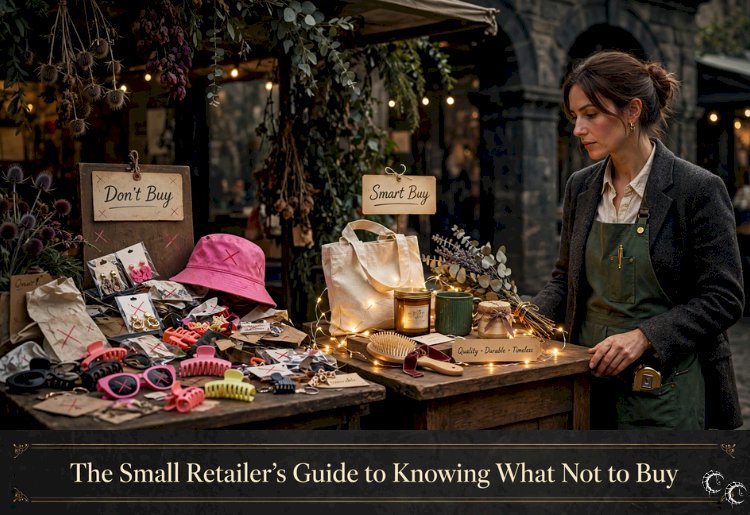
There is no shortage of advice telling small retailers what they should buy.
Find trending products. Watch what is going viral. Research your competitors. Look for profitable niches. Negotiate with suppliers. Buy in bulk when the price is right.
All of that sounds useful, and much of it is. But there is a side of inventory management that does not get nearly as much attention: knowing what not to buy.
That skill can be just as important as finding your next bestseller.
For a small retailer, every purchase is a decision about where limited cash is going to live for the next few weeks, months, or possibly much longer. A product sitting on a shelf is not just a product. It is money that cannot be used somewhere else until that product sells.
That changes the question completely.
Instead of asking, "Can I sell this?" a smarter retailer eventually starts asking, "Is this the best place for my money right now?"
Not Everything That Sells Is Worth Buying
A product can sell and still be a bad product for your business.
That might sound strange at first. If customers are buying it, surely you should keep stocking it, right?
Not necessarily.
Suppose you sell an item for $20 and make $2 after your costs. It moves quickly, customers like it, and you regularly have to replenish it. On the surface, that looks like a winner. But if another product sells for $25 and leaves you with $10 in profit while requiring roughly the same amount of effort and shelf space, the first product starts looking considerably less exciting.
This is why retail inventory management cannot be based on sales volume alone. Revenue matters, but margins matter too. A product that flies off the shelf is not automatically more valuable than a slower moving product that generates significantly more profit per sale.
The numbers have to be viewed together.
Sell-Through Tells You What Is Actually Moving
One of the most useful metrics for a retailer is sell-through, which looks at how much of your available inventory actually sells during a given period.
It sounds simple, but it can reveal problems that total sales numbers hide.
Imagine ordering 1,000 units of a product and selling 900. That sounds fantastic until you realize it took twelve months to sell those 900 units. Now compare it with a product where you ordered 300 units and sold 270 in three weeks.
Both products have sold a lot relative to their starting inventory, but they are behaving very differently.
Sell-through helps you see how efficiently inventory is moving rather than simply how much you sold. A product that consistently moves quickly may deserve more attention and more reliable replenishment. A product that spends months sitting on the shelf may be tying up cash that could be doing something more productive.
There is no universal sell-through rate that makes a product automatically good or bad because the right number depends on the industry, product type, sales cycle, and business model. What matters is understanding the pattern within your own store.
A Great Margin Does Not Matter If Nobody Buys It
Margins can be seductive.
A supplier offers you a product with an attractive wholesale price, and the potential markup looks fantastic. You calculate the numbers and realize that each sale could generate a healthy profit.
Then the product sits there.
And sits there.
Eventually, the theoretical margin becomes less exciting because you cannot earn it until somebody actually buys the product.
This is one of the most common traps in inventory purchasing. Retailers can become so focused on the profit available per unit that they forget to consider how quickly those units are likely to sell.
A high margin product with terrible sell-through can tie up more cash than a lower margin product that sells consistently. The better choice depends on the entire financial picture, not one appealing number on a supplier's price list.
The goal is not to find products with the highest possible margin.
It is to find products that produce a worthwhile return without forcing your cash to take a very long vacation.
Seasonality Can Turn a Good Product Into a Bad Purchase
Some products are only valuable at certain times of the year.
That sounds obvious until you are staring at a warehouse full of last season's inventory.
Seasonality can make purchasing particularly tricky for small retailers because demand may be strong for a short window and almost nonexistent outside it. A product that sells extremely well during the holiday season may become difficult to move in January. Summer merchandise can lose its appeal when temperatures drop. Back-to-school products have a very specific period when customers suddenly care about them and another period when they absolutely do not.
The danger comes when retailers mistake temporary demand for permanent demand.
A product has an incredible season, sales explode, and it is tempting to assume the next season will be even bigger. The business places a larger order, only to discover that customer interest has shifted or the trend has cooled.
Seasonality should influence not just what you buy, but how much you are willing to have left over when the season ends.
That last part is important.
A product that sells brilliantly for three months but becomes nearly impossible to move afterward requires a very different purchasing strategy from something customers buy consistently all year.
Inventory Is Cash Wearing a Product Costume
This is one of the most useful ways to think about purchasing.
Every time you buy inventory, you are converting cash into products.
That cash is now sitting on a shelf until the product sells.
This does not mean inventory is bad. A retailer obviously needs products to sell. The problem happens when too much of the business's cash becomes trapped in products that are moving slowly.
A small retailer has less room for error than a massive corporation with enormous reserves. If $20,000 gets tied up in inventory that refuses to move, that money is unavailable for other opportunities. You may not be able to take advantage of a better product opportunity, invest in marketing, cover an unexpected expense, or simply maintain enough cash to comfortably operate the business.
This is why knowing what not to buy is really a cash flow skill.
The question is not just whether you can afford the purchase today.
It is whether you can afford to have that money unavailable tomorrow.
Sometimes the Best Purchase Is the One You Don't Make
There is a strange pressure in retail to always be adding something.
New products make the store feel exciting. Suppliers are constantly offering opportunities. Customers ask about new arrivals. Competitors launch something that looks interesting, and suddenly you feel like your own shelves are falling behind.
But more products do not automatically mean a better business.
Every new SKU creates another thing to monitor, reorder, price, photograph, merchandise, store, and eventually discount if it does not sell. Product variety can be valuable, but unnecessary variety can also create operational clutter.
Before adding something new, look at what is already working.
If your existing inventory has strong sell-through and healthy margins, expanding carefully may make sense. If you already have a large amount of slow-moving stock, adding another twenty products may not solve the problem. It may simply give you twenty more things that need attention.
Growth is not always about adding.
Sometimes it is about removing what is not working.
The Products You Should Be Careful With
There is no universal list of products every small retailer should avoid. The right inventory depends too heavily on the industry and customer base for that kind of rule to be useful.
There are, however, certain warning signs worth paying attention to.
Be cautious when a product has weak historical sell-through, requires a large upfront purchase, carries a narrow seasonal window, or produces a margin that looks good only if everything sells at full price. Be especially careful when a supplier is pushing you toward a large minimum order without evidence that your customers actually want that quantity.
A product can still be worth taking a chance on, particularly when the potential upside is significant and the initial investment is small.
The key is knowing when you are making a calculated experiment and when you are simply hoping something will sell.
Those are not the same thing.
Your Best Data Might Be Sitting on the Shelf
Small retailers sometimes assume sophisticated inventory management requires expensive software and complicated forecasting systems.
Technology can certainly help, but you can learn a lot by simply paying attention to the products already in front of you.
Which items sell quickly without heavy discounts?
Which ones require constant promotions?
Which products do customers ask for repeatedly?
Which ones have been sitting in the same place for months?
Which products generate healthy margins?
Which ones technically make money but consume an unreasonable amount of cash and shelf space?
Your existing inventory is a collection of clues about what your customers value and what they do not.
Paying attention to those clues can be more useful than chasing every new product trend that crosses your social media feed.
Buying Less Can Sometimes Help You Grow More
Knowing what not to buy does not mean becoming afraid of inventory.
Retail requires risk. New products will fail. Trends will surprise you. Some purchases will turn out to be brilliant while others will make you wonder what possessed you to order 400 of something nobody wanted.
That is part of the game.
The goal is to make those mistakes smaller and make your successful bets more meaningful.
When you look at retail inventory management through the lens of sell-through, margins, seasonality, and cash tied up in inventory, purchasing becomes less about collecting products and more about allocating resources. Every purchase gets measured against the bigger question of whether it deserves a piece of your limited cash.
That mindset can be surprisingly freeing.
You do not have to chase every trend. You do not have to stock everything your competitors carry. You do not have to say yes every time a supplier presents you with a "great opportunity."
Sometimes the smartest thing a small retailer can put on the purchase order is nothing at all.
Because knowing what to buy can help you fill your shelves.
Knowing what not to buy can help you keep your business healthy.