The Science of Magic: Could a Fantasy World Actually Follow Its Own Rules?
 Cordelia Cross
Jul 21, 2026 03:42
0
Cordelia Cross
Jul 21, 2026 03:42
0
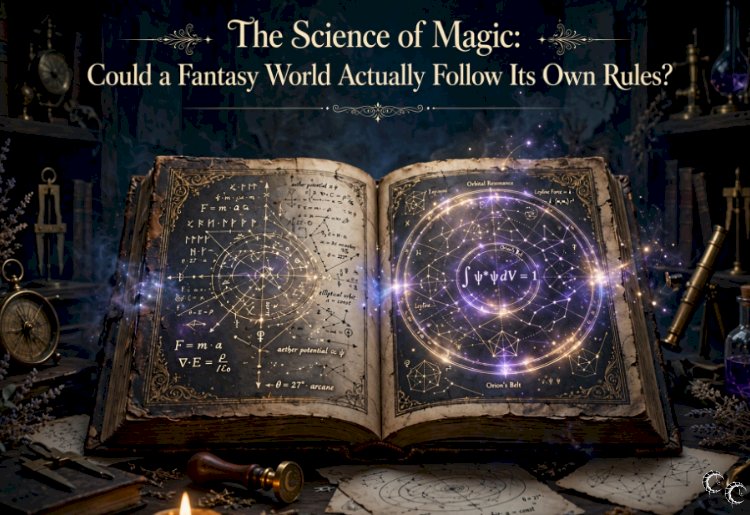
Magic has always been one of humanity's favorite ways to explore the impossible.
A wizard can summon fire from their fingertips. A healer can close wounds with a whispered spell. A traveler can step through a portal and cross impossible distances in seconds.
On the surface, magic seems like the complete opposite of science.
Science depends on rules, evidence, and explanations.
Magic depends on mystery.
But what if those two ideas are not as different as they seem?
What if a fantasy world had its own version of science? What if magic wasn't just random power, but a force with patterns, limitations, and rules waiting to be discovered?
That question is where things get interesting.
Every Magic System Needs Rules
The most fascinating fantasy worlds usually have one thing in common.
Their magic has boundaries.
A world where anyone can cast any spell at any time without consequences quickly becomes difficult to understand. If every problem can be solved with unlimited magic, tension disappears.
The best fantasy magic systems work because they create questions.
How does magic work?
Who can use it?
What does it cost?
What happens when someone pushes beyond their limits?
In a way, these questions are the magical equivalent of scientific research. A fantasy scientist might study spells the same way our world studies physics, biology, or chemistry.
Magic becomes something that can be observed, tested, and understood.
Could Magic Be a Form of Energy?
One common idea in fantasy is that magic behaves like a type of energy.
A spell might require a source of power, a specific amount of effort, or a particular environment to work. Some characters might have more natural ability, while others might spend years learning techniques.
That sounds surprisingly similar to how we think about real-world systems.
Electricity follows rules.
Gravity follows rules.
Chemical reactions follow rules.
If magic existed, scientists in that world would likely try to discover its patterns. They would measure it, experiment with it, and probably create a few magical accidents along the way.
Because every great scientific breakthrough usually starts with someone saying, "I wonder what happens if I try this?"
Hopefully, with fewer explosions.
The Physics of a Fantasy Universe
Every universe has fundamental laws.
Our world has gravity, thermodynamics, and the speed of light.
A fantasy world could have different foundations.
Perhaps magic particles exist throughout the environment.
Maybe certain materials naturally store magical energy.
Maybe living creatures evolved the ability to interact with a force humans in our world cannot detect.
From the perspective of someone living in that world, magic might not seem supernatural at all.
A person from a fantasy civilization might look at a smartphone and think it is a magical artifact. Meanwhile, we would look at a teleportation spell and wonder how anyone managed to bend space itself.
The difference is often just perspective.
The Role of Limits and Consequences
The most believable magic systems usually have consequences.
Using powerful spells might drain energy, shorten a person's lifespan, require rare materials, or create unpredictable effects.
These limitations make magic feel real within its own universe.
They also create opportunities for creativity.
A character who cannot simply solve every problem with a spell has to think differently. They have to make choices. They have to decide whether the cost is worth the reward.
The best magic isn't interesting because it can do everything.
It's interesting because it can't.
Could Magic Be Explained Through Future Science?
Throughout history, many things once considered impossible eventually became understood.
Lightning was once mysterious.
Disease was once blamed on supernatural causes.
Invisible forces like radio waves and radiation were once completely unknown.
Science has a long history of revealing hidden systems behind things we couldn't explain.
That doesn't mean magic is secretly real.
But if a fantasy world had a force that behaved consistently, scientists in that world would likely study it the same way we study everything else.
The unknown is often just the undiscovered.
Magical Creatures and Evolution
A fantasy world becomes even more interesting when you consider biology.
How would magical creatures evolve?
Would dragons require special organs to produce fire?
Would creatures that use illusions have unique sensory abilities?
Would magical plants develop ways to store energy?
A fantasy ecosystem with consistent rules could be studied just like our own.
Researchers might spend centuries examining magical creatures, discovering adaptations, and debating whether certain abilities are biological, environmental, or something entirely new.
The fantasy equivalent of a biology textbook would probably be fascinating.
And possibly terrifying.
Why We Love Worlds With Magical Rules
The reason people connect with fantasy worlds isn't because magic has no explanation.
It's often because magic has just enough explanation to feel possible.
We enjoy imagining a world where the impossible becomes part of everyday life.
A place where people have learned to work with forces beyond our understanding.
A place where curiosity leads to discovery.
The best fantasy doesn't ignore rules.
It creates new ones.
The Science Behind the Wonder
Could a fantasy world actually follow its own rules?
Absolutely.
Not because magic would become identical to science, but because both are driven by the same thing.
Curiosity.
Science asks, "How does the universe work?"
Magic asks, "What else might be possible?"
A world filled with magic would still need explorers, researchers, inventors, and people willing to ask difficult questions.
Because even in a universe filled with spells and impossible creatures, the desire to understand the unknown would remain one of the most powerful forces of all.
Maybe that's the real magic.