Deconstructing Raid Mechanics: The Collaborative Puzzle of High End Boss Fights
 Cordelia Cross
Jul 3, 2026 03:48
0
Cordelia Cross
Jul 3, 2026 03:48
0
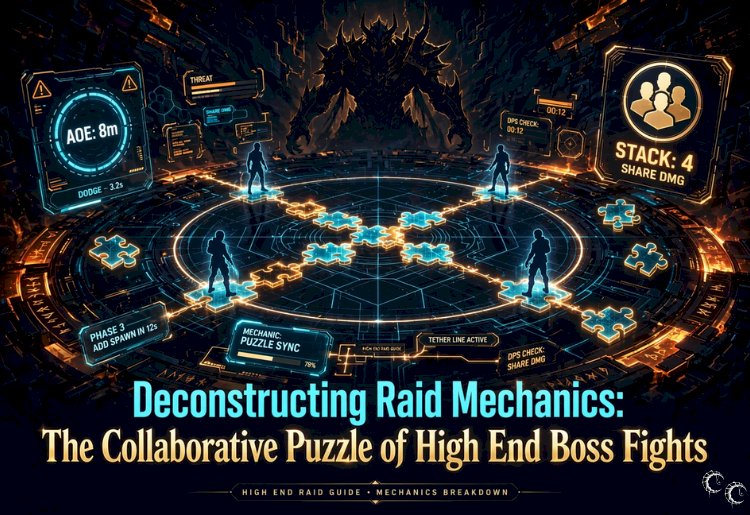
If you've never stepped into a high end raid, it might look like complete chaos.
Explosions fill the screen. Giant monsters swing impossible weapons. Players sprint in every direction while colorful effects light up the battlefield. Somehow, through all of it, everyone seems to know exactly where they're supposed to stand.
At first glance, it looks like organized madness.
Look a little closer, though, and you'll discover something entirely different.
Every high end boss fight is a puzzle waiting to be solved.
More Than Just Bigger Health Bars
Many people assume raids are simply tougher versions of regular battles. Stronger enemies, more health, and harder hits.
While those things certainly play a role, they are rarely what makes a raid memorable.
The real challenge comes from the mechanics.
A raid boss might force players to split into groups, solve environmental puzzles, pass dangerous effects between teammates, or react to visual clues in just a few seconds. Victory isn't about dealing the most damage. It's about understanding the encounter itself.
Think of it less like a boxing match and more like solving an escape room where the walls occasionally try to crush you.
Every Player Has a Role
One of the things that makes raid mechanics so satisfying is that success depends on everyone contributing.
Tanks control the boss and position enemies.
Healers keep the group alive while responding to sudden bursts of damage.
Damage dealers focus on defeating enemies while also managing mechanics that can instantly wipe the entire raid if ignored.
It doesn't matter if you're wearing the best gear in the game. If one mechanic requires eight players to stand in exactly the right places and only seven show up, everyone usually learns the lesson together.
Often the hard way.
Learning Through Failure
Very few groups defeat a brand new raid on their first attempt.
In fact, repeated failure is expected.
The first pull reveals one mechanic.
The second explains another.
By the fifth or tenth attempt, players begin recognizing patterns.
Someone notices a visual cue.
Another player realizes two mechanics always happen in sequence.
Eventually, confusion turns into understanding.
What once felt impossible starts feeling almost routine.
Those early defeats aren't wasted time. They're part of the learning process.
Communication Wins More Fights Than Damage
The strongest player isn't always the most valuable teammate.
Sometimes the person calmly calling out mechanics keeps the entire raid alive.
Simple communication can make an enormous difference.
"Stack on me."
"Spread out."
"Switch targets."
"Watch the left side."
These quick callouts help transform eight or twenty people into a coordinated team instead of a collection of individuals chasing their own objectives.
Good communication also builds confidence. Players make fewer mistakes when everyone understands what's happening.
Why Raid Mechanics Keep Evolving
Modern raid mechanics have become increasingly creative.
Developers know experienced players learn quickly, so encounters continue introducing new ideas that challenge both strategy and teamwork.
Some bosses manipulate the arena itself.
Others force players to memorize symbols, rotate positions, or coordinate actions across multiple groups simultaneously.
Just when players think they've mastered one style of encounter, the next boss introduces an entirely different challenge.
That constant evolution keeps high end boss fights exciting, even for veteran raiders.
The Community Solves the Puzzle Together
One of the most fascinating parts of a new raid release happens outside the game itself.
Entire communities begin analyzing mechanics almost immediately.
Players compare recordings, debate strategies, sketch diagrams, and test different approaches until the encounter starts making sense.
Some groups race for the world's first clear, while others patiently develop guides that help thousands of players experience the content later.
It's collaborative problem solving on a massive scale.
Everyone contributes another piece of the puzzle.
Why Defeating a Raid Feels So Rewarding
Finally clearing a difficult encounter delivers a different kind of satisfaction than simply defeating a tough enemy.
You aren't just overcoming statistics.
You're overcoming confusion.
Every failed attempt taught something new. Every adjustment improved coordination. Every teammate contributed to the final success.
By the time the boss falls, you've solved a challenge that once seemed impossible.
That's a feeling few games can replicate.
The Best Loot Isn't Always an Item
Of course, high end boss fights often reward powerful weapons, rare armor, and exclusive cosmetics.
Those rewards are exciting, but they're rarely what players remember most.
Years later, people still talk about the impossible mechanic their team finally mastered, the hilarious mistake that wiped the raid at one percent health, or the incredible moment when everyone executed the strategy perfectly for the first time.
Those shared victories become stories.
The gear eventually gets replaced.
The memories usually don't.
A Puzzle Worth Solving
High end boss fights are more than tests of skill or reflexes. They are carefully designed experiences that reward observation, communication, patience, and teamwork.
Every mechanic asks players to think differently. Every encounter encourages collaboration over individual achievement. And every successful clear is proof that even the most intimidating challenge can be broken down one mechanic at a time.
That's what makes raid mechanics so memorable.
They're not just battles.
They're puzzles that an entire team solves together, and the final piece is almost always trust.