Time Perception Experiments and Sci-Fi Paradoxes
 Cordelia Cross
Oct 24, 2025 05:35
0
Cordelia Cross
Oct 24, 2025 05:35
0
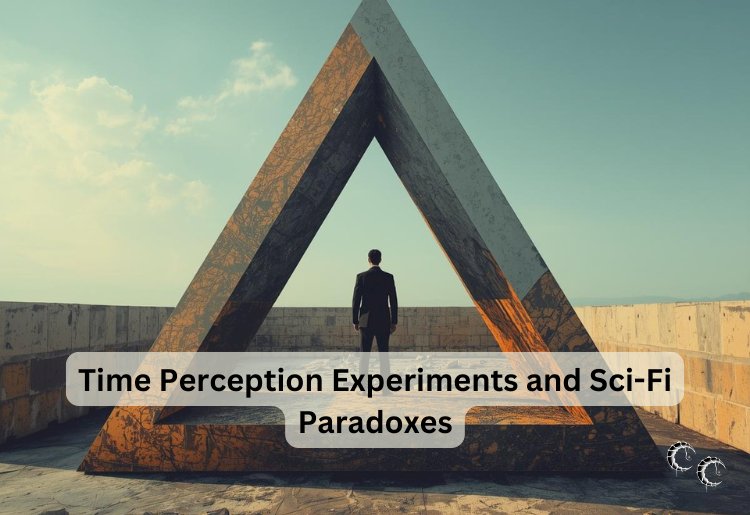
Science fiction often plays with time, from time travel to relativistic journeys, creating paradoxes that challenge our understanding of cause and effect. While these ideas are fantastical, they intersect with real science through experiments on human time perception and the physics of relativity. Exploring these connections reveals how our brains interpret time and how scientific principles can inspire narrative paradoxes.
Human perception of time is surprisingly flexible. Experiments show that the brain does not measure time like a clock but interprets duration through attention, memory, and sensory input. For example, moments of intense emotion or novelty can feel prolonged, while routine tasks seem to pass in an instant. Scientists measure these effects using controlled stimuli, comparing perceived duration against objective time. This variability is crucial for understanding why science fiction can convincingly manipulate subjective experience, making seconds stretch or years collapse within a narrative.
Cognitive load also affects perceived time. When the brain is processing complex information, time often appears to slow down. Conversely, under low stimulation, it can feel accelerated. Experiments using video games, virtual reality, and high-adrenaline tasks demonstrate this effect repeatedly. Sci-fi often dramatizes this phenomenon, such as characters experiencing slowed perception in zero-gravity environments or during hyperspeed travel. These portrayals, while exaggerated, have a basis in how the human brain integrates sensory and motor information.
Relativity introduces a different dimension to time. According to Einstein, time is not absolute; it is influenced by velocity and gravity. In special relativity, an object moving near the speed of light experiences time more slowly relative to a stationary observer. General relativity shows that intense gravitational fields also slow time. Science fiction frequently exploits these effects to create temporal paradoxes: astronauts traveling at near-light speeds may return home to find decades have passed, or a black hole may warp time so drastically that minutes for the traveler equal years outside. These scenarios are consistent with physical theory, even if they remain practically unattainable with current technology.
Time loops and causal paradoxes are staples of sci-fi. Films and novels often explore scenarios where actions in the past influence the future, raising questions of consistency and free will. Experiments in human time perception offer a psychological parallel: our subjective experience can “loop” through memory, anticipation, and expectation. Although the brain cannot literally travel through time, it can simulate temporal sequences, predict outcomes, and replay events vividly, creating a cognitive sense of temporal flexibility. Sci-fi amplifies these mechanisms to literal extremes, creating narratives that challenge both logic and intuition.
Neurological experiments also reveal how the brain encodes event order. Researchers use tasks that test temporal sequencing, showing that memory and attention can reorder events or create illusions of causality. This explains why paradoxes in fiction, such as meeting oneself in the past or altering an event without immediate consequences, feel plausible to audiences. The brain relies on contextual cues and narrative framing, allowing storytellers to exploit cognitive expectations while crafting compelling paradoxes.
Sleep, drugs, and sensory deprivation further modulate time perception. During dreams or altered states, subjective time can dilate or compress dramatically. Sci-fi often portrays characters in stasis or suspended animation, experiencing years as moments or vice versa. These depictions echo experimental findings, highlighting that the brain’s internal clock is malleable and dependent on environmental and physiological factors.
Ultimately, time in science fiction is both a narrative device and a reflection of human cognition. Experiments on time perception show that our experience of temporal flow is subjective, context-dependent, and influenced by sensory, emotional, and cognitive factors. Relativity introduces objective distortions of time that are scientifically grounded, while paradoxes explore the limits of causality and logic. By examining these intersections, we see that sci-fi’s time manipulations are more than fantasy; they resonate with real principles of physics and neuroscience, blending imagination with insight into the human mind.
Time perception experiments reveal that the brain interprets, compresses, and stretches temporal experience, while sci-fi exaggerates these processes to explore paradoxes, alternate timelines, and temporal anomalies. Together, they show that the mysteries of time are not only external—embedded in the universe—but internal, rooted in how consciousness experiences every passing moment.