Why Do We Root for Characters Who Make Terrible Decisions?
 Cordelia Cross
Jul 11, 2026 01:34
0
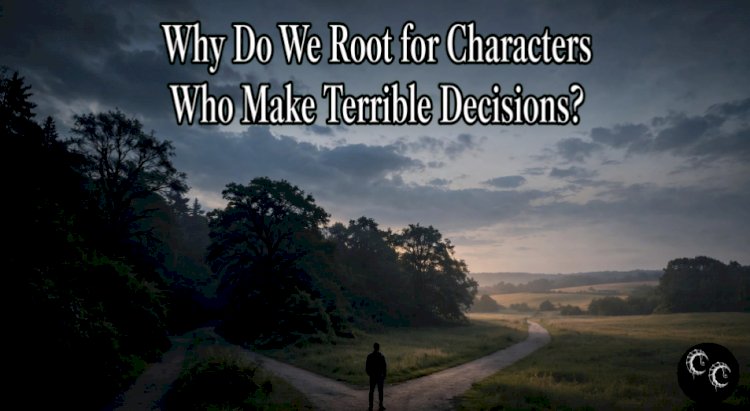
We've all been there. You're reading a book, completely invested in the protagonist, when they make a decision so spectacularly awful that you have to put the book down and stare at the wall for a moment.
Don't trust the suspicious stranger? They trust them immediately.
Don't run into the obviously haunted house? They're already opening the door.
Don't send that impulsive message to the person who has caused nothing but trouble? Well, they've typed three paragraphs and pressed send before you can even finish your coffee.
And somehow, despite all the frustration, you keep rooting for them.
You want them to succeed. You want them to find happiness. You want them to stop making decisions that could be resolved by having one sensible conversation with another human being.
But you also can't stop turning the pages.
Why do we care so much about fictional characters who seem determined to make their own lives harder? Why do their mistakes sometimes make them more lovable rather than less? And why is it so satisfying to watch someone stumble, fall, and occasionally make the exact same mistake for the third time?
As it turns out, there's something surprisingly human about loving characters who get everything wrong.
We Recognize a Little Bit of Ourselves in Them
Let's start with the most obvious reason: real people make terrible decisions, too.
We've stayed in relationships longer than we should have. We've ignored advice because we wanted to believe things would work out differently. We've convinced ourselves that one more attempt, one more conversation, or one more questionable purchase would somehow solve everything.
We know what it's like to understand the sensible choice and still feel drawn toward something else.
That's what makes an imperfect character so relatable.
A protagonist who always makes the right decision can be admirable, but they can also feel strangely distant. They never embarrass themselves, never let their emotions get the better of them, and never have to spend an entire afternoon regretting something they said.
Meanwhile, the character who makes a spectacular mess of their life feels familiar.
Perhaps they struggle with insecurity. Maybe they desperately want to be loved and keep choosing people who cannot give them the affection they need. Or perhaps they're so afraid of failing that they sabotage themselves before anyone else gets the chance.
We recognize those patterns because we've seen versions of them in ourselves or the people around us.
That recognition creates a connection. We aren't necessarily cheering for the bad decision itself. We're cheering for the person making it, hoping they'll eventually find a better way forward.
And when they do, their growth feels personal.
We Know Things the Characters Don't
One of the most entertaining parts of reading fiction is having information the protagonist doesn't possess.
You know the charming stranger is probably hiding something. You know the character's best friend has been acting suspiciously. You know that opening the mysterious letter is likely to create approximately seventeen new problems.
The protagonist, unfortunately, knows none of this.
This creates a delicious kind of tension. You want to warn them, shake them by the shoulders, or somehow climb into the book and explain why their current plan is a disaster.
Of course, the character can't hear you.
So you keep reading.
This gap between what readers know and what characters know is a powerful storytelling tool. It allows us to anticipate consequences, form theories, and experience suspense as we watch events unfold.
Sometimes, we even enjoy being frustrated because it means the story is doing its job. We care enough about the outcome to have an opinion about every decision.
There is also a strange satisfaction in watching our predictions come true.
When the protagonist finally discovers that the suspicious stranger was lying all along, we get to think, I knew it!
We might feel terrible for the character, but we also feel rewarded for paying attention.
And if our prediction turns out to be wrong? Even better. Now we have a new mystery to solve.
Their Flaws Make Their Victories More Meaningful
Imagine two characters facing the same challenge.
The first is brilliant, confident, emotionally mature, and somehow always knows exactly what to do. They make a plan, execute it perfectly, and achieve their goal without much difficulty.
The second is impulsive, insecure, and prone to making decisions that leave everyone around them exhausted. They stumble through the challenge, make several mistakes, lose something important, and eventually find a way forward.
Which character's victory is more satisfying?
For many readers, it's the second one.
Not because failure is inherently more interesting than success, but because overcoming a weakness gives a character somewhere meaningful to grow.
When an arrogant character finally learns to listen, we understand what that lesson cost them. When someone who struggles to trust others finally asks for help, the moment carries the weight of everything that came before it.
Their victory isn't simply about defeating an enemy or achieving a goal. It's about becoming someone they couldn't have been at the beginning of the story.
This is why character development matters so much.
A protagonist who begins the story convinced they can solve every problem alone might eventually realize that independence and isolation aren't the same thing. Their earlier mistakes become part of the journey rather than pointless obstacles.
Of course, the character has to learn something eventually. Watching someone repeat the same destructive behavior forever can become exhausting unless that repetition is itself an intentional part of the story.
But when mistakes lead to change, even the most frustrating protagonist can become someone we're proud to root for.
We Want to Believe People Can Change
There's something hopeful about watching a flawed character slowly become better.
Perhaps they begin as a selfish person who considers everyone else's needs an inconvenience. Over time, they learn to care about someone beyond themselves.
Maybe they constantly run away whenever life becomes difficult, only to discover that avoiding pain also means avoiding the things that make life worthwhile.
Or perhaps they keep making the same mistake because they haven't yet understood what they're really afraid of.
These stories remind us that personal growth rarely happens in a straight line.
People don't usually wake up one morning, recognize every flaw they possess, and immediately become emotionally enlightened. Change often involves setbacks, uncomfortable realizations, and moments when old habits prove difficult to abandon.
Fiction can capture that process in a way that feels deeply satisfying.
When a character finally makes a different choice, we remember all the times they chose badly before. A small act of courage can feel enormous because we understand how difficult it was for them to get there.
And sometimes, the character doesn't change completely.
They might remain stubborn, sarcastic, or overly dramatic. They may still make mistakes, just fewer of the ones that hurt the people they love.
That can be just as meaningful. Growth doesn't require a character to become an entirely different person. Sometimes, it simply means learning how to live with their flaws without allowing those flaws to control every decision.
Their Terrible Decisions Create the Drama We Came For
Let's be honest for a moment.
If fictional characters always made sensible choices, a lot of stories would be remarkably short.
The protagonist would recognize the misunderstanding immediately. The romantic leads would communicate their feelings in chapter three. The adventurers would prepare properly before entering the dangerous cave, and the villain's suspicious offer would be rejected without hesitation.
Everyone would go home safely.
The book would be forty pages long.
Terrible decisions create consequences, and consequences create stories.
A character who refuses to ask for help might accidentally put an entire group in danger. Someone who acts out of jealousy could destroy a relationship they genuinely value. A hero who believes they know what's best for everyone might make a choice that costs their friends their freedom.
These mistakes push the plot forward, reveal character, and force people into situations they would otherwise avoid.
The important distinction is that a mistake should feel connected to the person making it.
An impulsive character might act before thinking. Someone desperate for approval might believe an obvious lie. A proud protagonist could refuse assistance because accepting it feels like admitting weakness.
When the decision grows naturally from the character's personality, readers can understand how it happened even when they desperately wish it hadn't.
We might shout, "What are you doing?" at the page, but somewhere in the back of our minds, we know exactly why they're doing it.
And that makes the drama much more compelling.
Sometimes, We Root for Them Because Nobody Else Does
Some of the most lovable fictional characters are the ones everyone else has given up on.
They're the troublemakers, the disappointments, the people who never seem to get anything right. Their families are tired of them. Their friends have stopped offering advice. Even they might believe they're incapable of changing.
Then the story comes along and asks us to look a little closer.
Perhaps the supposedly selfish character has spent years pretending not to care because caring has always made them vulnerable. Maybe the reckless protagonist is terrified of being ordinary. Perhaps the person who keeps pushing everyone away has no idea how to ask someone to stay.
Their behavior might still be frustrating, but now we understand that there's something underneath it.
We start rooting for them because we want them to discover that their worst moments don't have to define their entire lives.
This is especially powerful when a character has been labeled a failure by everyone around them. Their eventual success becomes more than a personal achievement. It becomes proof that the people who underestimated them were wrong.
And sometimes, the most satisfying moment isn't when the character finally wins.
It's when they stop believing they deserve to lose.
We Love the Messy Characters in Romance for a Reason
Romance deserves its own conversation because it contains some of fiction's most spectacularly questionable decisions.
Why do characters insist they're not in love while memorizing every detail about another person's life? Why do they run away from perfectly reasonable conversations? Why do they sometimes choose the one person who seems determined to make everything complicated?
Because feelings are messy, and romance often explores the gap between what people want and what they're willing to admit they want.
A character might desperately desire intimacy while being terrified of rejection. They may want a relationship but struggle to believe they're worthy of being loved. They might confuse emotional distance with independence because vulnerability feels dangerous.
These contradictions create tension, but they also make characters feel real.
The best romantic stories understand that falling in love isn't always the difficult part. Sometimes, the real challenge is learning how to accept love without letting fear dictate every decision.
That's why a well earned confession can feel so satisfying. We're not just celebrating two characters finally getting together. We're celebrating the moment they choose honesty over avoidance, trust over suspicion, or vulnerability over self protection.
Of course, there is a difference between an imperfect romantic lead and someone whose behavior is genuinely harmful.
A character can be frustrating, guarded, or emotionally confused without the story asking readers to excuse cruelty, coercion, or repeated mistreatment. Romantic tension works best when the characters have room to grow and their choices have meaningful consequences.
We can love a fictional disaster without pretending every disaster deserves a relationship.
We Enjoy Judging Their Choices From the Safety of Our Own Lives
There is another reason we can become so invested in fictional mistakes: we get to explore difficult situations without personally experiencing their consequences.
A character might face an impossible decision between saving a friend and protecting an entire kingdom. Another might have to choose between pursuing a dream and staying with someone they love.
We can consider these dilemmas, imagine what we would do, and judge the protagonist's decision without having to make the choice ourselves.
At least, that's what we tell ourselves.
The truth is that it's easy to believe we'd make the perfect decision when we're sitting comfortably with a book and all the information the author has provided.
Real life is rarely so convenient.
We make choices while tired, frightened, hopeful, embarrassed, or desperate to avoid losing something important. We don't always understand our own motivations, and we certainly don't know everything that will happen next.
Fiction gives us the luxury of examining those moments from a distance.
Sometimes, we decide the protagonist is being ridiculous. Other times, we recognize that their decision makes sense given what they know, what they fear, and what they have already experienced.
And occasionally, we realize that we might have done exactly the same thing.
Those are often the moments that stay with us long after the book ends.
The Best Characters Don't Have to Be Good at Being Human
One of the loveliest things about fiction is that characters can be a complete mess and still be worth caring about.
They can be stubborn, frightened, selfish, overly trusting, and occasionally incapable of making a sensible decision when their life depends on it.
They can hurt people, regret it, and struggle to repair the damage. They can want to become better while remaining uncertain about how to begin.
Their flaws don't automatically make them bad characters. In many cases, those flaws are precisely what make them interesting.
What matters is how the story treats those flaws.
Does the character's behavior reveal something meaningful about them? Do their choices create believable consequences? Does the narrative allow them to grow, or does it simply excuse every mistake because the protagonist is supposed to be likable?
Readers don't need characters who are perfect. They need characters who feel alive.
We want to understand their fears, recognize their contradictions, and watch them make choices that reveal who they really are. We want to see them struggle with the difference between what they believe and what they actually do.
Most of all, we want to believe that their stories matter.
Because sometimes, watching a fictional character make a terrible decision is like watching someone stumble through a problem we've faced ourselves. We may not agree with their choices, but we understand the emotions behind them.
And that understanding creates a connection that perfection rarely can.
Final Thoughts
We root for characters who make terrible decisions because their mistakes remind us that being human is complicated.
We recognize our own insecurities in their worst choices. We hope they'll learn from their failures. We celebrate their victories because we know how much work it took to reach them, and we keep reading because we want to discover who they'll become.
Their flaws create conflict, their struggles create opportunities for growth, and their occasional moments of clarity remind us that change is possible.
Of course, sometimes we root for them for a much simpler reason.
Maybe they're funny. Maybe they're charming. Maybe they're a disaster in a leather jacket, and we have absolutely no intention of examining that preference too closely.
That's part of the fun, too.
Not every character needs to be a role model. Some exist to make us laugh, some challenge our assumptions, and others remind us that even the most frustrating people can have something worth understanding.
So the next time you're reading a book and find yourself whispering, "Please don't do that," at a protagonist who is clearly about to make everything worse, take a moment to appreciate the experience.
You're invested. You're feeling something. You're hoping this person will figure things out, even if they need another three hundred pages to get there.
And if they don't?
Well, there's always the sequel.