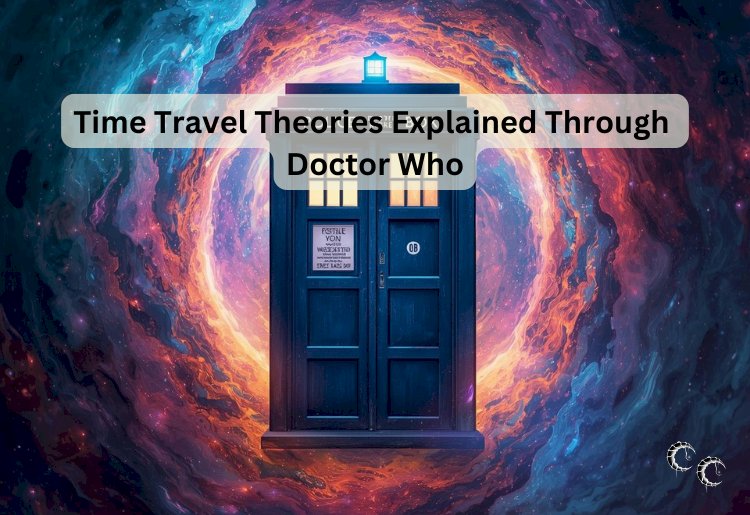
Time Travel Theories Explained Through Doctor Who
 Cordelia Cross
Jan 27, 2026 01:45
0
Cordelia Cross
Jan 27, 2026 01:45
0
Time travel is one of science fiction’s most enduring fascinations, and few stories explore it as playfully and thoughtfully as Doctor Who. For decades, the series has used its time hopping adventures not just to entertain but to explore complex theories about time, causality, and consequence. While the show embraces whimsy, its approach to time travel reflects real philosophical and scientific ideas, translated into stories that feel emotional, accessible, and deeply human.
Time as a Wibbly Wobbly Concept
Doctor Who famously describes time as a tangled, flexible thing rather than a straight line. This idea aligns with the concept that time may not be a single fixed path but a complex structure influenced by events and observers. In the show, history can bend, overlap, or ripple outward depending on actions taken at key moments.
This reflects the idea that time may be more like a landscape than a road. Certain events act as landmarks that shape everything around them. While this is not how time is currently understood in physics, it mirrors philosophical debates about whether the past, present, and future exist simultaneously.
Fixed Points in Time
One of the most important rules in Doctor Who is the existence of fixed points in time. These are events that must happen no matter what. Attempts to change them often result in catastrophic consequences.
This concept echoes the idea of temporal consistency, where certain events are necessary to preserve the structure of reality. In theoretical discussions of time travel, this resembles the Novikov self consistency principle, which suggests that actions taken by a time traveler were always part of history and therefore cannot create contradictions.
By framing fixed points as emotionally significant events, the show adds weight to the theory. It suggests that not all moments are equal, and some sacrifices are unavoidable no matter how powerful the traveler may be.
Paradoxes and Consequences
Doctor Who does not shy away from paradoxes. Characters meet younger versions of themselves, influence their own histories, and create loops that blur cause and effect. Instead of avoiding these contradictions, the show treats them as dangerous but manageable forces.
This approach reflects the grandfather paradox, where changing the past could erase the reason for time travel itself. Doctor Who often resolves these issues by allowing time to repair itself, or by introducing consequences that restore balance.
Rather than presenting paradoxes as purely logical problems, the show frames them as emotional and ethical dilemmas. The question is not just whether time can be changed, but whether it should be.
Multiple Timelines and Alternate Realities
At times, Doctor Who explores branching timelines and alternate realities. When characters make different choices, new versions of events emerge, existing alongside or temporarily replacing the original timeline.
This idea parallels the many worlds interpretation of quantum mechanics, which suggests that every possible outcome of an event exists in a separate universe. While the show simplifies this concept, it uses alternate timelines to explore themes of regret, responsibility, and the weight of choice.
These stories highlight how even small decisions can lead to dramatically different outcomes, reinforcing the emotional impact of choice rather than focusing solely on scientific accuracy.
Time as a Living System
One of Doctor Who’s most unique ideas is treating time as something that can be damaged, healed, or corrupted. Cracks in time, collapsing realities, and temporal scars suggest that time itself is a fragile system.
This metaphor resonates with the idea that the universe operates under delicate balances. While time may not literally tear like fabric, the concept helps viewers understand how interconnected events are. Changing one thread can strain the entire structure.
By personifying time, the show makes abstract theories feel immediate and understandable, transforming cosmic concepts into narrative stakes.
The Role of the Time Traveler
The Doctor is not a passive observer. They are an active participant who shapes events while trying to respect the boundaries of time. This reflects ongoing philosophical debates about free will versus determinism.
If time can be changed, does choice truly matter. If it cannot, are actions meaningful. Doctor Who answers by embracing contradiction. The Doctor makes choices knowing they cannot control everything, suggesting that responsibility exists even within limits.
This balance between agency and restraint is central to the show’s emotional core. Time travel becomes a lens for exploring morality rather than a tool for power.
Why Doctor Who’s Approach Endures
Doctor Who succeeds because it prioritizes storytelling over strict scientific rules. Its time travel theories are flexible enough to support emotional arcs, character growth, and moral questions. Rather than overwhelming viewers with technical explanations, the show uses metaphor and consequence to communicate complex ideas.
By blending real theoretical concepts with imaginative storytelling, Doctor Who makes time travel feel personal. It invites viewers to consider not just how time works, but how choices echo forward and backward in ways that shape who we become.
Conclusion
Doctor Who uses time travel as more than a narrative device. It is a framework for exploring causality, responsibility, and the human desire to change the past. Through fixed points, paradoxes, and branching timelines, the show translates complex theories into stories that resonate emotionally.
In doing so, Doctor Who reminds us that time travel is not just about moving through history. It is about understanding the weight of moments, the cost of change, and the power of choice in a universe where time itself is anything but simple.