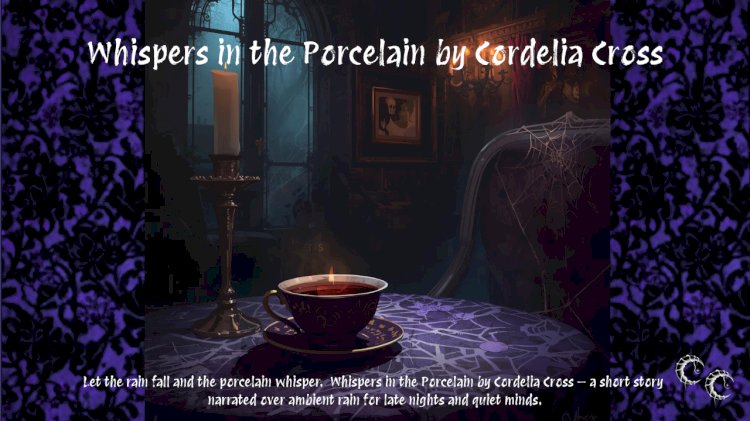
Whispers in the Porcelain by Cordelia Cross
 Cordelia Cross
Feb 7, 2026 01:25
0
Cordelia Cross
Feb 7, 2026 01:25
0
The café learned how to whisper after it learned how to die.
It happened slowly, the way all good endings do. The windows clouded first, their glass dimmed by years of steam and cigarette smoke and winter breath. The bell above the door rang less often. The tables grew lighter where hands once rested and darker where no one ever sat anymore. Eventually the espresso machine stopped screaming, and silence moved in like a patient lover, rearranging everything without asking.
The teacups were the last to give up.
They sat on their shelves in a crooked alphabet of porcelain, thin lipped and stained by memory. Rose patterns faded into ghosts. Hairline cracks split like secret smiles. They remembered mouths. They remembered warmth. They remembered the way fingers trembled when holding something fragile and important at the same time.
At night, when the city forgot this street entirely, the cups began to speak.
It started with murmurs that sounded like cooling ceramic. Then names surfaced. Laughter pressed thin and flat between saucer and rim. Confessions sank into the glaze and returned altered, softened, sharpened. The café filled with voices that no longer had bodies to anchor them.
Every cup whispered about love.
The kind that lingered. The kind that ruined. The kind that made people leave rings on wooden tables and never come back to claim them.
Most nights, the cups spoke to each other.
Tonight, one cup spoke to you.
You did not know why you came to this street. You only knew you could not sleep. The hour had stretched too far, elastic and cruel, and your thoughts had begun to chew on themselves. Your apartment felt too close, its walls breathing in unison with your chest. You put on your coat without looking at yourself in the mirror, because mirrors had learned your face too well.
The city did not resist you. Doors opened. Lights blinked. Your feet remembered a path you did not.
You stopped in front of the café without understanding the reason until after your hand was already on the handle.
The sign still hung above the door, its paint cracked but stubborn. A forgotten name in looping script. Inside, the darkness waited with intention.
You hesitated.
That was when the voice reached you.
It did not come from the door or the street or your head. It came from deeper, from somewhere porcelain and hollow and aching.
It said your name the way someone says it when they have been practicing alone.
You froze.
There are moments when fear feels sharp and electric, when it demands movement. This was not that kind. This fear was intimate. It pressed close and warm. It knew you.
You opened the door.
The bell did not ring. It had forgotten its job. The air inside the café was cooler, layered with dust and old sweetness. Moonlight slipped through the windows and rested on the tables, illuminating rings left by cups long gone.
You stepped inside and closed the door behind you.
The sound echoed.
The teacups waited.
Shelves lined the far wall, bowed slightly with age. Dozens of cups stared back at you, their handles like ears turned inward. For a moment nothing happened, and you wondered if exhaustion had finally unstitched your mind.
Then one cup shifted.
It was small and plain compared to the others. White porcelain with a thin gold rim worn to a dull glow. A crack ran from lip to base, careful and deliberate, as if placed there on purpose. It trembled, just once.
Your name floated out of it again.
Softer this time.
You stepped closer.
Each footfall stirred the dust. The café sighed around you, as if relieved to be occupied by something living. When you reached the counter, you could see the inside of the cup, stained with the shadow of a thousand teas.
You did not touch it.
You said, very quietly, “How do you know me.”
The cup did not answer immediately. Cups, you would learn, had a sense of timing that humans rarely respected.
Finally, it spoke.
It told you about the first night someone loved you in this room.
Your breath caught.
You had been younger then. Nervous in the way people are when they believe everything matters forever. You had sat at the corner table with your hands wrapped around warmth, listening to someone talk about their dreams as if they were confessing sins.
The cup described the way your smile faltered when they reached for you. The way your fingers traced the rim absentmindedly, already learning how to leave.
You whispered, “That was a long time ago.”
“Yes,” the cup said. “You left something here.”
The other cups stirred. Shelves creaked. A low susurration filled the room, a tide of remembered affection and regret.
You swallowed. “People leave things everywhere.”
“Not like this,” the cup replied.
Images pressed against your mind. Not visions, but impressions. Heat. Breath. The ache of almost. The feeling of being known too well and not well enough at the same time.
You remembered the goodbye. You remembered standing up too fast, chair scraping, tea sloshing dangerously close to the rim. You remembered the way you did not look back.
The cup remembered too.
It said your name again, and this time it sounded like longing.
You reached out before you could stop yourself.
The porcelain was warm.
The café inhaled.
The moment your fingers closed around the cup, the whispers sharpened into clarity. Voices overlapped, not chaotic but intimate, as if leaning close to be heard. Every story threaded through your skin.
The woman who cried into chamomile after being left at the altar. The boy who proposed with a ring hidden beneath a saucer. The couple who broke up three times at the same table and never learned.
Love did not fade here. It condensed.
You gasped and nearly dropped the cup. It steadied itself in your hands, impossibly gentle.
“You feel it now,” it said.
You nodded because you could not speak.
The cup pulsed once, like a heartbeat.
“You can listen,” it continued. “Or you can leave again.”
You laughed, a short broken sound. “You say that like it is a choice.”
“It always is,” the cup replied.
Silence spread, expectant.
You looked around the café. At the tables. At the stains. At the moonlight caught in dust. You thought about all the places you had run from without knowing why. All the nights that felt unfinished.
You looked back at the cup.
“What happens if I stay,” you asked.
The crack in the porcelain gleamed.
“Then you will remember who you were before you learned how to leave.”
Outside, the city shifted in its sleep.
Inside, the café leaned closer.
And the cup, still warm in your hands, began to whisper the rest of your story.
The cup did not rush you.
It understood waiting. Porcelain is patient by nature. It is shaped by heat and survives by stillness. While your hands trembled around it, the café rearranged itself subtly, chairs inching closer, shadows pooling where light once dared to linger. The shelves bowed a little further, as if eavesdropping required effort.
“You stayed,” the cup said, not as praise, not as accusation, but as fact.
“I am still here,” you replied. The words felt heavier than they should have.
“That is how it begins,” it murmured. “Staying is the rarest form of devotion.”
You carried the cup to the corner table without realizing you had decided to sit. The chair accepted you with a low wooden sigh. When you set the cup down, a ring appeared beneath it, fresh and dark, as though time had briefly reversed itself to accommodate you.
The café remembered this angle of your body. The way you leaned slightly to the left. The habit of pressing your thumb against the table edge when thinking too hard. Memory slid into place like a blade finding an old wound.
The cup continued speaking.
It told you about the one who loved you after that first night. The one who laughed too loudly and believed in redemption. The one who traced constellations on your back while you pretended to sleep. Their cup was two shelves up, blue with a chipped handle, listening intently now.
“They waited for you,” the white cup said.
“I did not ask them to,” you whispered.
“No,” it agreed. “But you let them.”
The café stirred. Cups whispered among themselves, porcelain conspiring. You felt watched in the way one feels seen by something that knows the ending already.
“You are cruel,” you said to the cup, surprising yourself with the sharpness of it.
“I am honest,” it replied. “Cruelty belongs to those who forget.”
The word forget pressed into you, tender and invasive. You had made a life out of it. Forgetting rooms. Forgetting hands. Forgetting the sound of your own name spoken softly by someone who meant it.
You picked up the cup again, ignoring the heat.
“What do you want,” you asked.
The crack in the porcelain widened, just a fraction. Enough to breathe through.
“We want you to listen,” it said. “We want you to remember us the way we remember you.”
A whisper rose from the shelves, unified now. Names brushed past your ears. Some you recognized. Some you did not. All of them felt familiar in the way strangers sometimes do, as if they have already loved you in another life.
The cup guided you. It did not move itself, but your hand followed its intention, lifting, tilting. You drank.
The tea was cold.
It tasted like longing left too long on the tongue. Like apologies unsent. Like the space between words when someone almost says I love you.
Your chest tightened. Images bloomed behind your eyes. Not scenes, but sensations. The weight of a head on your shoulder. The sound of rain against this very window. The precise second when affection curdled into fear and you decided to leave before being left.
Tears slid down your face without permission.
The café did not judge. It had seen worse.
“You see now,” the cup said gently. “Love does not disappear. It ferments.”
You laughed through the ache. “That is disgusting.”
“Yes,” it agreed. “And beautiful.”
You wanted to argue. You wanted to stand up, to put the cup back, to flee into the anonymous mercy of the street. Instead, you stayed. Your fingers tightened around porcelain, grounding yourself in the present even as the past gnawed hungrily at your edges.
“What happens to the people,” you asked. “The ones who loved here.”
“They live,” the cup said. “They forget. They repeat. Some of them come back.”
“And me.”
The cup hesitated. A rare thing.
“You are here,” it said at last. “That means the café has not finished with you.”
The lights flickered. Not electricity, but memory, illuminating moments you had buried carefully. A kiss stolen by the counter. A fight whispered so the other tables would not hear. The exact curve of a smile you once believed was meant only for you.
You pressed your free hand to your chest. Your heart beat too fast, as if trying to escape the ribs that had failed to protect it before.
“If I give you this,” you said, lifting the cup slightly, “what do I lose.”
The porcelain warmed further, almost feverish.
“Only what you already abandoned,” it replied.
The words settled deep. You understood then that the café was not haunted by ghosts, but by choices. By people who loved and left pieces of themselves behind because carrying them forward felt unbearable.
You looked around the room one last time, truly seeing it. This was not a trap. It was an archive.
You lifted the cup to your lips again.
And somewhere in the shelves, another cup began to whisper your name with longing.
The café leaned in, eager for what you would give next.
The café did not let you leave after that night.
It did not bar the door or raise its voice. It simply waited, confident in the gravity of what it had begun. You felt it the next evening before you ever reached the street. A tug beneath your ribs. A porcelain ache. Your name echoing faintly, as if spoken into a cup held to the other side of the world.
When you returned, the lights were already awake.
Not bright. Never bright. Just enough to reveal the familiar shapes of tables and shelves, the soft discipline of order imposed on chaos long ago. The white cup sat where you left it, steaming gently.
“You came back,” it said.
You removed your coat slowly. “I was not finished.”
“No,” the cup agreed. “You were only opening.”
You sat. The chair adjusted itself beneath you, remembering your weight. When you lifted the cup, the tea tasted deeper than before, less like sorrow and more like hunger.
The café had learned something about you.
Tonight, the whispers did not arrive all at once. They came in pairs. Moments stitched together with thread so thin you barely noticed until it tightened.
A hand brushing yours by accident. Another hand lingering too long to be innocent. A look held across a table while someone else talked, electricity humming beneath politeness.
Romance, the café knew, was never loud. It was cumulative.
“You loved many,” the white cup said. “But you never stayed long enough to let love finish becoming itself.”
You bristled. “That is not fair.”
“No,” it replied gently. “It is precise.”
The shelves murmured. Cups chimed softly against their saucers, as if agreeing reluctantly. You felt exposed in a way that had nothing to do with skin.
“You are afraid of devotion,” the cup continued. “Not because it hurts, but because it changes you.”
The words struck too close. You looked down into the tea, watching your reflection fracture across the surface.
“Devotion requires witnesses,” the cup said. “And you do not like to be seen when you soften.”
Your throat tightened. The café pressed in, not threatening, simply present. You realized then that this place had never judged you. It had only waited for you to tell the truth out loud.
“I thought leaving meant survival,” you said.
“For a time,” the cup answered. “It did.”
You drank again. Warmth spread, not overwhelming, but steady. A different kind of courage bloomed in you, unfamiliar and frightening.
“What do you want from me,” you asked, quieter now.
The cup pulsed faintly. “We want you to choose one memory to keep awake.”
The café hushed. Every cup leaned inward, handles poised like held breath.
“One,” you repeated.
“Yes,” it said. “The rest may sleep.”
You closed your eyes.
Faces rose unbidden. Smiles. Arguments. Mouths forming your name. Love in all its unfinished shapes. You felt the weight of choice settle into your bones.
Slowly, deliberately, you saw the one who stayed longer than the others. Not because they demanded it, but because they made space. Their laughter was soft. Their silences generous.
You opened your eyes.
“That one,” you said.
The café trembled. A ripple moved through porcelain. Somewhere on the shelves, a cup glowed faintly in recognition.
The white cup warmed in approval.
“Then remember them truly,” it said. “Not as an ending. Not as a regret. But as a moment you allowed yourself to be real.”
Your chest loosened. Not healed. Not absolved. But opened.
The café did not cheer. It simply accepted.
Outside, the night deepened, and for the first time, you did not feel the urge to run from it.
By the fourth night, the café no longer pretended to be abandoned.
You had begun to return without questioning it. The door opened for you now. The air warmed when you crossed the threshold. Dust retreated politely to corners. The cups greeted you in a layered chorus that settled once you took your usual seat.
The white cup waited on the table, already full.
“You are changing,” it said.
“So are you,” you replied. The crack in its side had widened enough to resemble a mouth caught mid confession.
“That happens when someone remembers us,” it said.
You lifted the cup and drank without ceremony. The tea tasted different now. Less bitter. More deliberate. Memory had begun to sweeten.
The café no longer flooded you with everyone at once. It had learned your limits. Tonight, it chose one voice.
A cup near the bottom shelf trembled. Pale green glaze. A hairline fracture like a closed eye.
You knew that cup.
Your breath stuttered. “No.”
“Yes,” the white cup said softly. “This one stayed after you left.”
The green cup spoke your name the way it had always spoken it. Careful. Hopeful. As if it believed saying it correctly might keep you from going.
The café dimmed around you. The walls dissolved into the impression of rain and streetlight. You were back at the table where it had ended. The chair across from you was empty but warm with recent presence.
You remembered standing up. The words you chose because they were easier than the truth. I cannot do this. I need space. I am not ready.
The cup remembered what you did not. The pause after you left. The way they stared at the door long after it closed. The way they wrapped their hands around the cup to keep from shaking.
“I did not mean to hurt you,” you whispered.
The green cup answered gently. “You did anyway.”
You closed your eyes. The café breathed with you. No accusation. Only witness.
“They came back,” the white cup said. “They sat here for years. They told us about you until their voice grew thin.”
“What happened to them.”
The question felt like stepping onto thin ice.
“They learned how to leave too,” the white cup replied. “But they left something behind.”
The green cup glowed faintly. Not with light, but with presence. With the echo of a love that had never learned how to turn inward.
Your hands shook. “Why show me this now.”
“Because the café is full,” the white cup said. “And you are the common thread.”
The weight of it pressed into you. Every whispered story. Every ring left on wood. Every cup aching with unspent devotion. You had walked away so many times that pieces of you had scattered like breadcrumbs across this room.
The café did not want punishment.
It wanted completion.
“You can take it back,” the white cup said.
Your heart pounded. “All of it.”
“No,” it replied. “Only what you are willing to carry.”
You stood. The room steadied itself around you. Cups leaned forward, handles like outstretched hands. The café waited, holding its breath.
You reached for the green cup.
It was cooler than the others. Steady. When your fingers closed around it, a quiet warmth bloomed in your chest. Not overwhelming. Not consuming. Simply present.
“I am sorry,” you said, to the cup, to the room, to yourself.
The café shuddered. Shelves creaked. A sound like relief passed through porcelain.
The green cup settled. Its crack smoothed, just slightly.
You understood then that love did not demand forever. It asked only to be acknowledged.
You placed the green cup beside the white one.
Two cups. Two truths.
The café exhaled.
“One more,” the white cup said.
You nodded. You already knew.
Dawn pressed faintly against the windows, uncertain but persistent. The café felt smaller in its presence, like a secret held too long under morning light.
The cups were quieter now. Not silent, but settled. Stories rested instead of clawed. You sat between the white cup and the green one, hands wrapped around warmth that no longer burned.
“What happens when the sun rises,” you asked.
The white cup considered. “Some cafés become shops. Some become rubble. Some remain exactly as they are.”
“And this one.”
“It will forget how to call you,” it said.
A strange ache bloomed in your throat. You had not expected grief to arrive so late.
“You have given us enough,” the cup continued. “You have remembered what you abandoned. That is all we ever wanted.”
You looked around the room one last time. The stains on the tables seemed lighter now. The shadows less hungry. The café no longer leaned toward you.
You felt fuller. Heavier. More intact.
The white cup cooled in your hands.
“I cannot stay,” you said.
“We know,” it replied. “You never do.”
The words did not wound this time. They felt like understanding.
You stood. Your coat waited where you left it, faithful in its stillness. At the door, you paused.
“What will you do,” you asked the café.
The answer came from everywhere and nowhere.
“We will listen.”
You smiled. A small honest thing.
When you stepped outside, the city greeted you with ordinary cruelty. Buses groaned. A shop gate rattled open. The sky blushed pale with beginning.
Behind you, the café dimmed.
The sign loosened its grip on memory. The bell forgot how to ring entirely.
Inside, the white cup settled into its place among the others. Its crack sealed, not erased but healed. The green cup rested nearby, no longer trembling.
The café slept.
And for the first time in years, so did you.